Hello! Welcome to the first lesson in our new module, "Global Climate Systems and Classification."
In our previous modules, we've explored the dynamic, short-term phenomena of the atmosphere—what we call weather. We've studied everything from pressure systems and winds to the dramatic formation of cyclones. Now, we're going to shift our focus from the daily fluctuations of weather to the long-term patterns that define a region's character. This is the study of climate.
Given your interest in Climatology, this module will be a cornerstone of our course. It provides the framework for understanding how all the atmospheric processes we've discussed come together to create distinct climate zones across the globe.
Today, our goal is to explain the purpose of climate classification and the principles of the Köppen system. We'll explore why geographers need a systematic way to organize the world's climates and learn the fundamental rules of the most widely used classification system in the world.
1. Why Do We Classify Climates?
Before diving into a specific system, let's first ask: why do we need to classify climates at all? The world is a complex place with a vast amount of atmospheric data. Classification helps us make sense of it all.
A climate classification system serves several key purposes:
- It organizes enormous amounts of data on temperature and precipitation into a manageable, understandable framework.
- It helps us recognize and analyze global and regional patterns.
- It allows us to understand the deep relationships between climate and other natural systems, such as vegetation, soils, and animal life.
- It provides a simplified, common language for scientists to describe and compare different parts of the world.
To get a formal introduction to this concept, please watch the first short segment of the following video.
Koppen’s Climate Classification (Geography)
This video from Vidya-mitra introduces the concept of climate and explains why classification is a necessary tool in geography.
Watch from 01:22 to 02:38. Focus on the definition of climate and the stated purpose of classifying climates.
2. The Köppen System: A Foundation in Nature
The most famous and widely used method for classifying climates was developed by the German climatologist Wladimir Köppen (1846-1940). As a systematic thinker, you will appreciate the logic behind his approach. Köppen's system is empirical, meaning it is based on observable, measurable data—specifically, long-term average temperature and precipitation.
What makes the Köppen system so powerful is its foundational principle: Köppen believed that the natural vegetation of a region was the best overall indicator of its climate. Therefore, he drew his climate boundaries to correspond with the boundaries of major vegetation zones. For example, the line separating a tropical rainforest from a savanna is not just a climate line; it's a vegetation line.
Let's watch a short video that introduces Köppen and this core idea.
Köppen Climate Classification
The video 'Köppen Climate Classification' by Earth Explained provides an excellent introduction to the system, its creator, and its connection to botany.
Watch the beginning of the video, from 00:00 to 01:52. Pay close attention to the two primary variables Köppen used and how his interest in plants influenced the classification.
To deepen our understanding of the system's development, let's turn back to the Vidya-mitra video for a more detailed historical account.
Koppen’s Climate Classification (Geography)
This segment provides more detail on the history and empirical basis of Köppen's work, including its later modifications by Rudolf Geiger.
Watch from 02:38 to 05:03. This section explains how vegetation serves as an 'index' for temperature and precipitation, which is the core principle of the system.
3. The Principles: A Climate Code
The Köppen system uses a code of two or three letters to assign a classification to any given location. Each letter has a specific meaning related to temperature and precipitation. Let's break down this code, piece by piece.
The following video segments will be our primary guide for understanding the letter codes.
Köppen Climate Classification
We will now use the 'Earth Explained' video to walk through the meaning of the first, second, and third letters in the Köppen classification system.
Please watch from 04:14 to 14:11. The video is clearly structured, covering the first, second, and third letters in sequence. You may want to pause after each section to review the information below.
As you watch, use the following summary to reinforce the key principles.
The First Letter: Major Climate Groups
The first letter, always a capital, assigns a location to one of five major groups (plus a sixth for highlands). These are based on broad temperature characteristics.
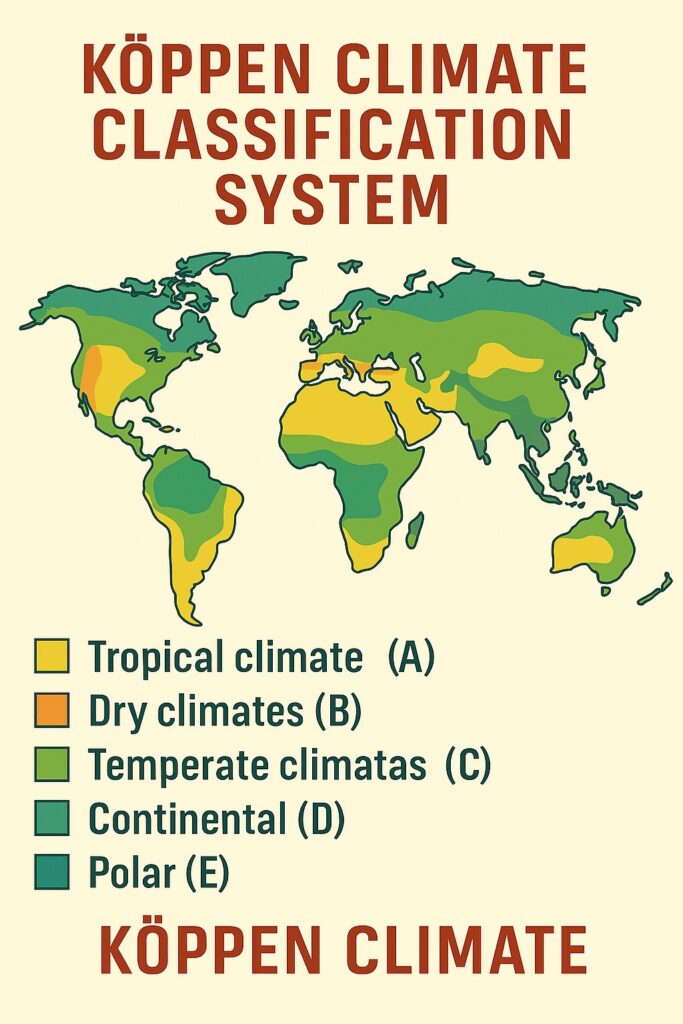
- A - Tropical: Humid climates where all months have an average temperature above 18°C (64°F). These are the lands of the rainforests and savannas.
- B - Dry: Climates where potential evaporation exceeds precipitation, leading to a moisture deficit. These are the world's deserts and steppes.
- C - Temperate (Mesothermal): Mid-latitude climates with mild winters. The average temperature of the coldest month is between 18°C and -3°C.
- D - Continental (Microthermal): Mid- and high-latitude climates with cold, snowy winters. The warmest month averages above 10°C, and the coldest month averages below -3°C.
- E - Polar: Extremely cold climates where the average temperature of the warmest month is below 10°C (50°F).
- H - Highland: A special designation for high mountain areas where altitude is the dominant climate control, causing abrupt changes over short distances.
The Second Letter: Precipitation Patterns
The second letter specifies the seasonal pattern of precipitation.
| Letter | Meaning | Applies to Climates |
|---|---|---|
| f | feucht (moist) | Wet all year; no dry season |
| w | wintertrocken | Dry winter |
| s | sommertrocken | Dry summer |
| m | Mittelform | Monsoon pattern (short dry season) |
| S | Steppe | Semi-arid |
| W | Wüste (desert) | Arid (true desert) |
| T | Tundra | Warmest month is above 0°C |
| F | Frost | All months are below 0°C |
The Third Letter: Temperature Nuances
The third letter gives more detail about the summer heat or winter cold.
| Letter | Meaning | Applies to Climates |
|---|---|---|
| a | Hot summer | Warmest month > 22°C |
| b | Warm summer | Warmest month < 22°C |
| c | Cool summer | Fewer than 4 months > 10°C |
| d | Very cold winter | Coldest month < -38°C |
| h | heiß (hot) | Annual average temp > 18°C |
| k | kalt (cold) | Annual average temp < 18°C |
Test your understanding!
Without looking at a map or the descriptions, what general climate characteristics would you infer from the Köppen code Csb? Break it down letter by letter.
Show answer
- C: Temperate climate (mild winters).
- s: Dry summer (most precipitation occurs in the winter).
- b: Warm summer (not a hot summer).
Therefore, Csb describes a temperate climate with mild, wet winters and warm, dry summers. This is a classic "Mediterranean" climate type.
4. A System of Rules
It's important to understand that these letter codes aren't just subjective labels. Each one is determined by applying a set of strict, quantitative rules based on specific temperature and precipitation thresholds. Geographers use a classification key, which is essentially a decision tree, to systematically determine a location's climate type from its data.
We will not go through the full calculations today, but it is useful to see the logic. The resource below provides an excellent example of such a key.
The document 'Appendix 2: Köppen Climate Classification System' contains a link to a PDF that shows the logical structure used to classify a climate. This helps illustrate the systematic nature of the process.
Please open the web page and find the link at the very bottom titled 'Köppen Decision Chart'. Open this one-page PDF. You don't need to memorize it; just look at its structure. Notice how it guides you through a series of yes/no questions based on temperature and precipitation values to arrive at a final classification.
This flowchart approach ensures that the classification is objective and repeatable—a core principle of scientific methodology.
Conclusion
In this lesson, we have laid the groundwork for our study of global climates. We have established not just what the Köppen system is, but why it is so essential for geography and climatology.
Key Takeaways:
- Purpose of Classification: Climate classification systems are essential for organizing complex data, identifying patterns, and understanding the relationship between climate and the environment.
- Köppen's Principle: The Köppen system is an empirical classification based on long-term temperature and precipitation data, using natural vegetation as the ultimate indicator of climate boundaries.
- The Letter Code: The system uses a three-letter code to describe a climate's fundamental characteristics:
- First Letter: The major climate group (Tropical, Dry, Temperate, Continental, Polar).
- Second Letter: The seasonal precipitation pattern (e.g., wet all year, dry winter).
- Third Letter: Nuances of summer heat or winter cold.
Preview of the Next Lesson:
Now that you understand the principles and the "language" of the Köppen system, our next lesson will be a practical application. We will learn how to apply the Köppen climate classification system to identify major climate types. Using real-world data from climographs and the logic of a classification key, you will determine the climate of specific locations for yourself.