Hello! Welcome to the first lesson in our new module, "Atmospheric Moisture and Precipitation."
In our previous module, we focused on atmospheric dynamics—understanding why and how air moves, from the vast global circulation cells down to local sea and mountain breezes. Now, we shift our focus to one of the most important things this moving air carries with it: water. The presence and transformation of water in the atmosphere are fundamental to all weather and climate.
This entire module is built around the hydrologic cycle (or water cycle), the continuous movement of water on, above, and below the surface of the Earth.
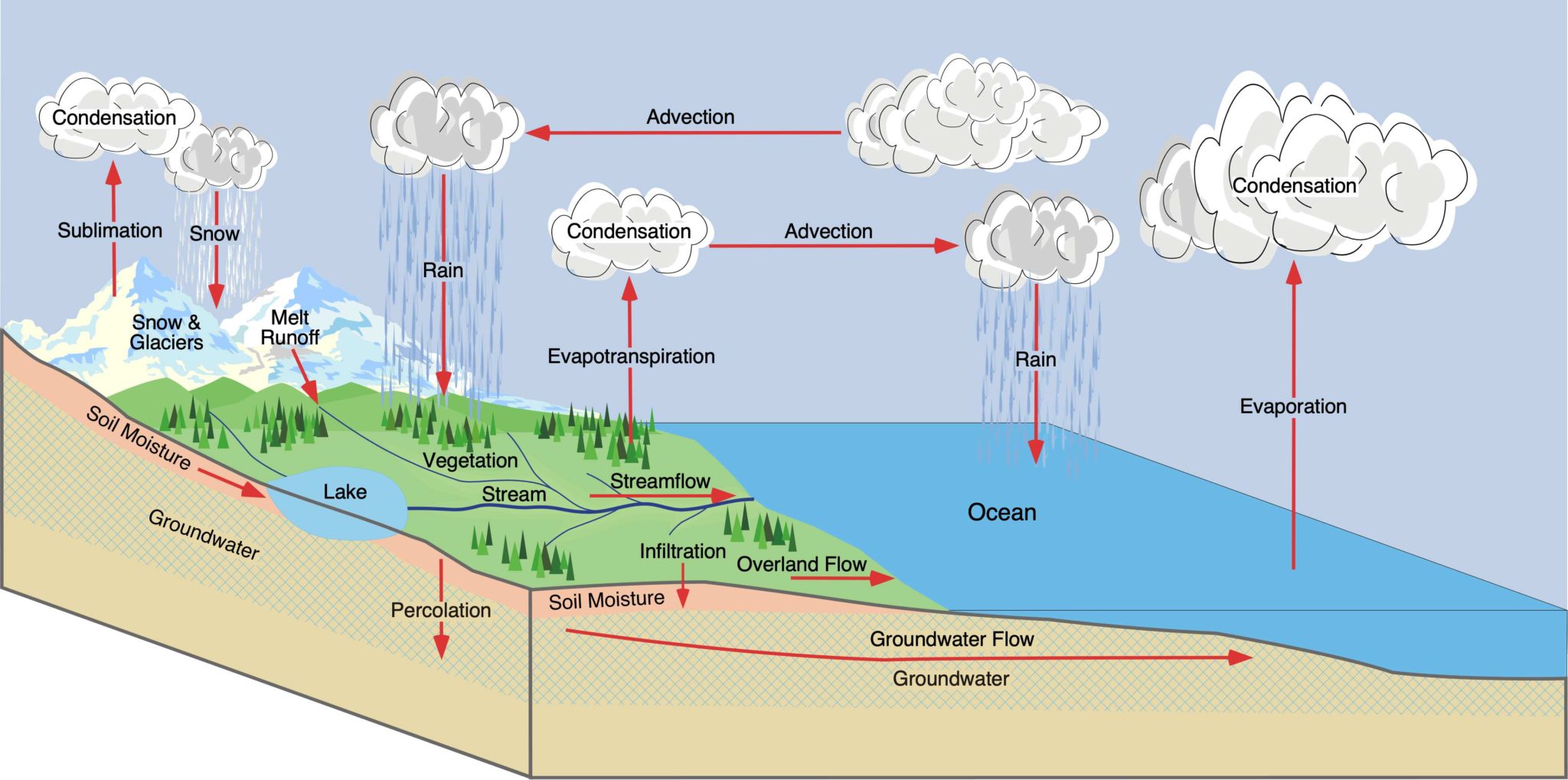
Today, we'll start with the foundational processes that get water into the air and set the stage for it to come back out. Your learning outcome is to: Explain the processes of evaporation, condensation, and humidity. We will explore how water changes state, how we measure it in the atmosphere, and the hidden energy involved in these transformations.
1. The Dance of Water Molecules: Phase Changes
At its core, the movement of water into and out of the atmosphere is about phase changes: from liquid to gas and back again. To understand this, it helps to visualize what's happening at the molecular level.
Let's watch a video that uses a simulation to show how water molecules behave as they gain or lose energy.
Lecture 4: Introduction to evaporation and latent heat
The video 'Lecture 4: Introduction to evaporation and latent heat' from Mel Strong provides a fantastic visual introduction to the behavior of water molecules in their solid (ice), liquid, and gaseous (vapor) states.
Watch the first part of the video from the beginning until 06:08. Focus on how the molecules behave in each state and what happens when heat energy is added.
As you saw, water molecules in a liquid are constantly moving and bumping into each other. When they gain enough energy, typically from the sun's heat, some molecules can escape the liquid surface and become a gas. This process is evaporation.
- Evaporation: The process by which liquid water turns into water vapor (an invisible gas).
- Transpiration: A similar process where plants release water vapor from their leaves. Often, these two are combined into the term evapotranspiration.
Evaporation is constantly happening from oceans, lakes, rivers, and even damp soil. This is the primary way water enters the atmosphere.
2. Measuring Atmospheric Moisture: Humidity
Once water has evaporated, it exists in the air as water vapor. Humidity is the general term for the amount of water vapor present in the atmosphere. However, to understand weather, we need to be more specific. Let's explore the key ways geographers and meteorologists measure and describe humidity.
Meteorology-Climatology-and-Geography.pdf
The textbook excerpt 'Meteorology-Climatology-and-Geography.pdf' provides clear, formal definitions for the different types of humidity. Reading this will give you a solid definitional base.
Read Unit 6.1, titled 'Role and causes of water vapour in the atmosphere'. Focus on the definitions of Absolute humidity, Saturation vapor pressure, Relative humidity, and Dew-point temperature.
Let's break down these crucial concepts.
The Concept of Saturation
This is the most important idea to grasp. The amount of water vapor that the air can "hold" is not infinite; it depends directly on the air's temperature. Warmer air can hold significantly more water vapor than colder air.
Imagine a sponge. A large sponge (warm air) has the capacity to hold more water than a small sponge (cold air). When the sponge is holding the absolute maximum amount of water it can, it is saturated. Similarly, when the air is holding the maximum amount of water vapor possible at its current temperature, it is said to be saturated.
Types of Humidity
-
Absolute Humidity: This is the actual mass of water vapor in a given volume of air (e.g., grams per cubic meter, g/m³). It's a direct measurement of the water content, but it's not very useful for predicting weather because it doesn't tell us how close the air is to being saturated.
-
Relative Humidity (RH): This is the most common measure you'll hear in weather reports. It's a ratio, expressed as a percentage, that compares the actual amount of water vapor in the air to the maximum amount the air could hold at that temperature.
- An RH of 50% means the air is holding half the water vapor it could.
- An RH of 100% means the air is saturated. The sponge is full.
-
Dew Point: This is a temperature, not a percentage. The dew point is the temperature to which a parcel of air must be cooled (at constant pressure) to become saturated (reach 100% RH). If the air cools further, the water vapor will have to condense into liquid water. You see this happen on cool mornings when the ground cools to the dew point temperature, and dew forms on the grass.
Test your understanding!
Imagine two rooms. Room A is at 30°C and Room B is at 10°C. Both rooms have a relative humidity of 50%. Which room contains more actual water vapor (i.e., has a higher absolute humidity)?
Show answer
Room A (the 30°C room) contains more water vapor. Because warm air can hold much more moisture than cold air, 50% of the maximum capacity at 30°C is a much larger amount of water than 50% of the maximum capacity at 10°C.
3. From Vapor Back to Liquid: Condensation
Condensation is the reverse process of evaporation. It is the transformation of water vapor (gas) back into liquid water droplets.
The key condition for condensation is that air must be cooled to its dew point. When the air's temperature drops to the dew point, its relative humidity becomes 100%. The air is saturated and cannot hold all its water vapor in gaseous form anymore. The excess vapor condenses into tiny liquid droplets, forming clouds, fog, or dew.
Now, let's return to the first video to see how the rates of evaporation and condensation are in a constant balance.
Lecture 4: Introduction to evaporation and latent heat
This section of the video 'Lecture 4: Introduction to evaporation and latent heat' explains the dynamic relationship between evaporation and condensation, showing how temperature and relative humidity control the net result.
Please watch from 06:08 to 10:26. Pay attention to how temperature controls the rate of molecules leaving the liquid (evaporation) and how relative humidity controls the rate of molecules returning (condensation).
To summarize the video's point:
- Evaporation adds water vapor to the air. Its rate is controlled mainly by temperature (and water availability).
- Condensation removes water vapor from the air. Its rate is controlled by how close the air is to saturation (relative humidity).
- When evaporation > condensation, humidity increases.
- When condensation > evaporation, humidity decreases (and clouds/dew form).
- When evaporation = condensation, the air is saturated (100% RH).
4. The Hidden Energy: Latent Heat
When water changes phase, something else is happening that is crucial for weather and climate: energy is being transferred. This "hidden" energy is called latent heat. Understanding this is especially important given your interest in climatology, as it's the engine that powers major weather systems.
The next segment of the video explains this with a very helpful analogy.
Lecture 4: Introduction to evaporation and latent heat
Using an analogy of 'thermal energy boxes', this final video segment from 'Lecture 4' clearly explains the concept of latent heat and why evaporation causes cooling while condensation causes warming.
Watch from 13:00 to 23:02. Focus on the core idea: water molecules must take a 'box' of energy to evaporate and must release it to condense. Notice the real-world examples of sweating and steam burns.
This is a profound concept with simple, but powerful, consequences:
- Evaporation is a COOLING process. To evaporate, a water molecule must take energy (latent heat) from its surroundings. This is why you feel cold when you get out of a swimming pool—the evaporating water is drawing heat from your skin.
- Condensation is a WARMING process. When water vapor condenses back into a liquid, it must release that stored latent heat into its surroundings. This release of heat inside a cloud is what warms the air, helps the cloud grow taller, and provides the immense energy for thunderstorms and hurricanes.
Conclusion
Today we've laid the essential groundwork for understanding all atmospheric moisture. We've seen that the water in our atmosphere gets there through evaporation and returns to liquid form through condensation, driven by changes in temperature.
Key Takeaways:
- Evaporation is the process of liquid water turning into a gas (water vapor), which is powered by heat energy.
- Humidity is the amount of water vapor in the air. The most important concepts are relative humidity (how full the air is, as a percentage) and the dew point (the temperature of saturation).
- A key rule is that warm air can hold more water vapor than cold air.
- Condensation is the reverse of evaporation, occurring when air is cooled to its dew point, causing water vapor to turn back into liquid water.
- These phase changes involve a massive, hidden transfer of energy called latent heat. Evaporation cools the environment, while condensation warms it.
Preview of the Next Lesson:
Now that we understand how condensation happens, we will explore its visible results. In our next lesson, we will look at the different forms of condensation, including dew, frost, fog, and the beautiful variety of clouds that decorate our sky.