Welcome to the next lesson in our journey through the Foundations of Learning Design. In our previous session, we examined the systemic challenges often present in African education and corporate training, such as the digital divide, multilingualism, and skills gaps. We identified the "what" and the "why" of these barriers. Today, we turn our attention to the "how"—how we can design learning experiences that actively and respectfully address this context.
This lesson is designed to help you master the learning outcome: Apply culturally responsive principles to adapt a learning design for a specific audience. We will explore Culturally Responsive Pedagogy (CRP) not as a simple checklist, but as a mindset that reframes how we see learners and their backgrounds. For someone with your expertise in user-centered design, this will feel familiar; it's about deeply understanding your audience and designing with them and for them, viewing their cultural context as a powerful asset, not a deficit to be overcome.
1. What is Culturally Responsive Teaching?
To begin, let's establish a foundational understanding of what "culturally responsive" means in an educational context. It goes beyond surface-level celebrations of culture and dives into the cognitive and social aspects of learning.
This short video from Edutopia provides a clear and concise introduction.
Education Buzzwords Defined: What Is Culturally Responsive Teaching?
This video, "What Is Culturally Responsive Teaching?", features several educators explaining the core idea of using students' backgrounds to create powerful learning experiences.
Please watch the full video. As you watch, notice how the educators emphasize the importance of knowing your students and ensuring they see themselves in the curriculum.
The video introduces the central idea: leveraging learners' lives and experiences to make learning more relevant and meaningful. To build on this, we'll turn to a more detailed guide from Achieving the Dream, an organization focused on equity in education.
This guide provides a robust theoretical foundation for Culturally Responsive Pedagogy (CRP). It defines key terms and outlines the evolution of these ideas.
Please read the first few pages of the guide. Start from the beginning and read up to the end of the section titled Culturally Sustaining Pedagogy. Focus on understanding the definitions and distinctions between: Culturally Responsive Pedagogy (CRP) Culturally Responsive Teaching (CRT) Culturally Affirming Teaching and Learning Culturally Sustaining Pedagogy (CSP)
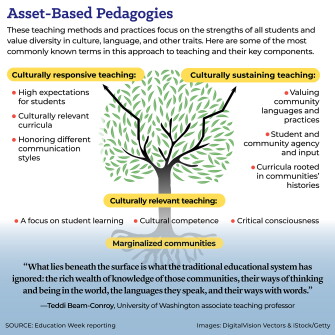
These readings show an evolution of the concept, from being "relevant" to students' cultures, to "responsive" to them, and finally to actively "sustaining" them.
A key voice in this field is Zaretta Hammond. She emphasizes that CRP is fundamentally about cognitive development—building students' brainpower to handle rigorous academic work. It's not about making students "feel good" with superficial cultural additions, but about building genuine competence.
Zaretta Hammond "Culturally Responsive Teaching" at the San Francisco Public Library
In this clip from a talk by Zaretta Hammond, she clarifies common misconceptions about CRP.
Watch the section from the core of CRT where she contrasts authentic CRP with "multicultural kumbaya." Then, watch from competence precedes confidence to understand her key argument about how to truly empower learners.
Hammond’s point is critical: confidence comes from competence. A culturally responsive approach helps learners build that competence by connecting new, complex ideas to what they already know and how they already learn.
2. From Theory to Practice: Three Core Strategies
So, how do we apply these ideas? The "Putting Equity Into Practice" guide we looked at earlier outlines three core instructional strategies. These provide a practical framework for adapting a learning design.
This reading details three actionable strategies for implementing CRP. This is the practical core of the lesson.
Please read the sections describing the three main strategies, starting from the heading PEDAGOGICAL PRACTICE: CULTURALLY RESPONSIVE INSTRUCTIONAL STRATEGIES. Read through the detailed explanations of: Strategy 1: Assess and activate culturally bound prior knowledge. Strategy 2: Empower students by using cultural referents. Strategy 3: Foster learning environments that validate cultural identity and experiences.
Let's break these down with some concrete connections.
Strategy 1: Activate Prior Knowledge
This is about building a bridge from the learner's existing knowledge (their "schema") to the new content. Your UX background is relevant here; it's like understanding a user's existing mental model of a system before introducing them to a new interface.
Strategy 2: Use Cultural Referents
This involves making learning materials, examples, and case studies relevant to the learners' world. For instance, in our previous lesson, we discussed the philosophy of Ubuntu. A design that incorporates principles of collaboration, shared responsibility, and community—tenets of Ubuntu—is inherently more culturally responsive in many Southern African contexts.
This next reading explores how the philosophy of Ubuntu naturally supports a collaborative, project-based learning approach, which is a powerful instructional strategy.
Philosophy of ubuntu and collaborative project-based ...
This research article provides a real-world example of applying a cultural philosophy to learning design in South Africa.
Please read the following two sections: Theoretical Mooring: Understanding the Philosophy of Ubuntu: This section defines Ubuntu and its core values like interdependence and collectivity. Discussion: This section connects the observed collaborative behaviours of learners directly to the tenets of Ubuntu.
As the paper shows, instructional strategies like project-based learning and group work are not culturally neutral. They can align powerfully with collectivist cultural values, making the learning process itself feel more natural and effective. This echoes Zaretta Hammond's point that learners from collectivist cultures often learn best by doing and talking things through together.
Strategy 3: Foster Validating Environments
This strategy is about creating a learning space (whether face-to-face or online) where learners feel safe, respected, and seen. This involves everything from the instructor-student relationship to how you handle feedback.
Zaretta Hammond speaks directly to this, framing errors not as failure but as information.
Zaretta Hammond "Culturally Responsive Teaching" at the San Francisco Public Library
This final clip from Zaretta Hammond's talk summarizes several principles for creating an inquiry-based, culturally responsive learning environment.
Watch the section from the great cognitive equalizer. Pay close attention to the principles she lists, especially questioning over quiet and errors as information.
This idea of "errors as information" is a powerful way to reduce the anxiety that can hinder learning, particularly for those who may feel like outsiders in an academic or corporate setting. It creates psychological safety, which is essential for the "productive struggle" that leads to real learning.
3. Application Activity
Let's put these principles into practice. We'll return to the scenario from our last lesson.
Scenario: You are an instructional designer at a Cape Town-based tech company. You've been tasked with creating a blended learning program to upskill junior graphic designers in the company's regional offices in smaller towns and rural areas of South Africa. The goal is to teach them advanced UI/UX principles and collaborative workflows in Figma.
In the last lesson, you identified three systemic challenges for this project. Now, choose one of those challenges (e.g., digital divide/infrastructure, multilingualism, or limited exposure to corporate tech culture).
Your Task:
In 2-3 paragraphs, describe how you would apply the principles of culturally responsive design to adapt your instructional plan to mitigate that specific challenge. Be specific in your proposed solutions.
To guide your thinking, consider:
- Strategy 1 (Prior Knowledge): How can you connect the complex, abstract concepts of UI/UX to the designers' existing visual language, community context, or lived experiences?
- Strategy 2 (Cultural Referents): What kind of examples, case studies, or project prompts would be more relevant than typical Silicon Valley examples? Could you incorporate local aesthetics, languages, or community problems into the design tasks? (See image below for inspiration).
- Strategy 3 (Validating Environments): How would you structure collaborative activities or feedback sessions to align with cultural norms (e.g., collectivist vs. individualist) and make learners feel empowered?

Take about 15 minutes to write your response.
Conclusion
Today, we moved from identifying problems to exploring a framework for solutions. We've seen that Culturally Responsive Pedagogy is an asset-based approach that deeply respects learners. It leverages their existing knowledge and cultural frames of reference to build bridges to new, complex learning.
Key Takeaways:
- Culturally Responsive Pedagogy (CRP) is not about superficial gestures, but about rigorous cognitive development that builds learner competence and confidence.
- It is grounded in three core strategies: activating prior knowledge, using cultural referents, and creating validating learning environments.
- Instructional choices like collaborative projects, storytelling, and inquiry-based learning can be powerful tools for CRP, especially when they align with the cultural backgrounds of learners (e.g., Ubuntu).
- Viewing errors as "information" is a key practice for creating psychological safety and encouraging productive struggle.
This lesson connects directly to our next topic. While CRP helps us design for cultural diversity, Universal Design for Learning (UDL) provides a broader framework for addressing all kinds of learner variability from the outset, including differences in physical ability, cognitive processing, and learning preferences. Together, CRP and UDL form a powerful toolkit for creating truly inclusive and effective learning experiences.