Hello! Let's dive into the second lesson of our "Foundations of Learning Design" module.
In our first lesson, we explored the "big three" learning theories—behaviorism, cognitivism, and constructivism. These theories provide a general psychological foundation for how anyone learns. Now, we'll narrow our focus to a specific and crucial audience for most instructional designers: adults. This is especially relevant for designing in corporate, non-profit, and short-course contexts.
Today's lesson addresses the learning outcome: Explain key principles of andragogy and self-directed learning for adult learners. We'll examine the unique mindset and motivations that adults bring to a learning experience. For you, this is a direct bridge between your user-centered design expertise and instructional design. Just as you create personas to understand a user's goals and pain points, understanding andragogy helps you build a "learner persona" that guides your design decisions.
Andragogy: Designing for the Adult Mind
The term for adult learning theory is andragogy, coined to contrast with pedagogy (the teaching of children). The core idea is that adults learn differently from children because they have different needs, motivations, and a wealth of life experience. The foundational figure in this field is Malcolm Knowles.
To start, let's get a clear, practical overview of andragogy and why it matters in a professional learning and development (L&D) context.
A Comprehensive Guide to Adult Learning Theories, part 1
The L&D Academy's video, "A Comprehensive Guide to Adult Learning Theories," provides an excellent introduction. It clearly contrasts andragogy with pedagogy and offers a practical example.
Watch the section on Andragogy. Pay close attention to the four characteristics of adult learners and the workshop example, which shows how these principles are applied in a real-world setting.
Knowles' Assumptions of Adult Learners
As the video mentioned, Malcolm Knowles outlined several key assumptions that characterize adult learners. These are not just interesting observations; they are actionable principles for any instructional designer. Let's dig into them with a more detailed video.
Knowles’s Adult Learning Theory
The video "Knowles’s Adult Learning Theory" by PHILO-notes systematically breaks down the six core assumptions of andragogy.
Watch the following segments to understand each assumption. As you watch, think about how each one might challenge a "one-size-fits-all" approach to design. The Need to Know: Adults need to know why they should learn something. The Learner's Self-Concept: Adults see themselves as responsible for their own decisions. The Learner's Prior Experiences: Adults' experiences are a rich resource for learning. Readiness to Learn: Adults are ready to learn things that help them with real-life situations. Orientation to Learning: Adults are problem-centered rather than subject-centered. The Learner's Motivation: Adults are primarily driven by internal motivation.
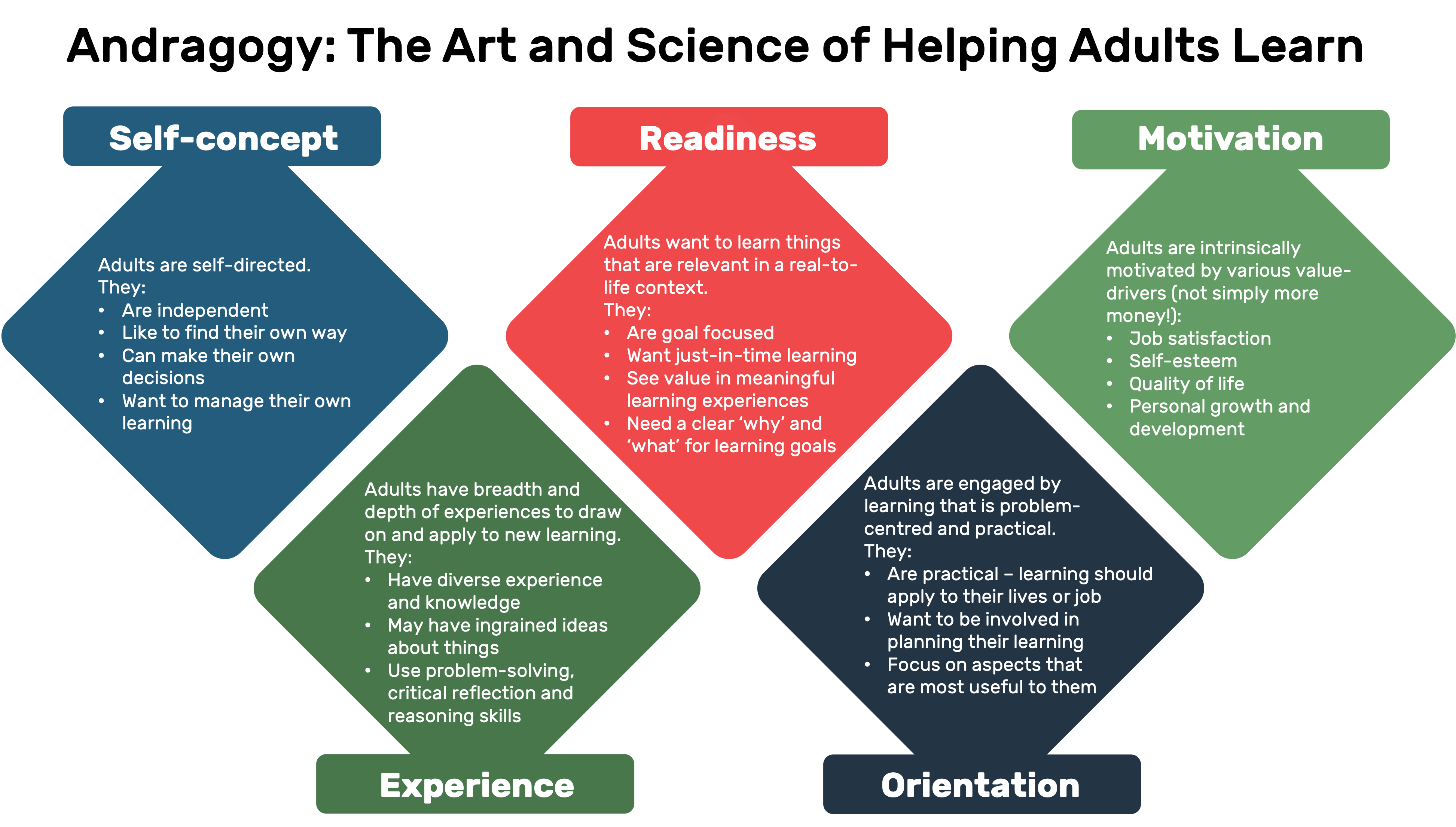
To summarize these principles, here is a helpful visual diagram. Note that while the video outlines six assumptions, this diagram groups them into five core principles, which is another common way to present Knowles' theory. The "Need to Know" is often considered the prerequisite for all other principles.
Self-Directed Learning: Empowering the Learner
A key thread running through andragogy is the idea of learner autonomy. This brings us to a closely related concept: Self-Directed Learning (SDL). While andragogy describes the nature of the adult learner, SDL describes the process by which they often prefer to learn—taking the initiative and responsibility for their own learning journey.
Let's return to the L&D Academy video for a concise explanation of SDL.
A Comprehensive Guide to Adult Learning Theories, part 1
This segment effectively defines self-directed learning and uses a great analogy to make the concept stick.
Watch the section on Self-Directed Learning. The "solo backpacking trip" analogy is a powerful way to think about the learner's role in this model.
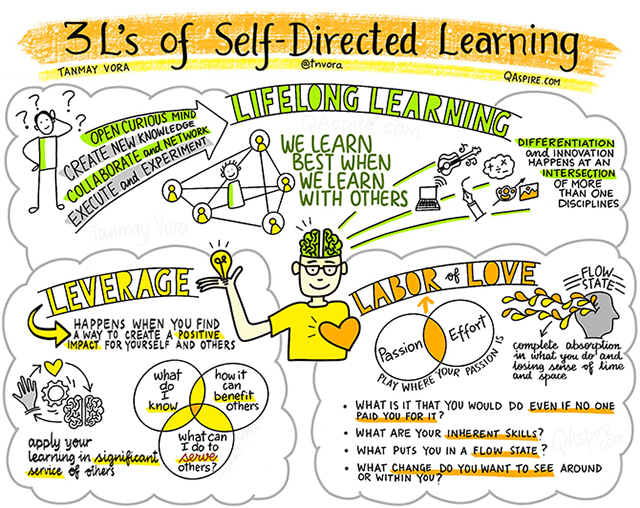
Another way to frame SDL is through the "3 L's" model, which connects the process of learning to personal impact and passion. As a designer, you may appreciate this more holistic, purpose-driven perspective.
From Theory to Practice: The UX Connection
Now, let's connect these principles directly to your work. Andragogy and SDL are not abstract academic ideas; they have direct implications for how you design a learning experience, from the structure of a course right down to the UI of a learning platform.
The following article is particularly relevant as it explicitly links Adult Learning Theory to UX/UI principles.
Adult Learning Theory and UX/UI in Education
This article from Cadmium does a fantastic job of translating the principles of andragogy into concrete advice for both course creators and UX/UI designers.
Please read the entire article. For each of the three principles discussed—Relevancy Oriented, Internally Motivated and Self-Directed, and Practical—pay close attention to the distinction between the "course creation perspective" and the "UX/UI perspective."
The article highlights a crucial synergy:
- Andragogy tells us what adult learners need: Relevance, autonomy, and practical application.
- UX/UI principles show us how to meet those needs: Through clear navigation, organized content, personalization, and intuitive design.
For example:
| Andragogical Principle | ID Strategy | UX Tactic |
|---|---|---|
| Relevancy-Oriented | Use examples from the learner's job. | Develop learner personas to ensure content alignment. Use relevant imagery and icons. |
| Self-Directed | Allow learners to choose their own path. | Organize content logically with clear labels to reduce cognitive load and decision fatigue. |
| Practical & Problem-Centered | Focus on solving real-world problems. | Make content easily searchable with tags and descriptions. Clearly define learning goals upfront. |
Application Activity
Let's put this into practice. Imagine you've been tasked with designing a 90-minute, self-paced online onboarding module for new UX designers joining your company. The goal is to familiarize them with the company's proprietary design system and collaboration workflow in Figma.
Based on the principles of andragogy and self-directed learning, list three specific design decisions you would implement in your design of this module. For each decision, briefly state which principle(s) it supports.
Think about things like:
- How would you structure the module?
- What kinds of activities would you include?
- How would you present the information?
- What choices would you give the learner?
Take about 10 minutes to think through your response. This exercise will help you internalize the theories and see how they directly inform design choices.
Conclusion
In this lesson, we moved from general learning theories to the specific needs of adult learners. You now have a foundational framework for designing experiences that resonate with a professional audience.
Key Takeaways:
- Andragogy is the theory of adult learning, which posits that adults are self-directed, bring a wealth of experience, are motivated by relevance and internal factors, and have a problem-centered orientation to learning.
- Self-Directed Learning (SDL) is a process where individuals take the initiative and responsibility for their own learning, from setting goals to finding resources.
- Effective adult learning design treats learners as partners, respects their experience, gives them control, and clearly connects learning to their real-world needs and goals.
- There is a strong, natural alignment between the principles of andragogy and user-centered design.
In our next lesson, we will continue to explore how context shapes learning design. We'll shift our focus to the influence of cultural frameworks, specifically Ubuntu philosophy and indigenous knowledge systems, on creating collaborative learning experiences in African contexts. This will add another important layer to your understanding of designing for diverse audiences.