Hello. This is the first lesson in a five-hour course on reading UK house-price reports critically. We begin with a basic distinction: a listed price, a price recorded in a mortgage approval, and a completed sale price are not interchangeable. By the end of this lesson, you will be able to identify which of these Rightmove, Nationwide, Halifax and the UK House Price Index (UK HPI) measure—and which homes each index leaves out. Later lessons will address how to compare reported changes and what those changes can, and cannot, tell you about the market.
Allow about 35–40 minutes, including the two short readings.
One home can have several relevant prices
Imagine a home advertised for £300,000. A buyer agrees to pay £290,000 and obtains a mortgage approval on that basis. If the purchase completes at £287,000 after a further negotiation, all three figures describe the same home at different points. If the purchase falls through instead, there may be an asking price and a mortgage approval but no completed sale price.
An index does not follow this particular home through every stage. Each provider draws on its own set of records. Before interpreting a headline, establish what price entered the index, when it was recorded, and which homes could enter its sample.
The official comparison below supplies the framework. It also helps separate coverage from timeliness: an earlier signal about listings or approvals is not automatically a more accurate measure of completed sale prices.
Comparing house price indices in the UK - GOV.UK
Read the UK government’s comparison to establish the data source, coverage and recording stage of each index.
Start with “Table 1: Summary table of HPI characteristics,” immediately before Section 2.1, “Coverage.” Read the UK HPI, Nationwide, Halifax and Rightmove rows, focusing on the “Data source,” “Coverage” and “Stage of recording transaction” columns. The UK HPI row provides a starting point; continue down to Rightmove. In Section 2.1, read the coverage discussion from its opening paragraph to the end of the geographical comparison. Note especially the distinction between cash purchases and lender-funded purchases, and Nationwide’s treatment of buy-to-let. Then go to Section 2.2, “Timeliness.” Read Table 2 and the explanation below it, stopping before Section 2.3, “Weights.” Focus on why an advertised property or approved mortgage might never become a completed sale.
The reading’s central distinction is straightforward. Rightmove measures sellers’ advertised asking prices. Nationwide and Halifax use prices in their respective lenders’ mortgage approval records, after valuation. The UK HPI uses prices from completed sales recorded at registration. An asking price is not an accepted offer; an approved mortgage is not proof that a purchase completed; and a registered sale records a transaction that did complete.
The stages also explain why the reports become available at different times. Listings can be counted while homes are being marketed. A lender can process its own approvals soon after they occur. A completed sale takes longer to reach the registration records used by the UK HPI. This is a difference in what is observed and when, not a ranking in which the earliest or latest publication is always “best.”
Four indices, four samples
The next distinction is who or what can appear in the data. “UK house prices” may sound like a common population, but the four providers do not observe an identical set of homes.
| Index | Price and recording stage | Main sample boundary |
|---|---|---|
| Rightmove | Advertised asking price when a property is listed | Properties advertised on its portal; excludes homes not listed there. A listing need not result in a sale. |
| Nationwide | Purchase price recorded in Nationwide’s mortgage approvals, after valuation | Its own approved mortgage purchases; excludes cash buyers, borrowers using other lenders and buy-to-let properties. |
| Halifax | Purchase price recorded in its lender group’s mortgage approvals, after valuation | That lender group’s approved mortgage purchases; excludes cash buyers and borrowers using other lenders, but includes eligible buy-to-let purchases. |
| UK HPI | Price paid for a completed sale, captured through sale registration | Registered residential sales, including cash and mortgaged purchases and buy-to-let; excludes listings and agreed purchases that do not complete, as well as sales not yet registered. |
There is a geographical qualification too. The government comparison describes the Rightmove series it examines as covering England and Wales, while the other three publish UK indices. Check a report’s stated geography rather than assuming every “national” figure covers the same area.
The two mortgage-based indices deserve a closer look. They exclude cash purchases not because those sales have no price, but because no mortgage approval from that lender exists to enter the dataset. Nor does “mortgage-based” mean that Nationwide and Halifax have the same borrowers or properties: each uses its own lending records, and their treatment of buy-to-let differs.
Halifax’s methodology makes the sample boundary more concrete:
Halifax House Price Index (HHPI) 2019 Index Manual ... - S&P Global
Read this methodological excerpt from S&P Global to see how a lender turns its approvals into an index—and why “mortgage approvals” does not mean every mortgage-related record.
In the paragraph immediately before subsection 3.1, “Index Calculation,” begin at the sentence identifying Lloyds Banking Group as the sole data source. Read through the exclusions, then read the following sentence about buy-to-let and purchases from less-conventional vendors, ending at “builders.” Focus on the distinction between a mortgage for a home purchase and, for example, a remortgage of a home already owned.
A remortgage illustrates an important limit: someone may obtain a mortgage without buying a home, so that record does not supply a new purchase price. Conversely, Halifax can include an eligible buy-to-let purchase even though Nationwide’s owner-occupier series excludes buy-to-let. “Based on mortgages” is therefore a useful first description, not a complete definition.
Rightmove’s boundary works differently. At the listing stage, the eventual buyer’s financing may be unknown—and there may never be a buyer. Its index includes asking prices for advertised homes, not a sample of completed cash or mortgage transactions. The UK HPI, by contrast, is much broader among completed registered sales: it is not limited to one lender’s customers. It still cannot report the price of a proposed purchase that never completed.
Why the published price levels differ
This historical chart shows why the word price needs care even when several reports seem to describe the same market.
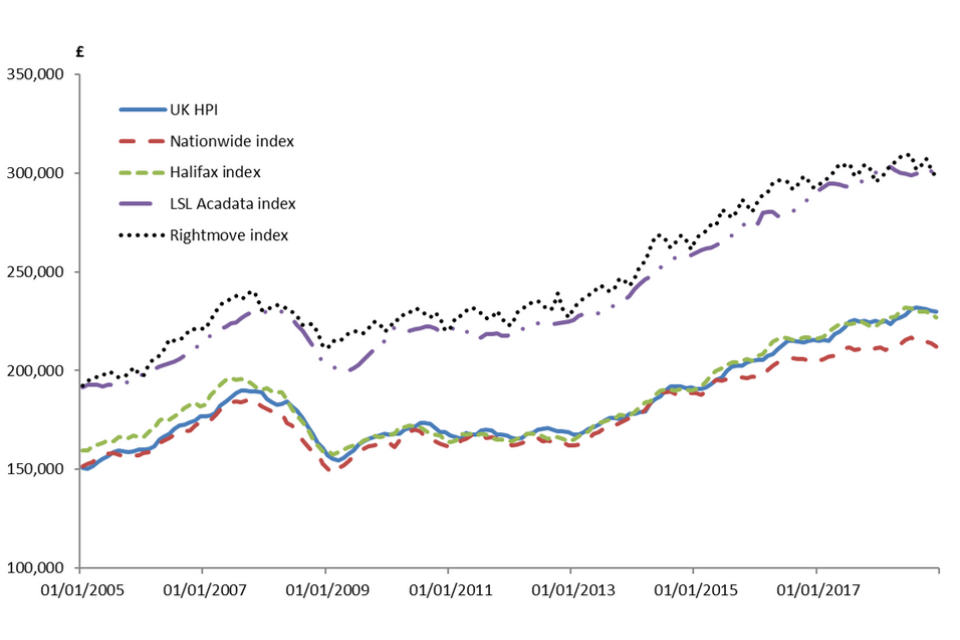
Near the end of the chart, Rightmove’s reported level is around £300,000, while the UK HPI level is nearer £230,000. Do not interpret that gap as the typical discount negotiated between an asking price and a final sale price. The indices do not track an identical collection of properties from listing to completion. They differ in sample, geography and calculation method as well as transaction stage. The chart is historical; its price levels do not describe today’s market.
Nor is every reported “average price” simply the arithmetic mean of that month’s recorded prices. Indices use adjustments intended to make changes more comparable when the types of homes in their samples vary. That does not erase their different sample boundaries. It means a difference between two headline price levels cannot, by itself, tell you how much an individual seller conceded.
A useful way to classify any of the four reports is to complete three phrases: “The price is…”, “It is recorded when…”, and “Homes missing from this sample include…”. For example: “Nationwide uses prices recorded in its mortgage approvals; it records them at the approval stage; cash purchases, purchases financed by other lenders and buy-to-let homes are outside that sample.” This states much more than “Nationwide says house prices are £X,” without claiming that its index is wrong.
Closing perspective
Rightmove observes asking prices at listing. Nationwide and Halifax observe purchase prices in their own mortgage approvals, with different eligibility rules. The UK HPI observes prices paid in completed, registered sales, including cash purchases. Their figures need not agree because they capture different stages and different sets of homes—not necessarily because one provider has made a mistake.
The next lesson will add a second check: even after identifying the index, two reported changes are comparable only if their reference periods, month-on-month or year-on-year basis, and seasonal-adjustment status line up.