Hello! Welcome to the first lesson of our final module, "Documenting and Sharing Your Design."
In the previous module, we focused on the creative aspects of mandala design—from exploring styles and color palettes to adapting your core designs for functional items like wall art and blankets. You've learned how to conceive of a beautiful design. Now, we'll shift focus to how you can communicate that design clearly to others—or even just to your future self!
This lesson addresses the learning outcome: Write clear, standardized instructions for a single round using common crochet abbreviations. We will learn the "language" of crochet patterns, focusing on the syntax and structure required to write an unambiguous, professional instruction for one round of a mandala.
For someone with your background in web design and development, the importance of clear, standardized conventions will be familiar. Just as HTML and CSS have a specific syntax that allows any browser to interpret them correctly, crochet patterns use a standardized set of abbreviations and formatting so any crocheter can understand and replicate the design.
1. Why Standardize? The "Grammar" of Crochet
Imagine trying to follow a pattern where every instruction was written out in long-form sentences. It would be dense, long, and easy to get lost in. Crochet abbreviations solve this problem by creating a shorthand for stitches and actions.
Crochet Abbreviations - Overview and Cheat Sheets
To understand the value of abbreviations, let's start with the article 'Crochet Abbreviations - Overview and Cheat Sheets' from the American Crochet Association.
Please read the first two sections, 'Why Use Crochet Abbreviations' and 'What Not To Abbreviate'. Pay attention to the example of the double crochet stitch. This will give you a clear sense of how abbreviations create concise and readable patterns. Also, note the reference to the Craft Yarn Council (CYC), which sets these standards.
A key part of standardization is also being clear about which terminology you are using. The most common cause of confusion is the difference between US and UK crochet terms. For example, a "double crochet" in US terms is a completely different stitch from a "double crochet" in UK terms. A well-written pattern will always state which system it uses (e.g., "This pattern uses US terminology.").
The article you just read also includes a helpful comparison chart under the section "US and UK Crochet Terms" (resource LINK), which is a great reference to bookmark. For this course, we will stick to US terminology, as it is most common in online patterns.
2. The Anatomy of a Single Round's Instruction
A line in a crochet pattern that describes a round has a consistent structure. Let's look at a clear visual example.
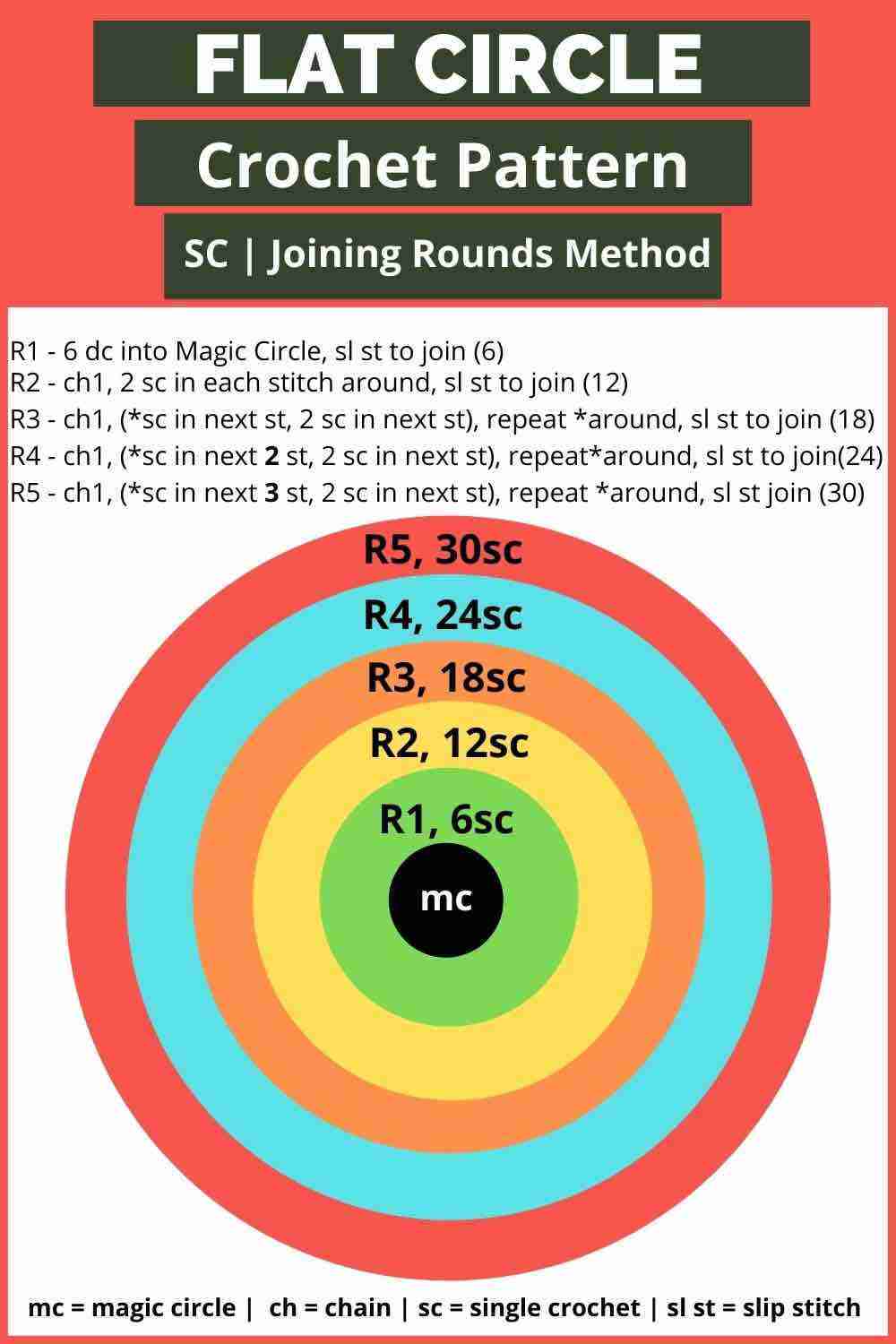
Based on the image above, we can identify four key components for each round's instruction:
- Round Number: Typically written as
Rnd 1:orR1:. This clearly marks the beginning of a new round. - Stitch Instructions: The sequence of stitches and actions to be performed, written using standard abbreviations (e.g.,
sc,inc). - Repeat Notation: Instructions on how many times to repeat a certain sequence. In the image, this is implied (e.g., "6 sc in mc"), but for more complex rounds, it's explicit.
- Final Stitch Count: The total number of stitches you should have at the end of the round, almost always enclosed in parentheses, like
(12). This is crucial for the crocheter to check their work.
3. Learning the Vocabulary: Common Abbreviations
To write instructions, you need to know the words. Below is a list of the most essential abbreviations for mandala design.
| Abbreviation | Term |
|---|---|
| ch | chain |
| sl st | slip stitch |
| sc | single crochet |
| hdc | half double crochet |
| dc | double crochet |
| tr | treble crochet |
| inc | increase |
| dec | decrease |
| st(s) | stitch(es) |
| sp | space |
| sk | skip |
| rnd(s) | round(s) |
| mc | magic circle |
| [...] or (...) | repeat instructions within |
For a more comprehensive list, the "Cheat Sheets" in the American Crochet Association article you reviewed earlier (resource LINK, section 3) are an excellent resource.
4. Structuring Repeats: The "Punctuation" of Patterns
Simply listing stitches isn't enough. We need a way to tell the user to repeat a sequence. This is where parentheses (), square brackets [], and asterisks * come in. These symbols can be used differently by various designers, but there are common conventions.
To see these conventions in action and understand the logic behind them, let's watch a video that demonstrates how a pattern is written "live."
How To Write Crochet Patterns 🧶 COMPLETE Beginner Guide, Step-By-Step 💕 Everything Crochet Patterns
The video 'How To Write Crochet Patterns' by CrochetByGenna shows a designer crocheting a project and writing the pattern down round-by-round. It's a perfect real-world demonstration of what we're learning.
Please watch the section where the designer creates the bear's head, from 09:25 to 27:06. As you watch, observe how she: Writes down each round's instruction after she's happy with it. Uses brackets ([] or ()) to group repeating stitch sequences (e.g., [one single crochet, increase]). Specifies how many times to repeat the sequence (e.g., ...repeat that six times). Always includes the final stitch count in parentheses at the end of the round's instruction.
The video demonstrates a common method: using brackets or parentheses to enclose a sequence that is repeated a set number of times. For example:
Rnd 3: [sc, inc] 6 times. (18)
This translates to: "Work one single crochet, then work an increase in the next stitch. Repeat this entire sequence a total of six times. You will have 18 stitches at the end of the round."
For more complex patterns, especially those with very long repeats, designers often use asterisks.
Repeats Most Misunderstood Thing About Patterns
The video 'Repeats Most Misunderstood Thing About Patterns' by expert Edie Eckman clarifies the often-confusing use of asterisks and repeat language.
Please watch the sections on asterisks and repeat wording from 01:58 to 06:53. Focus on: The difference between repeat *...* X times and repeat *...* X more times. How to understand that 'repeat' implies you've already done the sequence once.
An instruction using asterisks might look like this:
Rnd 5: ch 3 (counts as first dc), dc in next 2 sts, *ch 1, sk 1 st, dc in next 3 sts*; rep from * to end.
This means you work the initial part once, then you repeat the section between the asterisks over and over until you reach the end of the round.
5. Putting It All Together: Writing Your First Instruction
Now, let's practice writing an instruction for a single round of a hypothetical mandala.
Imagine you have just finished a round that has 60 double crochet stitches. For the next round, you want to create a lacy effect. Your design idea is:
- In each set of 5 stitches from the previous round, you will work a shell of 5 double crochets into the third stitch, and skip the other four stitches.
How would you write this as a standardized pattern instruction? Think about the components:
- What is the repeating stitch sequence?
- What stitches are skipped?
- How many times will this repeat around a circle of 60 stitches?
Test your understanding!
Write the full instruction for this round, including the round number (let's call it Rnd 9) and the final stitch count.
Show answer
A clear way to write this would be:
Rnd 9: *Sk next 2 sts, 5 dc in next st, sk next 2 sts*; rep from * 11 more times. (60)
Let's break this down:
\*...\*: Defines the repeating section.Sk next 2 sts, 5 dc in next st, sk next 2 sts: This is the core action, using 5 stitches from the previous round to create one shell.rep from * 11 more times: Since you have 60 stitches and each repeat uses 5 stitches, the pattern repeats 12 times in total. "Repeat 11 more times" is the clearest way to state this, as you've already worked the first one. Alternatively,[Sk 2 sts, 5 dc in next st, sk 2 sts] 12 times.is also correct and common.(60): The stitch count remains 60 (12 shells of 5 dc each).
Conclusion
In this lesson, you've taken the first step from being a pattern user to a pattern writer. You've learned that clear, standardized instructions are the foundation of any shareable crochet design.
Key Takeaways:
- Standardization is Key: Using common abbreviations and formatting (like those from the Craft Yarn Council) makes your patterns accessible and professional.
- Anatomy of an Instruction: Every round's instruction should clearly state the round number, the stitch sequence, the repeat structure, and the final stitch count.
- Vocabulary and Grammar: Abbreviations (
sc,dc, etc.) are the words, while symbols like[],(), and*provide the grammatical structure for repeats. - Clarity over Brevity: While abbreviations make patterns concise, the ultimate goal is clarity. Always include final stitch counts and specify your terminology (US vs. UK).
In our next lesson, you will build directly on this foundation. We will move from writing a single line of instruction to the next logical step: creating a complete, testable pattern for a multi-round mandala project. You'll learn how to link these individual rounds together to form a cohesive, finished pattern document.