Hello! Welcome to your next lesson in the Corporate Taxation module.
In our previous lesson, we explored the sophisticated world of tax-free reorganizations under IRC Section 368. We learned that through structures like Type A, B, and C reorganizations, a corporate acquisition can be designed to defer tax for the selling shareholders. This is a powerful tool, but it requires meeting very strict rules.
Today, we'll examine the default scenario: taxable acquisitions. We will evaluate the tax implications when a deal is structured as a taxable merger, asset purchase, or stock purchase. Understanding these implications is critical because the tax outcomes for the buyer and seller are often in direct opposition, creating a fundamental tension that you, as a future corporate lawyer, will need to help negotiate.
Your learning outcome for this lesson is to: Evaluate the tax implications of choosing a merger, asset purchase, or stock purchase structure.
By the end of this lesson, you will understand:
- The default tax treatment of stock purchases and asset purchases.
- Why sellers typically prefer to sell stock, while buyers prefer to buy assets.
- The concept of "double taxation" in asset sales.
- The difference between a "carryover basis" and a "stepped-up basis" and why it matters.
- How a special tax election, the Section 338 election, attempts to bridge the gap between buyer and seller preferences.
1. The Core Conflict: Buyer vs. Seller Preferences
In almost every M&A transaction, the buyer and seller have opposing desires when it comes to the deal structure. This conflict stems from two key issues: taxes and liabilities.
Let's start with a short video that provides a high-level, practical overview of the three main deal structures and why the interests of the buyer and seller are not aligned.
Merger & Acquistion (M&A) Deal Structures Explained
The video 'Merger & Acquistion (M&A) Deal Structures Explained' by attorney Brett Cenkus clearly lays out the fundamental tension. Focus on his explanation of the tax and liability reasons behind buyer and seller preferences.
Please watch from the introduction until 04:20. This covers the distinction between stock sales and asset sales and explains the primary tax and liability motivations for each party.
As the video explained, the general rule is:
- Sellers want to sell stock. This typically results in a single, simple tax event for the shareholders at favorable capital gains rates.
- Buyers want to buy assets. This allows them to get a "fresh start" on the assets for tax purposes and to avoid inheriting unknown liabilities.
Now, let's break down the tax mechanics that drive these preferences.
2. The Taxable Stock Purchase: Simple for the Seller
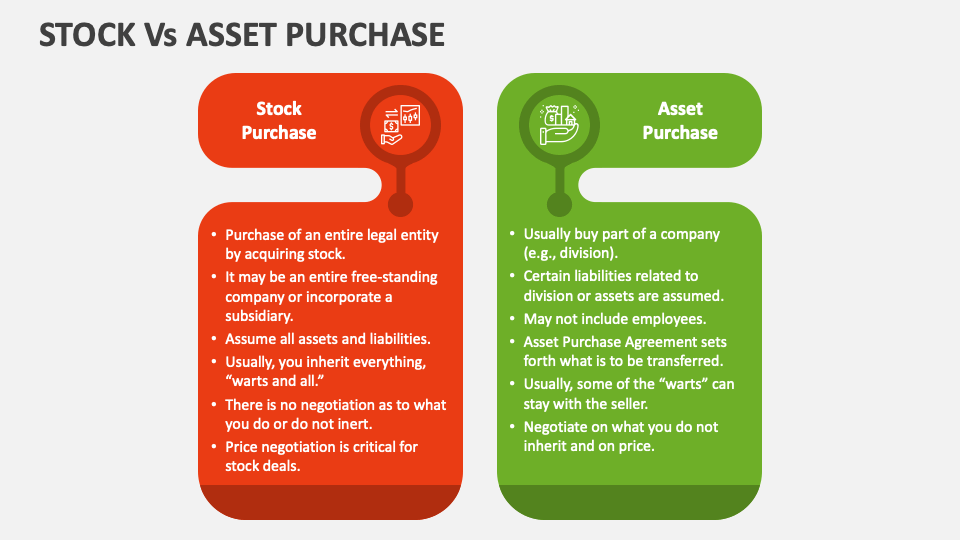
In a taxable stock purchase, the acquirer buys the target company's stock directly from its shareholders. The target company continues to exist, often as a subsidiary of the acquirer.
For the Seller (Target's Shareholders)
This structure is generally preferred by sellers.
- Single Layer of Tax: The shareholders are the only ones who pay tax. They calculate the difference between the sale price and their stock basis and pay capital gains tax on that amount. The target corporation itself does not have a taxable event.
- Clean Break: The shareholders sell their stock and are generally finished with the business, having transferred the entire company—including all its liabilities—to the buyer.
For the Buyer (Acquirer)
This structure is generally less desirable for buyers.
- Carryover Basis: The buyer inherits the target's existing tax basis in its assets. This is called a carryover basis. If the assets have been fully depreciated, their basis might be very low. The buyer cannot "step up" the basis to the price they just paid. This means fewer future tax deductions for depreciation and amortization.
- Liability Assumption: The buyer acquires the entire corporation, including all its known and unknown liabilities. This risk requires extensive due diligence.
3. The Taxable Asset Purchase: Advantageous for the Buyer
In a taxable asset purchase, the acquirer buys assets directly from the target corporation. The target corporation continues to legally exist (at least for a while) and holds the cash or stock received in the sale.
For the Buyer (Acquirer)
This structure is generally preferred by buyers.
- Stepped-Up Basis: The buyer receives a basis in the acquired assets equal to the fair market value price they paid. This is a stepped-up basis. This allows the buyer to claim larger depreciation and amortization deductions going forward, which reduces future tax bills.
- Liability Selection: The buyer can "cherry-pick" the assets it wants and specify which liabilities it will assume in the purchase agreement, leaving unwanted liabilities behind with the seller.
For the Seller (Target Corporation & its Shareholders)
This structure is a major tax problem for sellers of a typical C Corporation.
- Double Taxation: This is the critical disadvantage.
- Corporate-Level Tax: The target corporation must pay tax on the gain from selling its assets (the difference between the sale price and the assets' basis).
- Shareholder-Level Tax: When the corporation distributes the remaining cash to its shareholders in liquidation, the shareholders must pay a second tax on the distribution (the difference between the cash received and their stock basis).
Let's watch a video that walks through the mechanics of single vs. double taxation and introduces the concept of a "stepped-up basis."
Taxable Acquisitions in U.S. Corporate Tax
The video 'Taxable Acquisitions in U.S. Corporate Tax' from Edspira provides a clear, numerical illustration of the concepts we've just discussed. Pay close attention to how the two layers of tax arise in an asset sale.
Please watch from 00:36 to 04:46. This portion contrasts the tax consequences of an asset purchase (stepped-up basis but two layers of tax) with a stock purchase (one layer of tax but carryover basis).
To deepen your understanding, let's look at the specific sections of the Internal Revenue Code (IRC) that govern these outcomes.
Legal and Tax Implications of Asset Purchase vs. Stock ...
The article 'Legal and Tax Implications of Asset Purchase vs. Stock Purchase in M&A' by Cavitch, a law firm, details the specific IRC sections behind these concepts. This will help you connect the theory to the underlying law.
Please read the following sections: Under 'Asset Purchase Tax Implications,' read the subsections for Buyers (focusing on Depreciation and Amortization) and Sellers (focusing on Recapture and Capital Gains). Under 'Stock Purchase Tax Implications,' read the subsections for Buyers (focusing on Carryover Basis and Tax Attributes) and Sellers (focusing on Capital Gains and Single-Level Taxation). Focus on how specific IRC sections like 197 (amortization), 1012 (basis), and 382 (NOL limitations) create the incentives we've discussed.
Test your understanding!
A buyer is acquiring a technology company for $100 million. The company has very few physical assets, but its most valuable asset is its internally developed software, which has a tax basis of nearly zero on the company's books.
From a tax perspective, what structure would the buyer strongly prefer, and why? What would the seller prefer?
Show answer
-
The buyer would strongly prefer an asset purchase. This would allow them to allocate a large portion of the $100 million purchase price to the software and other intangible assets, creating a new, "stepped-up" basis. Under IRC Section 197, they could then amortize this basis over 15 years, generating significant tax deductions that would shield future income. In a stock purchase, they would inherit the near-zero basis and get almost no future tax benefit.
-
The seller would strongly prefer a stock sale. An asset sale would trigger a large corporate-level tax on the gain from selling the zero-basis software, followed by a second shareholder-level tax on the distribution of the proceeds. A stock sale avoids this double taxation, resulting in a single, lower capital gains tax for the shareholders.
4. Bridging the Gap: The Section 338 Election
So, we have a problem: buyers want to buy assets, and sellers want to sell stock. Is there a way to get the best of both worlds? The tax code provides a mechanism: the Section 338 election.
A Section 338 election allows a buyer to treat a qualified stock purchase (QSP) as an asset purchase for tax purposes only.
- Legally: The transaction remains a stock purchase. This is efficient because contracts, permits, and licenses transfer with the company without needing to be reassigned.
- For Tax: The transaction is treated as if the "old" target sold all its assets to a "new" target in a single transaction, triggering a taxable gain.
Consequences:
- The Buyer Wins: The "new" target gets a stepped-up basis in the assets, just as if it had been a true asset purchase.
- The Seller Loses (Initially): The deemed asset sale triggers immediate tax at the corporate level, which is a cost borne by the target company (now owned by the buyer).
Because the buyer is the one making the election and receiving the future tax benefit, but the seller's side bears the immediate tax cost, a Section 338 election is a major point of negotiation. A buyer who wants this election will typically have to agree to pay a higher purchase price to compensate the sellers for the additional tax burden.
Let's revisit the Edspira video, which provides a concise introduction to this concept.
Taxable Acquisitions in U.S. Corporate Tax
The 'Taxable Acquisitions' video also explains the Section 338 election as a way to resolve the buyer/seller conflict. Listen for who makes the election and what the 'catch' is.
Please watch from 04:46 to 07:00. This part explains what a Section 338 election is, how it allows the buyer to get a stepped-up basis, and what the tax cost is for the target corporation.
5. What About Mergers?
In the last lesson, we discussed the Type A tax-free statutory merger. But what happens if a merger doesn't qualify for tax-free treatment (for example, it's paid for entirely in cash)?
In that case, a taxable merger is generally treated for tax purposes as a taxable asset sale followed by a liquidation of the target. This means it has the same tax consequences as an asset purchase: double taxation for the seller and a stepped-up basis for the buyer.
This is a key principle: the legal form of a transaction (a "merger" under state law) does not automatically determine its tax treatment. The substance—particularly the type of consideration paid—is what matters.
This report from the Congressional Research Service provides an authoritative summary.
Corporate Acquisitions and Divisions: Tax Issues
This document, 'Corporate Acquisitions and Divisions: Tax Issues,' gives a concise overview of how taxable acquisitions are categorized. It confirms how stock purchases, asset purchases, and taxable mergers are treated.
Please read the section titled 'Taxable Acquisitions'. Focus on how it describes the tax consequences of a stock purchase, an asset purchase, and how a statutory merger can be taxed as either an asset or stock purchase depending on its structure.
Conclusion
Today we've mapped out the complex tax landscape of M&A deal structures. Unlike the cooperative nature of tax-free reorganizations, taxable deals are defined by the conflict between buyer and seller interests. As a corporate lawyer, your role is not just to document the deal, but to advise your client on how the structure will impact their financial outcome for years to come.
Key Takeaways:
- Seller's Choice: A taxable stock sale is preferred by sellers because it results in a single layer of tax at favorable capital gains rates.
- Buyer's Choice: A taxable asset sale is preferred by buyers because it provides a stepped-up basis for future tax deductions and allows for the selection of liabilities.
- The Core Conflict: The seller's preference (stock sale) results in a carryover basis for the buyer, while the buyer's preference (asset sale) results in double taxation for the seller.
- The Bridge: A Section 338 election allows a buyer to get the tax benefits of an asset purchase from a legal stock purchase, but this benefit comes at a tax cost that must be negotiated.
- Taxable Mergers: A merger paid for with cash is typically treated as a taxable asset sale, leading to double taxation and a stepped-up basis.
Preview of the Next Lesson:
We have introduced the Section 338 election as a powerful but costly tool. In our next lesson, we will perform a deep dive to fully explain the tax consequences of a Section 338 election in a qualified stock purchase. We will explore the mechanics in greater detail, including the important Section 338(h)(10) variant, and analyze the strategic situations where making this election makes financial sense.