Hello! Welcome to the next lesson in our module on Corporate Taxation.
In our last two lessons, we've explored how shareholders are taxed when they receive money from a corporation, either through a dividend or a stock redemption. A recurring and crucial term in those discussions was "stock basis." We saw that when a transaction is treated as a sale, the shareholder can recover their basis tax-free, and only the gain is taxed. This simple rule has massive financial implications.
But what exactly is this "basis"? How is it calculated, and why is it so fundamental to corporate law? This lesson is dedicated to answering those questions.
Your learning outcome for this lesson is to: Describe the role of a shareholder's stock basis in calculating taxable gain from a stock sale.
We will cover:
- The fundamental definition of stock basis and how it's used to calculate capital gains.
- How a shareholder's basis is established and adjusted over time.
- The practical importance of tracking basis and using it for tax planning.
1. What is Stock Basis? The Foundation of Gain and Loss
At its core, a shareholder's stock basis is the original cost of acquiring their shares. Think of it as the shareholder's total investment in the stock. This amount is not taxed when the stock is sold; only the profit, or capital gain, is.
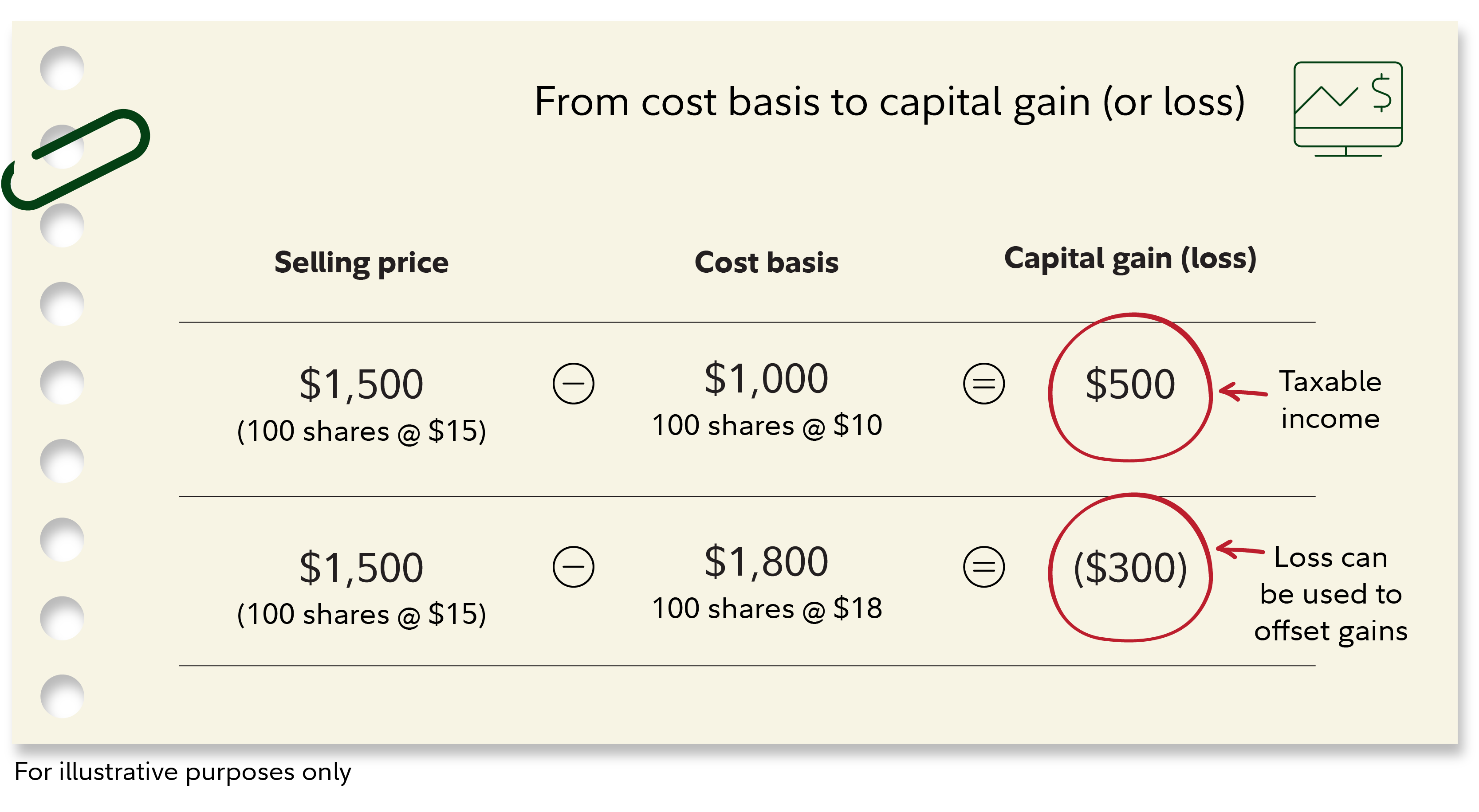
The formula is simple and is the bedrock of investment taxation:
To start, let's read a short, clear article that defines this concept.
What is cost basis and why is it important?
This article from Fidelity, 'What is cost basis and why is it important?', provides a great introduction to the topic. It clearly defines cost basis and shows how it's used to calculate gains.
Please read the first two sections, 'What is cost basis' and 'Why cost basis is important'. Focus on the simple formula for calculating gain or loss.
The image from the article you just read perfectly illustrates this core principle.
In the context of corporate law, a shareholder's basis in their stock is often called their "outside basis." This term helps distinguish it from the corporation's basis in its own assets, which is called the "inside basis." When a shareholder sells stock to another party, it is their outside basis that matters for calculating their personal tax liability.
Let's see how this plays out in a corporate transaction.
The article 'Tax Considerations' from Macabacus provides a more formal, corporate-focused explanation. It introduces the 'inside' vs. 'outside' basis distinction and provides a clear example of how outside basis is used in a stock sale.
Please read the section 'Tax Basis' and then skip down to the section 'Taxable Stock Acquisition of a Freestanding C Corporation,' focusing on 'Example A.' This will solidify the concept in a corporate acquisition context.
As you saw in Example A, the calculation is straightforward: the shareholders' aggregate taxable gain was the cash they received ($50) minus their aggregate outside basis ($15), resulting in a $35 gain. The corporation's "inside basis" in its assets ($25) was irrelevant for the shareholders' tax calculation.
2. The Moving Target: How Stock Basis is Adjusted
A shareholder's basis isn't always static. It doesn't remain fixed at the initial purchase price. Over the life of an investment, especially in a privately held corporation, several events can cause the basis to increase or decrease.
This is because, in certain types of corporations (like the S corporations we discussed in Module 3), the company's profits and losses are "passed through" to the shareholders for tax purposes. A shareholder's basis must be adjusted to reflect this, ensuring that profits are not taxed twice (once at the corporate level and again on sale) and that losses are properly accounted for.
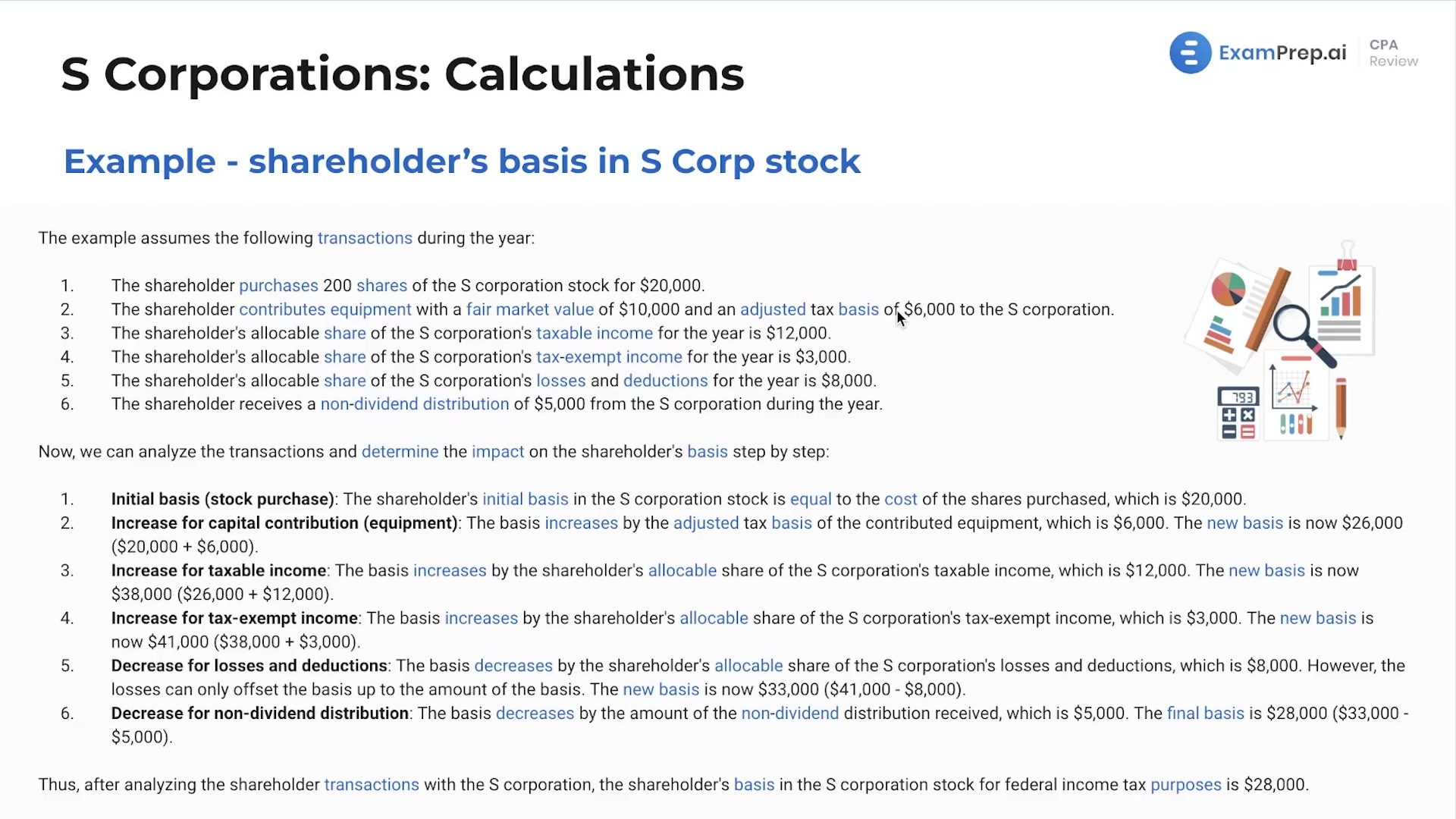
The general rules for basis adjustments are:
- Basis Increases with:
- Initial cash or property contributions for stock.
- Additional capital contributions made by the shareholder.
- The shareholder's pro-rata share of the corporation's income and gains.
- Basis Decreases with:
- Distributions of cash or property from the corporation to the shareholder (like the non-dividend distributions we saw in a previous lesson).
- The shareholder's pro-rata share of the corporation's losses and deductions.
Crucially, a shareholder's stock basis cannot go below zero.
The following image provides a detailed, step-by-step calculation of a shareholder's basis in an S Corporation, illustrating how these adjustments work in practice.
Now, let's watch a video that explains not only how basis is adjusted but also why it's so dangerous for a business owner to ignore these adjustments.
S Corp Basis Explanation | Distributions in EXCESS of Basis
This video from Navi Maraj, CPA, titled 'S Corp Basis Explanation,' uses a fantastic, practical example to show how business activities affect a shareholder's basis. He calls basis 'skin in the game'—a very useful way to think about it.
First, watch from 00:57 to 07:22. This is the core of the video where the presenter walks through an Excel example showing how profits, liabilities, and distributions impact basis. Then, watch from 11:04 to 12:40, where he explains that it is the shareholder's responsibility to track their basis and mentions the IRS forms used for this.
As the video powerfully illustrates, a shareholder who takes distributions from their company without tracking their basis can find themselves in a disastrous tax situation. If distributions exceed their basis, that excess amount is taxed as a capital gain. This often comes as a complete shock to uninformed business owners.
The key takeaway here is a crucial point of professional responsibility for a lawyer: It is the shareholder's legal responsibility to track their own stock basis. While accountants handle the calculations, a corporate lawyer must be able to advise their client on the importance of this and the consequences of getting it wrong.
Test your understanding!
Anya starts a company, "Anya's Art Supplies Inc." (an S Corporation), by contributing $10,000 in cash in exchange for all the stock. In Year 1, the company has a net income of $5,000. Anya takes no distributions.
What is her stock basis at the end of Year 1?
Show answer
Her basis at the end of Year 1 is $15,000.
- Initial Basis: $10,000 (her capital contribution)
- Adjustment for Income: +$5,000 (her share of the company's income)
- Ending Basis = $10,000 + $5,000 = $15,000
If she were to sell the company for $25,000 at the end of Year 1, her taxable gain would be $10,000 ($25,000 sale price - $15,000 basis).
3. Using Basis for Tax Planning
Understanding basis isn't just about compliance; it's a powerful tool for tax strategy. Shareholders often acquire stock in the same company at different times and for different prices. Each of these purchases represents a "tax lot" with its own distinct cost basis.
When it comes time to sell only a portion of their holdings, the shareholder can strategically choose which shares to sell to optimize their tax outcome.
The default method used by many brokers is FIFO (First-In, First-Out), where the oldest shares are assumed to be sold first. These often have the lowest basis and therefore result in the highest capital gain.
However, a more savvy investor (or their lawyer) can use the Specific Lot Identification method. This allows you to pinpoint exactly which shares you want to sell.
- To minimize a taxable gain, you would choose to sell the shares with the highest basis.
- To generate a capital loss (which can be used to offset other gains), you would choose to sell shares whose basis is higher than the current market price.
Let's watch a final video that explains this strategic element clearly.
This EASY Trick Will Save You THOUSANDS on Capital Gain Taxes
The video 'This EASY Trick Will Save You THOUSANDS on Capital Gain Taxes' from Merit Financial Advisors explains the different cost basis reporting methods and why Specific Lot Identification is the most powerful for tax planning.
Please watch from 01:32 to 03:54. This segment contrasts the default FIFO method with the strategic advantages of using Specific Lot Identification.
This ability to "cherry-pick" which lots to sell is a fundamental tax planning strategy that a corporate lawyer should be aware of when advising clients on stock sales, managing an executive's compensation portfolio, or planning for a partial exit from a business.
Conclusion
Today, we've broken down one of the most fundamental concepts in tax and corporate law: the shareholder's stock basis. Far from being a static number, it is a dynamic figure that reflects a shareholder's economic "skin in the game."
Key Takeaways:
- A shareholder's stock basis (or "outside basis") is their investment in the shares, starting with the purchase price.
- The taxable gain from a stock sale is calculated as the Sale Price minus the Stock Basis.
- Basis is adjusted over time, increasing with contributions and income, and decreasing with distributions and losses. Basis cannot be negative.
- It is the shareholder's responsibility to accurately track their basis.
- By using specific lot identification, shareholders can strategically choose which shares to sell to minimize taxable gains or harvest tax losses.
Preview of the Next Lesson:
We've now spent several lessons focused on taxable events—dividends, redemptions, and sales that result in a tax bill. However, much of high-level corporate law, particularly in mergers and acquisitions, is concerned with structuring transactions to avoid triggering immediate tax. In our next lesson, we will explore this fascinating area by learning to describe the principle of tax-free reorganizations and their significance in structuring corporate transactions.