Welcome to the fifth lesson in our module on communicating theoretical physics. In the previous lesson, we focused on the micro-level of communication, exploring how to design effective figures that tell a clear, self-contained story. Now, we will zoom out to the macro-level, learning how to weave those figures and your research results into a compelling oral presentation.
A scientific seminar is not simply a verbal recitation of a paper. It is a distinct medium with its own constraints and opportunities. An audience's attention is fleeting, and their ability to process dense information in real-time is limited. Therefore, a successful talk must be more than just a logical sequence of facts; it must be a story. This lesson is dedicated to the craft of structuring that story, building a presentation with a clear and engaging narrative arc that guides your audience from initial curiosity to final understanding.
We will deconstruct the elements of narrative and see how they map onto the structure of a physics talk. You will learn to define a core message, build a talk with a clear beginning, middle, and end, and use specific techniques to maintain audience engagement through the most technical parts of your presentation.
The Mindset of the Presenter: From Information to Communication
Before diving into structure, it's crucial to adopt the right mindset. Many scientists, particularly early in their careers, fall into a trap set by years of academic training. We are taught to present information to instructors who already know the material, with the primary goal of demonstrating our own knowledge and being graded. This "school reflex" is the antithesis of effective communication.
The goal of a seminar is not to impress the audience with complexity, but to clearly and memorably convey an idea. To understand the psychological shift required, let's hear from Dr. Jean-luc Doumont, an expert in scientific communication.
CTL Lecture - 'Communicating Science to Nonscientists'.mp4
This segment from a lecture at Stanford's Center for Teaching and Learning diagnoses the root cause of much poor scientific communication. It provides the essential "why" behind the need to relearn how to present our work.
Please watch the clip from 14:44 to 17:12. Pay close attention to the distinction between the purpose of communication in school (getting graded) versus in a research setting (conveying what's important and relevant).
Dr. Doumont's point is fundamental: you must shift your focus from yourself to your audience. The best way to do this is to leverage your own experience. As a student and researcher, you have spent countless hours listening to talks. You are an expert on what works and what doesn't from an audience's perspective.
Professor Susan McConnell from Stanford University makes this exact point in the introduction to her talk on designing effective scientific presentations.
Susan McConnell (Stanford): Designing effective scientific presentations
This video, produced by the Science Communication Lab, offers a practical guide to structuring scientific talks. This opening segment establishes the core principle of audience-centric design.
Watch the introduction from 0:10 to 1:34. The key idea is to translate what you, as an audience member, want to experience into how you design your own presentation.
With this audience-centric mindset, let's begin building the structure.
The Foundation: Your Core Message and the Dramatic Arc
Every story, whether a film, a novel, or a physics talk, is built on a central theme and follows a narrative structure that creates and resolves tension. Before you can build the structure, you must know what it is you're building.
Crafting the Core Message
Your first task is to distill your entire research project into a single, memorable idea. This is your core message: a statement of one to three sentences that encapsulates your primary finding and why it matters. This message will be the "touchstone" for every decision you make in constructing your talk.
The following reading provides a superb guide to this process.
[PDF] Story Telling and Theatre Skills for Bringing Your Presentation to Life
This chapter from the book Finding Your Research Voice provides practical guidelines and exercises for developing a clear, jargon-free core message.
Please read the sections from "Keep It Simple" to the end of the chapter. Focus on the three guidelines: "Keep It Simple," "Watch Out for the Curse of Knowledge," and "Avoid Jargon Whenever Possible." The examples of transforming a jargon-filled draft into a clear final message are particularly insightful.
The Shape of a Story: The Dramatic Arc
Once you have your core message, you can shape your talk around it using a dramatic arc. This is the structure that guides the audience's journey, building curiosity, introducing challenges, revealing a key insight, and providing a satisfying conclusion.
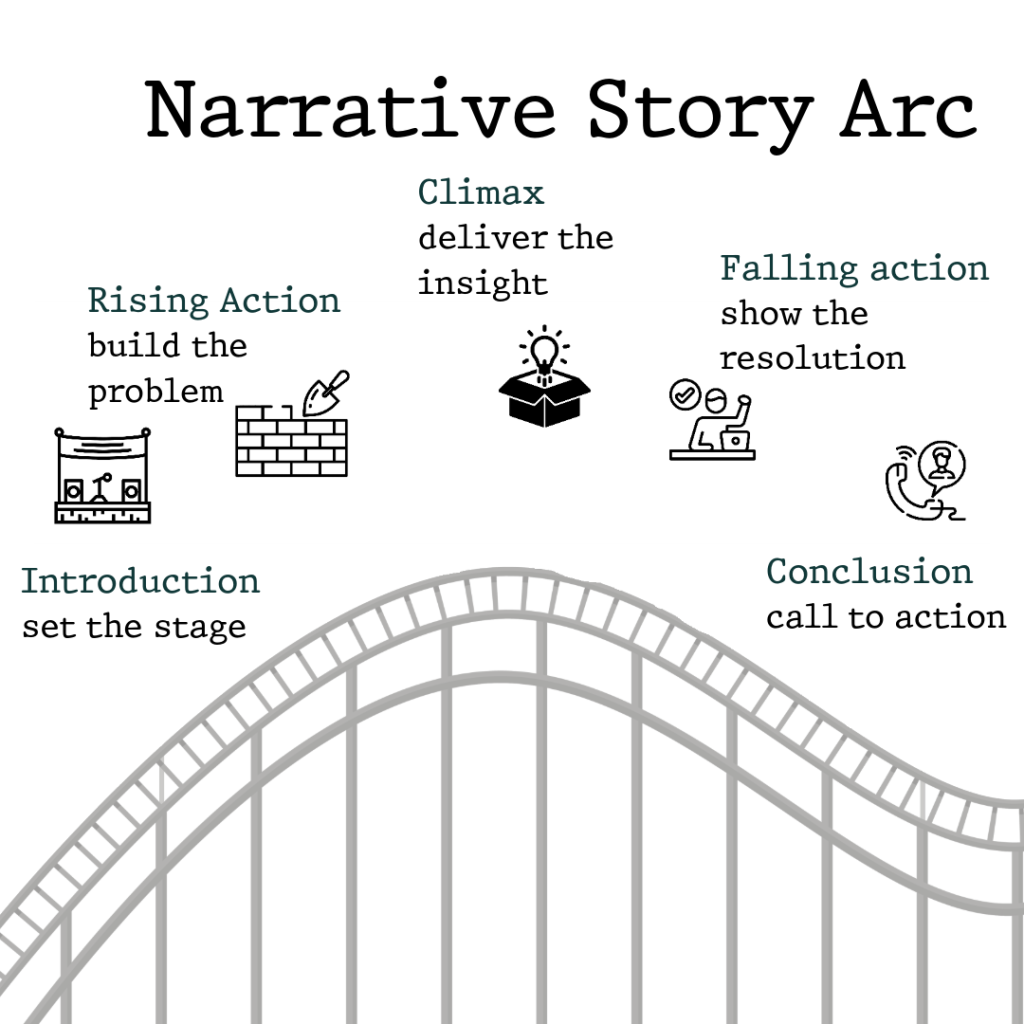
These narrative elements have direct analogues in a scientific presentation. The following reading provides a detailed breakdown of this mapping, using examples from both a TV show and a real physics talk.
[PDF] Story Telling and Theatre Skills for Bringing Your Presentation to Life
This chapter explains how to apply the principles of storytelling to structure a research presentation, defining the key components of a narrative.
Read the chapter from the beginning to the end of the "Structure" section, which concludes with the House example (Shaping the Dramatic Arc). Pay close attention to the definitions of: Exposition: The necessary background and context. Inciting Incident: The specific problem or gap in knowledge that motivates your research. Complicating Actions: The series of experiments, calculations, or challenges that build tension and lead to your main result. Climax: The moment of discovery; your central finding. Resolution: The immediate implications of your finding and how it solves the problem.
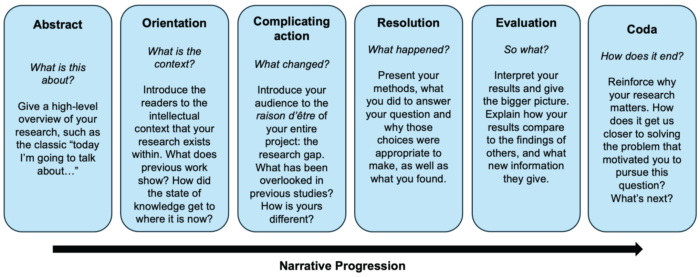
A more research-focused visualization of this structure is Labov's narrative schema, which provides a useful checklist for the key components of your story.
A Practical Framework for Your Talk
Now, let's translate these storytelling concepts into the concrete structure of a seminar, using a three-part model: the Beginning, the Middle, and the End.
The Beginning: Hook and Context
The first few minutes of your talk are critical. You need to capture the audience's attention and establish the "rules of the game": what is the broad topic, what is the specific problem, and why should they care?
- The Hook: Start with something that immediately engages your audience. This could be a provocative statement, a striking image, a surprising statistic, or a compelling analogy. Avoid the standard "My name is... and today I'm going to talk about..." opening.
- The Big Picture: Quickly zoom out to introduce the broader field. Why is this area of physics interesting? What are the foundational concepts?
- The Gap: Narrow your focus to the specific, unanswered question or puzzle that your work addresses. This is your "inciting incident."
Professor McConnell provides a clear example of how she structures her introduction to move from a broad analogy to the specific questions her talk will address.
Susan McConnell (Stanford): Designing effective scientific presentations
This segment shows a concrete example of an effective introduction and introduces a powerful tool for maintaining narrative coherence.
Watch the section from 27:24 to 29:16. Notice how she moves from a general analogy (brain vs. computer chip) to the specific cells and questions of her research. This introduces her "home slide", a visual anchor she will return to throughout the talk.
The Middle: Data Dives and the Home Slide
The middle of the talk is where you present your technical work—the "complicating actions" and the "climax." This is also where you are most likely to lose your audience. The key is to structure this section not as a monolithic data dump, but as a series of smaller, self-contained episodes.
Professor McConnell's concept of "data dives" provides an excellent model:
- Start Broad: Begin an episode with a clear question or hypothesis.
- Go Deep: Dive into the technical details—the calculation, the simulation, the key result from a figure. Present the "minimum essential data" needed to make your point.
- Come Up for Air: Conclude the episode with a clear summary of what was just shown.
- Transition: Use your "home slide" to re-orient the audience, connect the finding back to the big picture, and set up the question for the next data dive.
This structure acknowledges the natural limits of audience attention and builds in periodic "resets" that allow people to catch up if they get lost.
Susan McConnell (Stanford): Designing effective scientific presentations
This segment explains the problem of limited audience attention and presents the "data dive" and "home slide" model as a solution.
Please watch from 29:28 to 32:54. Visualize how you could break your own research into 2-4 of these "data dive" episodes, each culminating in a key piece of your argument.
The End: Payoff and Full Circle
The conclusion is your final opportunity to cement your core message. As you signal your conclusion, audience attention peaks. Use this chance effectively.
A strong conclusion has two parts:
- The Specifics: Start by clearly and concisely restating your main findings and how they answer the question you posed in the introduction (the Resolution). This is the payoff for the story you've built.
- The Big Picture: Zoom back out. Connect your specific findings to the broader context you established at the beginning. What are the implications? Why does your result matter? What new questions does it open up? This brings your talk "full circle" and provides a satisfying sense of closure.
Susan McConnell (Stanford): Designing effective scientific presentations
This clip details how to structure a conclusion that moves from specific findings back to the big-picture questions, completing the narrative arc.
Watch from 35:11 to 37:36. Note the advice to avoid "false endings" and the strategy of bringing the talk full circle.
A useful tip from Prof. McConnell is to leave your main conclusion/summary slide on the screen during the question-and-answer period. This helps the audience formulate better questions and allows you to reference your key findings in your answers.
Final Thoughts: Simplifying the Expression, Not the Science
Structuring your talk as a narrative is not about "dumbing down" your research. It is about finding the clearest, most memorable way to communicate complex ideas. You are not changing the content of your physics; you are changing the "coordinate system" in which you present it to make it more accessible and impactful. Dr. Doumont makes this point beautifully.
CTL Lecture - 'Communicating Science to Nonscientists'.mp4
This final clip addresses the common fear that simplifying communication means sacrificing scientific rigor.
Watch this short segment from 1:05:42 to 1:06:27. The analogy to choosing the right coordinate system to describe a circle is particularly apt for a physicist.
Conclusion
In this lesson, we have moved from the design of individual figures to the architecture of an entire presentation. We have seen that an effective seminar is not a linear report of research activities, but a carefully constructed narrative designed to guide an audience on a journey of discovery.
Here are the key takeaways for structuring your next presentation:
- Adopt an Audience-Centric Mindset: Design the talk you would want to listen to. Your goal is clear communication, not just demonstrating knowledge.
- Identify Your Core Message: Before you start, distill your work into a single, compelling idea that will serve as the guiding principle for your talk.
- Build a Dramatic Arc: Structure your talk with a clear beginning (Exposition, Inciting Incident), middle (Complicating Actions, Climax), and end (Resolution, Coda).
- Use a Practical Framework:
- Beginning: Hook the audience and move from the broad context to your specific research question.
- Middle: Break the technical content into "data dives," using a "home slide" to provide structure, re-orient the audience, and transition between points.
- End: Reiterate your specific findings and then zoom back out to the big picture, bringing the talk full circle.
In our final lesson of this module, we will turn the lens inward, learning how to critically evaluate the arguments and approximations in the work of others. This skill will not only make you a better reader of the scientific literature but will also sharpen your ability to construct and critique your own theoretical arguments.