Welcome to the second lesson in our module on communicating theoretical physics. In our previous session, we deconstructed the narrative architecture of a paper's introduction, learning how to guide the reader from a broad context to your specific, novel contribution using the CARS model. Having set the stage and stated your primary claims, the next task is to encapsulate your entire research story into a single, powerful paragraph: the abstract.
The abstract is often the most-read part of any scientific paper. It's the first point of contact for readers scanning databases like arXiv, and for many, it will be the only part they read. A well-crafted abstract acts as both a concise summary and a compelling advertisement for your work. In this lesson, we will focus on the principles of writing an effective abstract that clearly conveys the core question, method, and result of your theoretical research.
The Abstract as a Paper in Miniature
While the introduction funnels the reader toward your research question, the abstract presents a complete, top-down view of the entire paper. It must stand alone, providing a self-contained summary of your work. Its purpose is to give a reader enough information to decide whether the full paper is relevant to their interests.
A common and highly effective structure for an abstract can be remembered with the mnemonic MMRC:
- Motivation: What problem did you study, and why is it important?
- Methods: How did you approach the problem?
- Results: What were your principal findings?
- Conclusions: What are the broader implications of your results?
This structure ensures that you cover all the essential components of your research narrative in a logical and easily digestible format. The infographic below, "The Anatomy of a Research Abstract," provides an excellent visual summary of these core components and some best practices.
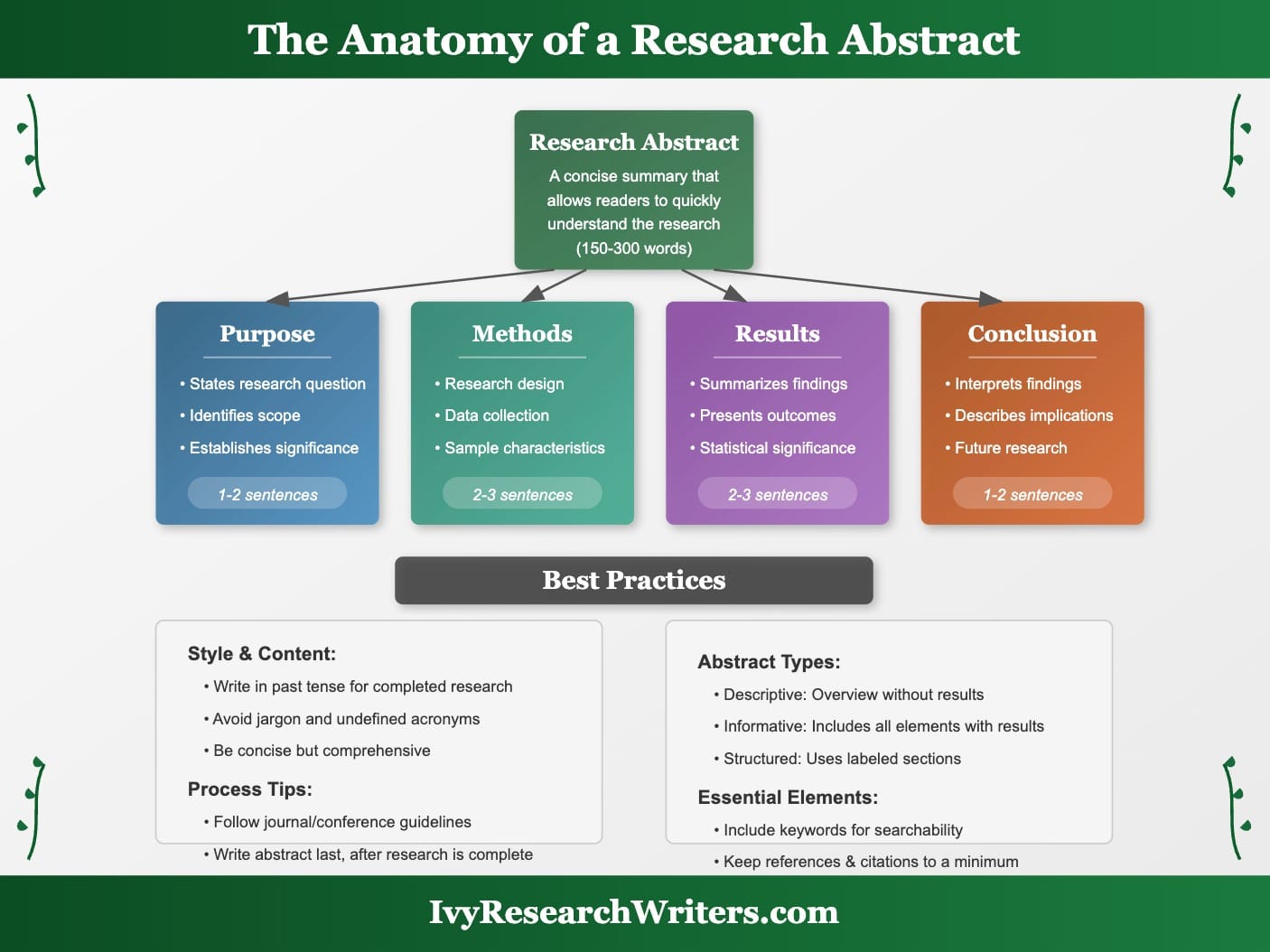
To dive deeper into the MMRC framework, let's turn to a guide written specifically for physicists by Celia M. Elliott from the University of Illinois.
[PDF] How to Write Abstracts that Capture Your Audience
This guide provides a clear, actionable recipe for writing effective abstracts, complete with excellent examples and common pitfalls to avoid.
Please read through the presentation slides, focusing on these key parts: Start with the slides that explain why the abstract is a "complete paper in miniature". Study "Celia's Foolproof Abstract Recipe" which introduces the MMRC framework. Carefully analyze the provided example of a strong abstract from condensed matter physics. Note how it is broken down into its MMRC components. Finally, examine the critique of the "fluffy" abstract to understand what to avoid, particularly the overuse of general introductory material.
Applying the MMRC Framework to Theoretical Physics
The MMRC structure is universal, but its application in theoretical physics has its own nuances. Let's refine each component for the kind of work you do.
M for Motivation
This section directly corresponds to the first two moves of the CARS model we discussed in the last lesson: Establishing a Territory and Establishing a Niche. In one or two sentences, you must set the context and state the specific problem or gap you are addressing.
- Sentence 1 (Context): Briefly introduce the area of study or the foundational concept. Example: "The fractional quantum Hall effect provides a rich playground for exploring emergent topological order and fractional statistics."
- Sentence 2 (Problem): State the specific puzzle, inconsistency, or unexplored question that your work tackles. Example: "However, a theoretical description for the observed plateau at filling fraction remains controversial."
M for Methods
For a theorist, "methods" are not experimental apparatus but rather the conceptual and mathematical tools you employed. Be precise.
- Did you use a specific theoretical framework (e.g., effective field theory, lattice QCD)?
- Did you apply a particular analytical technique (e.g., a perturbative expansion in a small parameter, a renormalization group analysis, a semi-classical WKB approximation)?
- Did you develop or use a specific computational method (e.g., Density Matrix Renormalization Group, Quantum Monte Carlo)?
The level of detail depends on your audience. For a very specialized journal, you can be highly technical. For a broader audience, you might be more descriptive. To see this in action, let's study some classic examples from a guide written by Sourendu Gupta of TIFR, an institution you'll be familiar with.
[PDF] How to write (and read) a paper - Theoretical Physics
This guide, written from a theoretical physicist's perspective, offers invaluable insights and examples.
Please read the section "The abstract: the bare bones of the paper." Pay close attention to the four examples provided, especially Example 3 (quark-gluon plasma) and Example 4 (the Kobayashi-Maskawa paper). Notice how the "methods" are described. In the quark-gluon plasma paper, it's a comparison of lattice QCD results with model calculations. In the Nobel-winning Kobayashi-Maskawa paper, the method is almost entirely implicit ("In a framework of the renormalizable theory of weak interaction..."), demonstrating an extreme, but effective, compression for a highly expert audience.
R for Results
This is the heart of your abstract. You must state your main finding as concretely and quantitatively as possible. Avoid vague statements like "we investigated the properties of X." Instead, deliver the "nitty-gritty," as one of our resources puts it.
- Theorist's Result: This might be a new equation, a calculated value for a critical exponent, a new term you've shown must be added to a Lagrangian, the phase diagram of a model, or a derived scaling relation.
- Example: Instead of "We found that the energy levels are shifted," write "We find that the ground state energy is shifted by , demonstrating a non-analytic dependence on the coupling constant ."
C for Conclusion
What does your result mean? This is where you state the main takeaway message and suggest its broader implications.
- Does your result resolve a standing controversy?
- Does it provide a new way of thinking about an old problem?
- Does it predict a new, experimentally observable phenomenon?
- Does it open up new questions for future research?
This final part is crucial for framing the importance of your contribution. The following video offers a good general overview of this four-part structure and reinforces the importance of the conclusion.
How to Write an Abstract for a Scientific Article
This video by Karen L. McKee provides a concise summary of the essential components of a scientific abstract.
Watch from the beginning of the structure section to the end. The video outlines a four-part structure: problem, methods, findings, and implications. Notice how this aligns perfectly with the MMRC framework and the examples we have studied.
Process and Audience Adaptation
Two final points are critical for writing a truly professional abstract: the writing process and audience adaptation.
-
When to Write: Some, like Sourendu Gupta, advocate writing the abstract first as a tool to outline your thoughts and define the core message of your paper. The more common advice is to write it last, after the rest of the paper is complete, to ensure it accurately reflects the final content. A practical approach is to do both: write a working abstract at the beginning to guide you, and then revise it carefully at the very end.
-
Adapting to Your Audience: An abstract for a highly specialized journal like Journal of High Energy Physics will look very different from one for a broad-scope journal like Physical Review Letters or Science. The level of jargon, assumed knowledge, and detail must be tailored. This is perhaps the most advanced skill in abstract writing. A powerful way to master this is to study the venue where you intend to publish.
The next video gives an excellent, practical tip for this.
How to write an abstract | My EASY formula with REAL examples
In this video, Andy Stapleton discusses the practicalities of abstract writing, including how to adapt to different journals.
Please watch the segment on adapting to different journals. His advice to create a "cheat sheet" by analyzing the structure of 5-10 recently published abstracts in your target journal is an invaluable strategy used by many seasoned researchers.
Conclusion
In this lesson, we've established that the abstract is a self-contained, miniature version of your paper. By adhering to a clear structure like the MMRC framework (Motivation, Methods, Results, Conclusion), you can ensure that you convey your research story completely and concisely.
The key takeaways are:
- An abstract must stand alone and serve as a summary of the entire paper.
- The MMRC structure provides a robust recipe: frame the problem, describe your theoretical tools, state your most important quantitative result, and explain its implications.
- For theoretical work, the "method" is your analytical or computational framework, and the "result" should be a specific, concrete finding, like an equation or a calculated value.
- The most effective abstracts are written last (or heavily revised last) and are carefully tailored to the audience and conventions of the target journal.
You have now learned how to set the stage with a strong introduction and how to summarize the entire story in a compelling abstract. These two components are the public face of your paper. The next step is to master the presentation of the core argument itself. In our next lesson, we will delve into the art of presenting mathematical derivations with a level of detail and clarity that is appropriate for your target audience.