In our last lesson, we mastered the craft of constructing a Landau free energy functional. By applying the foundational principles of symmetry and analyticity, we arrived at a phenomenological model for the order parameter field near a phase transition, bypassing the often-intractable details of the microscopic Hamiltonian. We now have our tool. Today, we will learn how to use it to make powerful, qualitative predictions about the nature of phase transitions.
The core idea is simple: a system in thermal equilibrium will adopt the state that minimizes the free energy. For a uniform system, this means finding the value of the order parameter that minimizes the Landau free energy density, . By analyzing how this minimum changes as we vary temperature, we can determine whether the transition into the ordered state is smooth and continuous or abrupt and discontinuous. This lesson will equip you to distinguish between these two fundamental classes of phase transitions—continuous (second-order) and first-order—directly from the form of the Landau potential.
Continuous (Second-Order) Transitions: The Symmetric Case
Let's begin with the canonical model we derived for a system with up-down symmetry (), such as an Ising ferromagnet. Ignoring spatial variations for now, the Landau free energy density is:
We established that for the free energy to be bounded from below for large , we must have . The crucial temperature dependence is captured by the coefficient , which we model as with . This ensures for (the disordered phase) and for (the ordered phase).
The equilibrium value of the order parameter, , is found by minimizing :
This equation has solutions:
Let's analyze the stability of these solutions:
- For (): The only real solution is . The second derivative, , is positive at (since ), confirming it is a minimum. The system is in the disordered phase.
- For (): We now have three real solutions: and .
- At , the second derivative is , so this is now a local maximum. The disordered state is unstable.
- At , the second derivative is . These are two degenerate minima. The system spontaneously breaks the symmetry and settles into one of these ordered states.
Crucially, as the temperature is lowered towards , the order parameter grows continuously from zero. This smooth onset of order is the defining characteristic of a continuous or second-order phase transition.
The following video provides an excellent visualization and walkthrough of this exact analysis.
Landau Ginzburg theory of Phase Transitions
This video from Jos Thijssen's course on Computational Physics clearly explains the analysis of the symmetric quartic Landau free energy.
Please watch from the introduction of the Landau expansion, where the speaker explains how the shape of the potential f(m) changes as the coefficient r_0 (our a) passes through zero. Then, continue watching the next segment, which shows the calculation of the equilibrium magnetization by minimizing the free energy. This directly derives the result that m is proportional to the square root of the reduced temperature.
The Thermodynamic Signature of Transition Order
Before we explore discontinuous transitions, let's formalize this classification. In thermodynamics, the order of a phase transition is defined by which derivative of the free energy with respect to temperature is the first to be discontinuous at .
- First-Order Transition: The first derivative, , is discontinuous. This implies a finite change in entropy, , and thus a latent heat, .
- Second-Order Transition: The first derivative (entropy) is continuous, but the second derivative, the heat capacity , is discontinuous.
Let's check our symmetric model. The equilibrium free energy is:
where . You can verify that the first derivative is continuous at (it's zero from both sides, relative to the background ), but the second derivative has a finite jump. This confirms our model describes a second-order transition.
Lectures on Landau Theory of Phase Transitions
This text by Peter Olmsted provides a clear, formal definition of phase transition orders based on the non-analytic behavior of the free energy.
Please read the section "How to get non-analytic behavior". Focus on the paragraph defining first-order and continuous transitions based on discontinuities in the derivatives of F, and observe the associated diagrams showing the behavior of F(T) for both cases.
First-Order Transitions: The Role of Asymmetry
How can we modify our model to produce a first-order transition? The key is to introduce terms that create a competition between the disordered state () and an ordered state with a large order parameter. The simplest way to do this is to break the symmetry by including odd powers in the expansion.
Consider a free energy of the form:
where we assume for definiteness. The cubic term, , explicitly favors positive . Such a term is forbidden in systems with up-down symmetry like the Ising model, but it is allowed in others, like the isotropic-nematic transition in liquid crystals, where the order parameter describes molecular alignment.
Let's analyze the minima of this potential. The shape of is now more complex.
- For high temperatures ( large and positive), still has a single minimum at .
- As decreases, a second, local minimum appears at a positive value of . Initially, this new minimum has a higher free energy than the minimum at .
- The phase transition occurs at a critical temperature where the free energies of these two minima become equal. At this point, the system can jump from the state to the new minimum with .
- Crucially, this transition happens while the state is still a local minimum (). The jump to the ordered state is therefore discontinuous.
The following reading details this analysis.
[PDF] Mean Field Theory - Physics Courses
Section 7.5.2 of these lecture notes by the University of California, San Diego, provides a crystal-clear analysis of how a cubic term in the Landau free energy leads to a first-order transition.
Please read the subsection titled "Cubic terms in Landau theory: first order transitions". Pay close attention to Figure 7.14, which shows the evolution of the free energy potential, and the logic that determines the transition point by equating the free energies of the two competing minima.
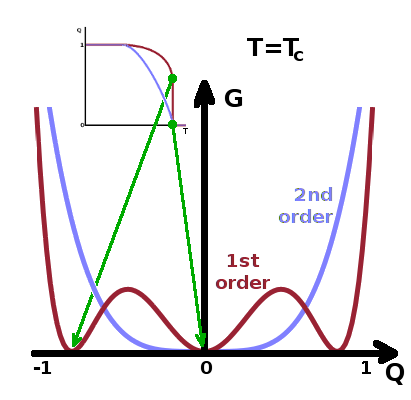
The image below visually contrasts the shape of the free energy potential (equivalent to our ) for the two types of transitions at their respective critical temperatures, .
First-Order Transitions from Symmetric Potentials: The Tricritical Point
A fascinating prediction of Landau theory is that a first-order transition can occur even in a system that respects symmetry, meaning no odd powers are allowed. This happens if the coefficient of the quartic term, , is negative. Stability then requires a positive sextic term, d/6$$\psi^6.
- If , we recover the standard second-order transition as passes through zero.
- If , the quartic term actually encourages a non-zero order parameter. A competition arises between the term, which wants for , and the term, which wants . This leads to a first-order transition, similar to the case with the cubic term.
The point in the parameter space where the transition changes from second-order to first-order (i.e., at ) is called a tricritical point. This is a beautiful example of how the Landau framework can predict complex phase behavior from simple symmetry arguments and analysis of polynomial coefficients.
[PDF] Mean Field Theory - Physics Courses
The same UCSD lecture notes explain this scenario in Section 7.5.4.
Please read the subsection "Sixth order Landau theory: tricritical point". Focus on Figure 7.16, which shows the phase diagram in the (a, b) plane and illustrates how the line of second-order transitions (for b>0) meets the line of first-order transitions (for b<0) at the tricritical point (0,0).
Conclusion
Today we have put the Landau free energy to work. By analyzing the minima of the potential as a function of its coefficients, we can predict the fundamental nature of a phase transition. This powerful method of theoretical inquiry reduces a complex many-body problem to the analysis of a simple polynomial.
Key Takeaways:
- The equilibrium state of a system corresponds to the minimum of the Landau free energy .
- Continuous (second-order) transitions are characterized by the order parameter growing smoothly from zero below . They are typically described by a Landau expansion with only even powers of and a positive quartic coefficient ().
- Discontinuous (first-order) transitions involve a sudden jump in the order parameter from zero to a finite value. They can arise from two primary mechanisms within Landau theory:
- The presence of odd-powered terms (e.g., a cubic term), which are allowed when the symmetry of the ordered state is not simply related by inversion to the disordered state.
- A negative quartic coefficient () in a symmetric potential, which requires a positive sextic term for stability.
- The meeting point of a line of second-order transitions and a line of first-order transitions is a tricritical point.
We have now seen how to construct the Landau model and use it to classify transitions. The next step in our methodological journey is to extract quantitative predictions. For a continuous transition, the order parameter near behaves as , where we found the exponent . In the next lesson, we will see how Landau theory allows for the systematic calculation of this and other critical exponents, which are universal quantities that characterize the physics near a second-order phase transition.