In the previous lesson, we established a powerful classification scheme for operators based on how their associated couplings transform under the Renormalization Group (RG) flow. We saw that relevant operators become stronger at long distances, driving the system away from a fixed point, while irrelevant operators become weaker, their effects fading into the microscopic details.
Today, we will see the profound consequence of this classification. It provides a complete and elegant explanation for universality, the remarkable experimental observation that vastly different physical systems—such as a liquid boiling, a magnet losing its magnetism, or even certain chaotic electrical circuits—exhibit identical behavior near a critical point. We will see that this is not a coincidence, but a deep statement about the structure of physical theories, which the RG framework makes transparent.
The Central Idea: Many-to-One Flow
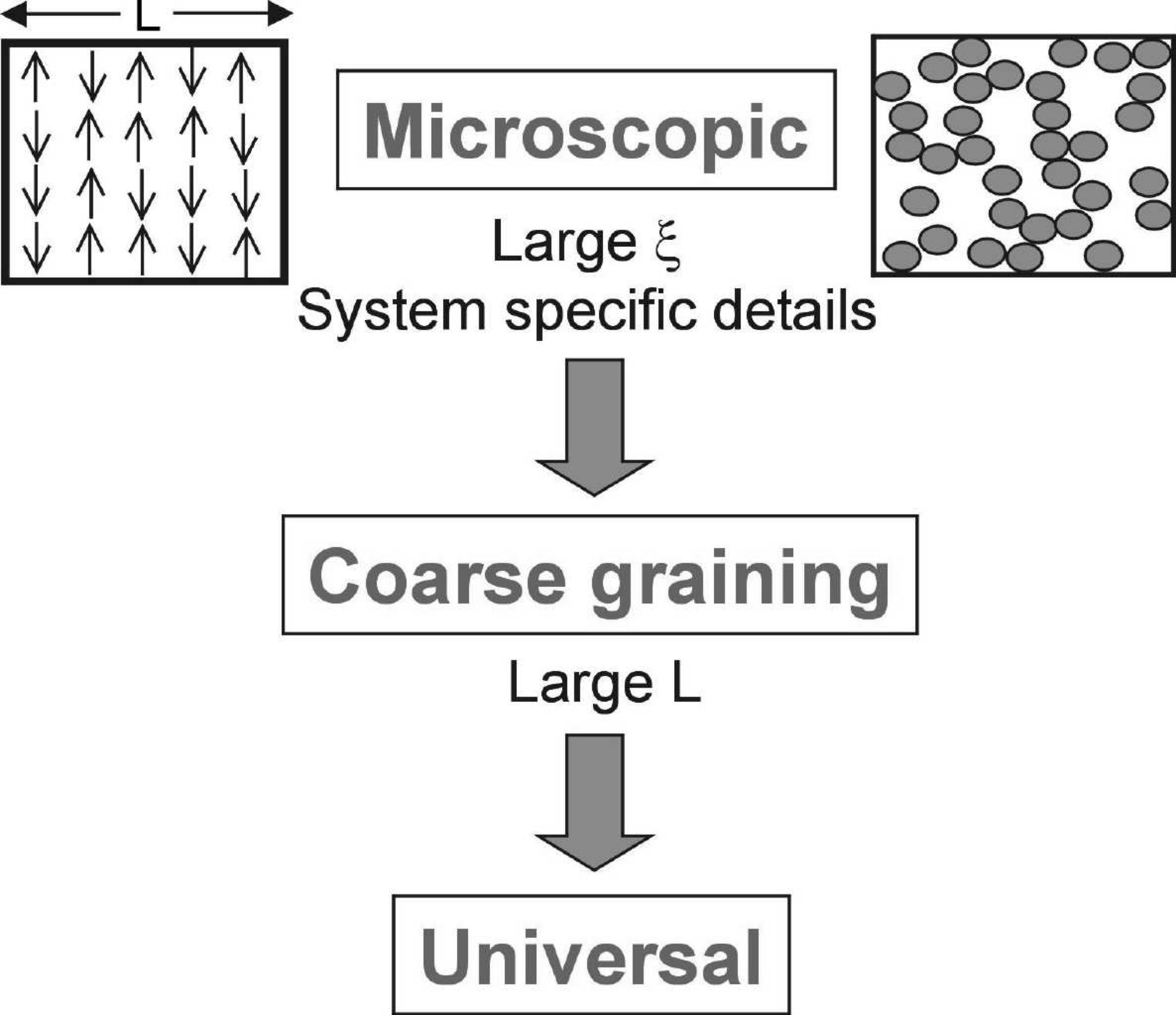
The core idea of universality is that the RG flow acts as a many-to-one map in the space of all possible theories. Many different microscopic Hamiltonians, with all their specific, complicated details, can flow to the very same fixed point. Since the long-distance, critical behavior of a system is entirely governed by the properties of the fixed point it flows towards, all of these microscopically distinct systems will end up in the same universality class, sharing identical critical exponents and scaling functions.
The short-distance, system-specific details are encoded in the irrelevant operators. As the RG flow proceeds towards the infrared (long distances), the couplings of these irrelevant operators are driven to zero. The system effectively "forgets" its microscopic origins, retaining only the universal properties dictated by the fixed point and its relevant operators.
This video from the channel Broken Symmetries provides an excellent visual and conceptual introduction to this idea.
Renormalization: Why Bigger is Simpler
This video explains how the RG flow in parameter space leads to simplification at large scales and how this picture naturally explains phase transitions and universality.
First, watch the segment on RG flow and fixed points. The narrator explains how repeated coarse-graining creates a flow in the space of coupling constants and how streamlines converge, meaning fewer parameters are needed to describe the system at large scales. This is the essence of universality. Then, watch the next segment on phase transitions and universality, which shows how different microscopic starting points can flow to the same fixed point, thus exhibiting the same large-scale properties.
The process is summarized beautifully in the following diagram. Different microscopic systems, when subjected to coarse-graining (the essential RG step), lose their system-specific details and are described by a common, universal theory at large length scales.
The Critical Surface
This concept can be formalized using the geometric picture of RG flows we developed previously. The set of all theories that flow to a particular fixed point is called the critical surface (or the basin of attraction) of that fixed point.
- To observe the critical behavior associated with a fixed point, the microscopic parameters of your theory must be tuned so that the system lies on the critical surface.
- Perturbing the system with an irrelevant operator moves it off the critical surface, but the RG flow naturally guides it back. The long-distance physics remains unchanged.
- Perturbing the system with a relevant operator kicks it off the critical surface, and the flow carries it away, typically to a different fixed point (representing a different phase of matter).
This is why, in experiments, one must precisely tune a small number of parameters (like temperature or pressure) to observe a critical point. These physical control knobs correspond to the relevant operators of the theory.
The following reading provides a concise formalization of this picture.
This section from David Tong's lecture notes connects the concepts of fixed points, RG flow, and operator classification to provide a clear explanation for universality.
Please read the subsection titled Universality Explained. Focus on how the convergence of RG flows to a fixed point explains why "many different microscopic theories have the same long distance behaviour." Also, note the definition of the critical surface as the basin of attraction for a fixed point.
A universality class is therefore defined by the properties of a fixed point. All systems within a given class share:
- The same spatial dimensionality .
- The same symmetries of the order parameter.
These two conditions determine which fixed point governs the critical behavior. Consequently, all systems in a class have the same set of critical exponents (), which are determined by the scaling dimensions of operators at that fixed point.
Case Study 1: The Ising Universality Class
Let's make this concrete. The 3D Ising model, which describes magnetism in materials like iron, has a critical point. The liquid-gas phase transition in fluids like carbon dioxide also has a critical point. Microscopically, these systems are entirely different—one involves interacting quantum spins on a lattice, the other classical particles interacting via van der Waals forces.
Yet, experimentally, their critical exponents are identical (e.g., , ). Why? Because despite their different microscopic Hamiltonians, both systems belong to the same universality class. They are both three-dimensional systems whose order parameter has the same simple up/down () symmetry (spin up/down for the magnet, liquid/gas density fluctuation for the fluid).
Under the RG flow, both systems are driven to the same non-trivial fixed point, known as the Wilson-Fisher fixed point. The universal critical exponents are the scaling dimensions associated with this fixed point.
The following text demonstrates a modern RG calculation that investigates this very fixed point and confirms the universality of the critical exponent .
[PDF] Introduction to universality and renormalization group techniques
In these notes, Alessandro Sfondrini uses the Functional Renormalization Group Equation (FRGE) to study the 3D Ising universality class.
Please read the section The Wilson-Fisher fixed point in D = 3. The key idea is presented in the first paragraph: the universal behavior of diverse magnetic systems "should be explained in terms a property of the theory space T common to all these theories, namely the existence of a fixed point". The calculation that follows uses the RG to find this fixed point (the Wilson-Fisher point) and computes the critical exponent \nu, finding a value close to experiment, confirming the whole picture.
Case Study 2: Universality in Chaos
The power of the RG method is its generality. The concept of universality classes governed by fixed points extends far beyond statistical mechanics. A celebrated example comes from the study of dynamical systems and the route to chaos.
Consider simple iterative maps, like the logistic map which you may have encountered in computational physics. As the parameter is increased, the system undergoes a sequence of period-doubling bifurcations on its way to chaotic behavior. In the 1970s, Mitchell Feigenbaum discovered numerically that the ratio of distances between successive bifurcation points converges to a universal constant, , for a huge variety of different maps (e.g., ).
This is a classic example of universality. The "microscopic detail" is the specific functional form of the map, yet the "critical behavior" (the onset of chaos) is governed by a universal constant.
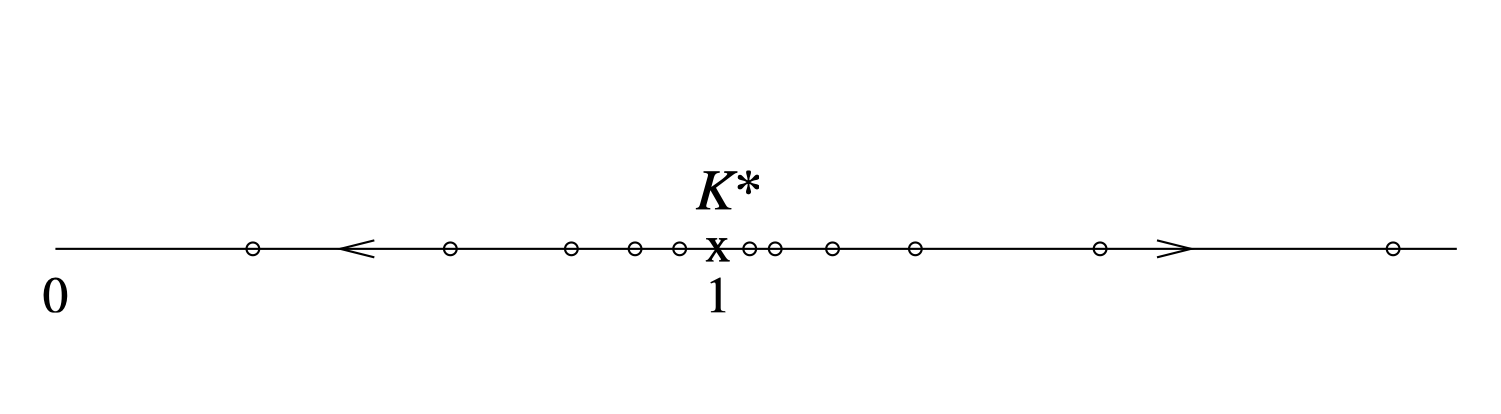
Feigenbaum explained this by constructing a renormalization operator that acts not on a Hamiltonian, but on the space of functions themselves. The operator essentially involves iterating the map twice and then rescaling space: , where is a scaling factor.
.
The universal behavior of period-doubling is explained by the existence of a fixed point function that satisfies . The universal constant is an eigenvalue of the RG operator linearized around this fixed point, corresponding to the single relevant direction.
The following video and text explain this beautiful application of the RG idea.
[PDF] Introduction to universality and renormalization group techniques
These sections from Sfondrini's notes introduce the phenomenon of universality in period-doubling and outline the RG explanation.
First, read section 2.3 Universality. This section describes the experimental and numerical observations of universal behavior in iterated maps. Then, read section 3. Renormalization group approach. This introduces the renormalization operator \mathcal{R} and sketches how its fixed point structure, with stable and unstable manifolds, explains the observed universality.
To see the RG operator in action, the next video gives a more detailed visual walkthrough of the process.
Renormalization Theory for Dynamical Systems | Feigenbaum's Analysis of Period-Doubling Universality
In this video, Dr. Shane Ross provides a quantitative look at Feigenbaum's renormalization analysis.
Watch the segment from self-similarity to scaling, which illustrates the self-similar structure of the bifurcation diagram and motivates the idea of a rescaling transformation. Then, continue from the RG transformation to the universal function. This part shows exactly how iterating the map and rescaling space (the RG transformation) leads to a convergence towards a single, universal function g_0(x), independent of the initial map f(x). This is the "many-to-one" flow in action.
This example from dynamical systems is particularly instructive. It demonstrates that the RG is not just a tool for QFT or condensed matter, but a general mathematical framework for understanding how systems behave when observed at different scales, revealing universal structures that are hidden in the microscopic laws.
Conclusion
This lesson has connected the abstract machinery of RG flows and fixed points to the concrete, experimentally observed phenomenon of universality. This is arguably the crowning achievement of the renormalization group program.
Key Takeaways:
- Universality is the observation that diverse microscopic systems exhibit identical behavior at a critical point.
- The RG explains universality via many-to-one flows in theory space. Many different theories flow to the same fixed point.
- The long-distance physics is determined by the properties of the fixed point, not the microscopic starting point.
- The critical surface is the basin of attraction of a fixed point. To observe criticality, one must tune the system's relevant parameters to land on this surface.
- A universality class comprises all systems that flow to the same fixed point, characterized by the same dimensionality and order parameter symmetry.
- This RG framework is a general methodological tool, applicable not only to phase transitions but to other fields like dynamical systems, explaining phenomena like the universal route to chaos.
In our last lesson on the Renormalization Group, we will focus on the concept of the upper critical dimension. We have seen hints that is special for theory. We will explore why, above this dimension, the interactions become irrelevant and the simpler mean-field theories become exact.