Welcome to the next step in our exploration of building theoretical models. In our last lesson, we developed a systematic procedure for constructing Lagrangians using symmetry and power counting. We now have an algorithm for writing down the most general theory and organizing its terms. But physics is more than an algorithm; it's a process of reasoned argument. Today, we will delve into the physical justifications that underpin this procedure.
This lesson focuses on the "why" behind the "how." Why are we allowed to ignore an infinite tower of complex interactions? What physical principles guide our decision to include one term but exclude another? Answering these questions is central to developing the intuition of a theoretical physicist. We will move beyond the mechanics of dimensional analysis to the physical reasoning that makes it such a powerful tool, exploring how controlled approximations, symmetry arguments, and experimental facts guide the art of model-building.
1. The Foundational Argument: Decoupling of Scales
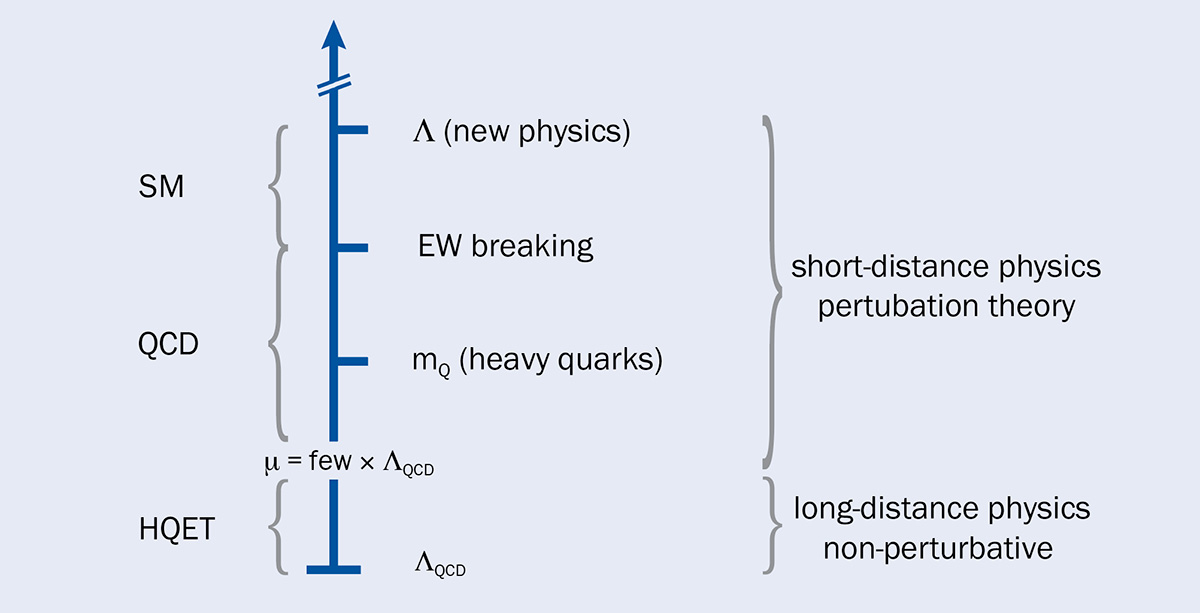
The entire enterprise of effective field theory (EFT) rests on a single, profound physical principle: the decoupling of scales. In simple terms, physics at low energies (long distances) is largely insensitive to the intricate details of physics at high energies (short distances). This is why you can use Newtonian gravity to describe planetary orbits without needing to know about quantum gravity, or use fluid dynamics without tracking every single molecule.
This decoupling is not just a convenient approximation; it's a fundamental feature of local quantum field theories. The uncertainty principle dictates that to resolve short-distance structures, you need high-momentum probes. If your experiment operates at a low energy , you simply don't have the resolution to excite or even "see" the heavy particles of mass that exist in the full, underlying theory. Their effects are not zero, but they are suppressed by powers of , manifesting as the "irrelevant" operators we discussed.
The following video provides a clear explanation of this core principle and a fantastic, concrete example using the hydrogen atom.
1. Introduction to Effective Field Theory (EFT)
This video from MIT OpenCourseWare's course on Effective Field Theory, taught by Prof. Iain Stewart, articulates the key ideas behind EFT.
First, watch the segment on the core principle of EFT. The lecturer explains that physics at a low energy scale m^2 is insensitive to the details of physics at a much higher scale \Lambda^2. This is the fundamental justification for excluding high-energy degrees of freedom. Next, watch the detailed example of the hydrogen atom. This section demonstrates multiple, layered physical arguments for excluding terms. For instance: We exclude quarks because the typical momentum transfer of photons in the atom is much smaller than the inverse size of the proton, so the photon cannot resolve its internal structure. We treat the proton as a static source because the momentum transfer is also much smaller than the proton's mass. We use non-relativistic quantum mechanics because the momentum transfer is much less than the electron's mass.
This hydrogen atom example perfectly encapsulates our learning goal. Each simplification is not arbitrary but is a physical argument based on a comparison of scales.
2. Justification in "Top-Down" Models
In a "top-down" approach, we assume we know the fundamental, high-energy theory and wish to derive a simpler, low-energy effective model. Here, our justifications for including or excluding terms are often rooted in controlled mathematical approximations that are themselves motivated by physical arguments. A prime example, highly relevant to your interest in condensed matter physics, is the derivation of the Ginzburg-Landau theory of phase transitions from a microscopic model.
Example: From Microscopic Interactions to Phenomenological Models
Let's consider two cases from condensed matter theory.
1. The Heisenberg Model of Magnetism:
We often start with a complex Hamiltonian for interacting electrons in a solid. The full interaction is quite complicated. However, we can decompose it into different "channels" that represent distinct physical processes.
Concepts of Condensed Matter Physics
This section from Prof. Oreg's lecture notes at the Weizmann Institute shows how a full interacting Hamiltonian is simplified.
Please read from the beginning of subsection 2.1.3 to see how the general interaction term is split into the direct (Hartree), exchange (Fock), and pairing (Cooper) channels. Then, read subsection 2.1.4. This section explicitly justifies the Heisenberg model by assuming the exchange term is dominant and neglecting the others.
The physical argument for this exclusion is an appeal to the specific context. For materials with strong orbital overlap, Pauli's exclusion principle makes the spin-aligning exchange interaction the most significant contributor to the low-energy magnetic properties. We justify excluding the other terms by arguing their effects are sub-dominant for the phenomena of interest (magnetism).
2. Ginzburg-Landau (GL) Theory from BCS Theory:
The Bardeen-Cooper-Schrieffer (BCS) theory provides a microscopic description of superconductivity. The Ginzburg-Landau theory is a phenomenological model that brilliantly describes superconductors near their critical temperature, . We can justify the form of the GL theory directly from BCS.
The physical argument is that close to the transition, the superconducting order parameter is small. This smallness provides a control parameter that justifies a Taylor expansion of the system's free energy in powers of .
Concepts of Condensed Matter Physics
This part of the notes outlines the derivation of the Ginzburg-Landau theory.
Please read Section 7.3, "Deriving the Ginzburg-Landau theory". The key steps are: Using the Hubbard-Stratonovich transformation to rewrite the interacting theory in terms of a field \Delta(x, \tau). This justifies treating the order parameter as a fluctuating field. Integrating out the original fermion fields to get an effective action for \Delta. Expanding this effective action in powers of \Delta and its gradients. The physical justification for this expansion is the assumption that \Delta is small and slowly varying near T_c. This procedure justifies why the GL free energy includes terms like |\Delta|^2 and |\Delta|^4 and a gradient term |(\nabla - 2ie\mathbf{A})\Delta|^2, and why we can safely exclude higher powers like |\Delta|^6.
3. Justification in "Bottom-Up" Models
More often, we don't know the full high-energy theory. In this "bottom-up" approach, we construct our model based on the observed low-energy degrees of freedom and their symmetries. Our justifications for including or excluding terms rely on a combination of symmetry, experimental observation, and principles of elegance or "naturalness."
Symmetry and "Accidental" Symmetries
As we saw in the last lesson, symmetry is a powerful constraint. A term is excluded if it violates a known symmetry. A more subtle and profound argument involves accidental symmetries. These are symmetries that are not fundamental but emerge "accidentally" at low energies because all the operators that could violate them are irrelevant.
In the Standard Model, baryon number (B) and lepton number (L) are accidental symmetries. There are no possible Lorentz- and gauge-invariant operators of dimension 4 or less that can violate them.
[PDF] Lectures on effective field theory - University of Washington
Prof. David Kaplan's lecture notes provide a clear explanation of accidental symmetries.
Please read the first three paragraphs of Section 2.2, "Accidental symmetry and BSM physics". This section explains how symmetries like baryon and lepton number conservation arise as low-energy approximations, even if they are broken in the full UV theory.
This concept provides a powerful framework for interpreting experimental results.
-
Proton Decay (Justifying Exclusion): The proton is observed to be incredibly stable. In the EFT framework, this means the dimension-6 operators that violate baryon number must be excluded for all practical purposes. More precisely, their coefficient, which scales as , must be minuscule. The non-observation of proton decay is a physical argument that pushes the scale of new physics, , to be extraordinarily high ( GeV).
-
Neutrino Masses (Justifying Inclusion): Conversely, the discovery of small but non-zero neutrino masses was a revolutionary observation. The Standard Model with only renormalizable (dimension ) operators predicts massless neutrinos. The most elegant explanation within the EFT framework is to include the lowest-dimensional operator that can generate a mass. This is the unique dimension-5 "Weinberg operator". Its coupling scales as , so a very large naturally explains the very small neutrino mass. The observation of the mass is the physical justification for including this term.
[PDF] Lectures on effective field theory - University of Washington
These two subsections apply the idea of accidental symmetries to real BSM physics.
First, read subsection 2.2.1, "BSM physics: neutrino masses". This shows how the dimension-5 operator provides a compelling explanation for the smallness of neutrino masses via the "see-saw mechanism". Then, read subsection 2.2.2, "BSM physics: proton decay", which details how the experimental limits on proton decay constrain the dimension-6 operators that violate baryon number.
The Principle of "Naturalness"
A deeper, more aesthetic justification comes from the principle of naturalness. A parameter in a theory is considered "natural" if its small value can be explained by a symmetry. Specifically, if setting a parameter to zero restores a symmetry of the Lagrangian, then quantum corrections to that parameter will be proportional to the parameter itself. This protects it from receiving huge corrections proportional to powers of the cutoff .
- Fermion masses are natural. If we set a fermion mass to zero, the Lagrangian gains a chiral symmetry.
- Gauge boson masses are natural. If we set them to zero, we restore gauge symmetry.
The mass of the Higgs boson in the Standard Model is famously unnatural. It is a relevant operator, and there is no additional symmetry restored when its mass is set to zero. Therefore, quantum corrections should drive its mass up to the cutoff scale . The fact that the Higgs mass is GeV and not GeV (the GUT scale) or GeV (the Planck scale) is a profound puzzle. This "fine-tuning problem" is a primary physical argument used to justify the inclusion of new physics at the TeV scale, such as supersymmetry or composite Higgs models, which would provide a symmetry to protect the Higgs mass and make it natural.
Conclusion
In this lesson, we have moved from the algorithm of model building to the physical arguments that give it meaning and predictive power. You have seen that the decision to include or exclude a term is a reasoned choice, not an arbitrary one.
Key Takeaways:
- The fundamental justification for simplifying theories is the decoupling of scales: low-energy physics is insensitive to high-energy details.
- In top-down models, we justify approximations by identifying a small physical parameter (like the order parameter near ) that allows for a controlled expansion.
- In bottom-up models, justifications come from a blend of principles:
- Symmetry is a rigid filter; terms that violate symmetries are excluded.
- Accidental symmetries explain why some conservation laws (like baryon number) appear exact at low energies.
- Experimental observation (or non-observation) provides the ultimate justification for including a term (like the neutrino mass operator) or excluding it (like proton decay operators).
- Naturalness provides a deeper, aesthetic guide, suggesting that parameters should be small only if protected by a symmetry. Puzzles of naturalness, like the Higgs mass, are powerful arguments for proposing new physics.
You are now equipped not just to construct a model, but to defend its structure with physical arguments. In our next lesson, we will complete the initial cycle of model building by learning how to validate a model. Once constructed and justified, we must test it by checking its predictions in simple, analytically tractable limits to build confidence in its validity.