In our last lesson, we developed a systematic approach for identifying the symmetries of a physical system by finding the group of transformations that leave its Lagrangian or Hamiltonian invariant. Now, we will uncover the profound physical consequence of this invariance. This lesson focuses on one of the most elegant and powerful results in theoretical physics: Noether's theorem.
You will learn to implement the theorem to derive conserved physical quantities, like momentum and energy, directly from the continuous symmetries you learned to identify. We will begin with the classical formulation of the theorem to build a strong physical intuition. Then, leveraging your familiarity with field theory, we will generalize to the more powerful concept of conserved currents, deriving foundational results like the energy-momentum tensor. This will solidify the deep connection between the abstract language of symmetry and the concrete, conserved quantities that govern the universe.
1. The Essence of Noether's Theorem
In 1915, while tackling puzzles in Einstein's newly formulated theory of general relativity, the mathematician Emmy Noether discovered a remarkable and universal connection. She proved that for every continuous symmetry of the action describing a physical system, there exists a corresponding conserved quantity.
This is a statement of incredible power. It tells us that the conservation of energy is a direct consequence of the fact that the laws of physics don't change over time (time-translation symmetry). The conservation of linear momentum comes from the laws being the same everywhere in space (spatial-translation symmetry).
The derivation hinges on a crucial insight we touched on last time: for the equations of motion to be invariant, the Lagrangian doesn't need to be strictly unchanged. It is sufficient for the Lagrangian to change by at most the total time derivative of some function, . Let's see how this leads to a conservation law.
The following video provides a very clear, self-contained derivation of Noether's theorem in the context of classical mechanics.
Symmetry in physics and Noether’s theorem
This video by Dr. Jorge S. Diaz, "Symmetry in physics and Noether’s theorem", walks through the proof and its immediate consequences.
Please watch the following two segments: First, watch the section that establishes the mathematical condition for a symmetry, from the examples to the formal definition. This part formalizes the idea that the Lagrangian can change by a total time derivative, \Delta L = \frac{dG}{dt}. Next, watch the proof itself, from the derivation of the conserved quantity. Follow the steps as he considers the change in the Lagrangian under an infinitesimal transformation and uses the Euler-Lagrange equations to reveal a quantity whose total time derivative is zero.
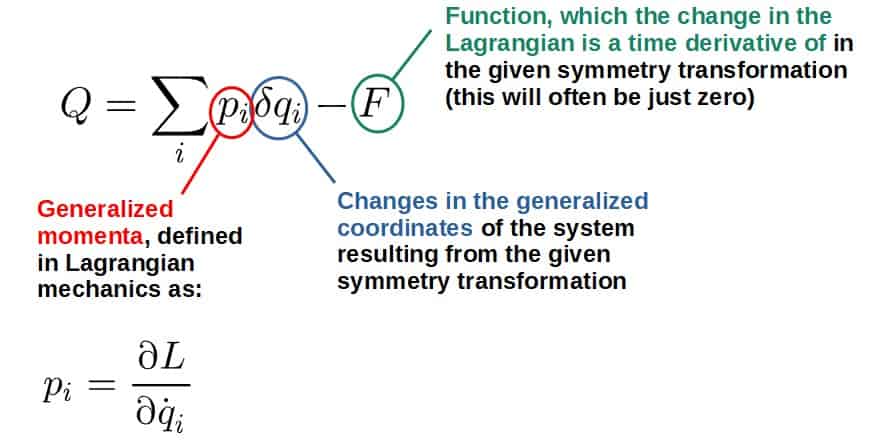
The video's derivation leads to a general expression for the conserved quantity, or Noether charge, . For an infinitesimal transformation of the coordinates that causes the Lagrangian to change by , the conserved charge is:
Here, is the small parameter of the continuous transformation. Let's break this down:
- is the generalized momentum conjugate to the coordinate .
- represents how the coordinate changes under the symmetry transformation.
- is the function whose total time derivative gives the change in the Lagrangian. In many simple cases, the Lagrangian is strictly invariant, making .
2. From Abstract Theorem to Physical Laws
The formula above is an engine for generating conservation laws. By plugging in the specific transformations for familiar symmetries, we can recover the conservation laws of classical mechanics. The same video provides excellent worked examples.
Symmetry in physics and Noether’s theorem
This segment applies the general theorem to derive the conservation of linear momentum, angular momentum, and energy.
Please watch from the application examples. For each case, notice how the specific form of the transformation (e.g., q \to q+\epsilon) determines the \delta q_i and G terms in the general formula.
Let's summarize these foundational results in a table. This pattern—a spacetime symmetry leading to a mechanical conservation law—is fundamental.
| Symmetry Transformation | What is Invariant? | G | Conserved Quantity (Noether Charge) | |
|---|---|---|---|---|
| Spatial Translation | Laws are location-independent | (Linear Momentum) | ||
| Rotation | Laws are orientation-independent | (for ) | (Angular Momentum) | |
| Time Translation | Laws are time-independent | (Energy/Hamiltonian) |
This last case, time translation, is particularly insightful. The change in the Lagrangian under an infinitesimal time shift is . This means , leading directly to the Hamiltonian as the conserved quantity associated with time-invariance.
3. Field Theory and Conserved Currents
As you are studying Quantum Field Theory, you know that the framework shifts from discrete coordinates to fields . In this context, Noether's theorem is even more powerful. A continuous symmetry implies the existence of a conserved current, a four-vector that satisfies the continuity equation:
This is a statement of local conservation. It says that the rate of change of the charge density within any given volume is precisely balanced by the flux of the current across the boundary of that volume. Integrating over all space gives the total conserved charge , which is constant in time.
The following video provides a clear derivation of the Noether current in the language of field theory, helpfully providing a "dictionary" to translate from the classical concepts we just discussed.
Deriving Noether's Theorem: How Symmetry Leads to Conservation. GAOMON PD1560 for Online Teaching!
This video by Andrew Dotson derives the Noether current using field theory formalism.
Please watch the main derivation from the start of the formal derivation to the emergence of the continuity equation. The key steps to focus on are: Writing the variation of the action \delta S with respect to the symmetry parameter. Using the chain rule to expand the variation of the Lagrangian density \mathcal{L}. Integrating by parts to move the spacetime derivative. Imposing the Euler-Lagrange equations, which causes most terms to vanish, leaving only a total divergence.
The derivation shows that if a transformation is a symmetry under which the Lagrangian density changes by , then the conserved Noether current is:
This is the field-theoretic analogue of the classical formula. The most common case is when the Lagrangian density is strictly invariant, so .
4. Key Applications in Field Theory
Let's use this powerful result to derive two cornerstone results in field theory. We will use a set of QFT lecture notes to guide us.
A. U(1) Symmetry and Conserved Charge
First, consider a complex scalar field with the Lagrangian . As we saw in the last lesson, this has a continuous global U(1) symmetry: . For an infinitesimal transformation, and . The Lagrangian is strictly invariant, so . We can now construct the current.
Quantum Field Theory Lecture Notes
This excerpt from a QFT course by T. Anous, T. Hartman, and D. van der Woude provides a clear derivation of the U(1) current.
Please read the sections 3.3.1 Example: a complex scalar field to see the setup, and then read the derivation of the current. You can follow the general proof in 3.3.2 Proof of Noether's theorem or use the shortcut formula derived in section 3.3.3. The result is the conserved current: the explicit expression.
The resulting current, , is proportional to the 4-current you know from quantum mechanics. The associated conserved charge can be interpreted as particle number or electric charge.
B. Spacetime Translations and the Energy-Momentum Tensor
Next, let's consider the symmetry of spacetime translation, , where is a set of four constant infinitesimal parameters. Under this transformation, a field transforms as , so . The Lagrangian density transforms as . We can write this change as a total derivative: , which means . Plugging these into the master formula for the current gives a set of four conserved currents, one for each value of , which we group into a single object: the energy-momentum tensor .
This text by M. Spannowsky provides a concise derivation of this fundamental object.
Please read the section "The Energy-Momentum Tensor". The key result is the expression for the tensor: the tensor definition.
The derived energy-momentum tensor is:
The components of this tensor have direct physical meaning.
- is the energy density, which is the Hamiltonian density . Its integral is the total energy.
- is the momentum density in the -th direction. Its integral is the total momentum .
- is the energy flux in the -th direction.
- is the flux of -momentum in the -th direction, related to pressure and shear stress.
The conservation law expresses the local conservation of energy () and momentum () in a fully relativistic framework.
Conclusion
Today, we have seen how Noether's theorem provides a constructive and profound link between the symmetries of a system and its conservation laws. This is a cornerstone of the theoretical physicist's toolkit, allowing us to deduce fundamental physical principles directly from the mathematical structure of a theory's Lagrangian.
Key Takeaways:
- Noether's theorem states that every continuous symmetry of the action implies a corresponding conserved quantity.
- The invariance of the action is a less strict condition than the invariance of the Lagrangian; the Lagrangian can change by a total derivative.
- In classical mechanics, symmetries lead to conserved charges like energy and momentum, which you can derive using the formula .
- In field theory, symmetries lead to locally conserved currents satisfying . The spatial integral of the component gives the globally conserved charge.
- We applied this framework to derive the conserved U(1) charge for a complex scalar field and the conserved energy-momentum tensor from spacetime translation invariance.
We have focused on the consequences of continuous symmetries. In our next lesson, we will broaden our scope to see how all symmetries, both continuous and discrete, can be used to derive powerful selection rules that determine which physical processes and transitions are allowed or forbidden.