Hello! In our previous lesson, we established a systematic procedure, the Buckingham theorem, for reducing the complexity of a physical problem by identifying its fundamental dimensionless parameters. This is a powerful tool when you have a good grasp of the relevant variables. But what if you're faced with a problem where the variables are uncertain, or you simply need a quick, back-of-the-envelope answer to gauge the plausibility of an idea?
This lesson delves into the art of estimation, a skill that is absolutely central to the craft of a theoretical physicist. We'll move from the formal algorithm of the theorem to more heuristic, but equally powerful, methods. Your goal is to learn how to estimate the order of magnitude of physical quantities using two key techniques: Fermi problems and scaling arguments. This will equip you to quickly break down complex questions, develop a "feel" for the numbers that govern a system, and check whether a detailed calculation is even worth pursuing.
1. The Philosophy of "Street-Fighting" Physics
Before we dive into techniques, it's crucial to adopt the right mindset. In theoretical physics, precision is not always the primary goal. The initial, and often most important, step is to grasp the essential physics by knowing what details to ignore. This approach, which emphasizes intuition and clever approximation over brute-force calculation, is a hallmark of effective theoretical work.
Let's begin by watching a discussion with Sanjoy Mahajan, a physicist and educator at MIT, who is a prominent advocate for this "street-fighting" approach to mathematics and physics.
Natural Mathematics: Intuition and Insight
This video, "Natural Mathematics: Intuition and Insight," introduces the philosophy of using approximation and intuition as primary problem-solving tools.
Please watch the following segments to understand the value of moving beyond pure formalism: First, watch from "a big fat lie" to understand the limitations of a purely formal education. Mahajan argues that by only showing finished proofs, we fail to teach the creative process of building understanding. Next, watch the segment from "fear of math". This section discusses how the demand for a single, precise answer can create an "intellectual defensiveness" that hinders the flexible thinking required for novel problems. Your goal is to cultivate this flexibility. Now, jump to the discussion on comparison. This highlights the first key idea of estimation: numbers are meaningless in isolation. Making friends with numbers by comparing them is the first step to developing physical intuition. Finally, watch from "throw away information". This covers the second key idea: after giving numbers meaning, you must learn to approximate by discarding unnecessary detail to avoid being overwhelmed. Notice the proposal to invert the traditional process: start rough, and only add accuracy as needed.
2. Fermi Problems: The Art of Guesstimation
The first technique, named after the physicist Enrico Fermi, involves answering seemingly impossible questions by breaking them down into a chain of smaller, more easily estimated quantities. Fermi was legendary for his ability to get surprisingly accurate answers with very little data.
The video below provides an excellent introduction and a step-by-step guide to solving Fermi problems.
One Weird Math Trick Estimates ANYTHING (Fermi problems)
The video "One Weird Math Trick Estimates ANYTHING (Fermi problems)" by Kyle Hill will walk you through the methodology.
Please watch the following parts: The introduction presents the classic story of Fermi estimating the Trinity test's yield with just scraps of paper. The section on dimensional analysis shows how basic unit conversion forms the backbone of these estimates. The five-step process is clearly explained with the example of estimating the total length of one's hair. Pay close attention to the principle that over- and underestimates tend to cancel out. Finally, watch the more complex example of estimating the great white shark population. This demonstrates how to chain together multiple probabilistic guesses to arrive at a reasonable final number.
The core of the Fermi method is a five-step process:
- Identify and Break Down the Problem: What pieces of information do you need?
- Dare to Be Imprecise: Make educated guesses for each piece. Don't worry about getting them perfect. The power of the method lies in the cancellation of errors.
- Bound the Problem: Use what you know to set upper and lower limits on your guesses. Is it closer to 10, 100, or 1000? This is often all the precision you need.
- Do the Math: Multiply and divide your estimates. Keep track of your units.
- Perform a Sanity Check: Does the final answer seem plausible in the context of what you know about the world?
Your Turn: A Fermi Problem
Let's apply this to a domain relevant to your studies. Given your work in astrophysics and condensed matter, let's try this:
Estimate the total energy (in Joules) released by all core-collapse supernovae in the Milky Way galaxy over a typical human lifespan (say, 80 years).
Try to break this down before looking at the suggested decomposition below.
Click here for a suggested breakdown
You might structure your estimate as a product of several factors:
To get the number of supernovae, you could estimate:
- Number of stars in the Milky Way.
- Fraction of these stars massive enough to go supernova.
- Average lifetime of such a massive star.
You likely have a rough idea of these numbers from your astrophysics course. Remember to bound your estimates and trust the process. An answer within one or two orders of magnitude of the accepted value is a success.
3. Scaling Arguments: How Things Change
Fermi problems are excellent for estimating static quantities. But much of physics is concerned with dynamics—how one quantity changes in response to another. This is the domain of scaling laws. A scaling argument describes a relationship of the form , where the core of the analysis is determining the scaling exponent, .
Geometric Scaling
The most intuitive scaling laws are geometric. We know that if we scale up the length of an object, its surface area and volume scale differently.
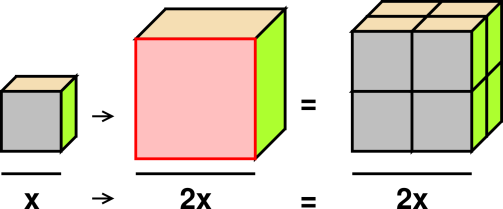
This square-cube law is fundamental. As you can see in the image of scaling squares, it's a general property of dimensionality, not a specific property of the object's shape.
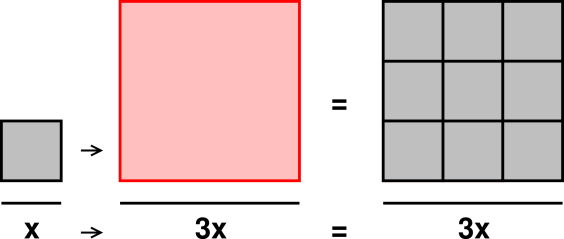
The resource below provides a good introduction to these basic ideas and lists many fascinating examples of physical scaling laws.
This article from Av8n.com gives a clear, visual introduction to scaling and provides a long list of examples.
First, read sections 1.1 and 1.2 for a quick, visual reinforcement of how area and volume scale with length. Then, browse the list in Section 8. You don't need to study them all, but notice the patterns. Pay particular attention to: Item 8: Period of a simple pendulum. Item 10: Free-fall distance vs. time. Item 14: Diffusion distance vs. time. This is particularly relevant in condensed matter systems. Item 34: Terminal velocity.
Physical Scaling and Successive Approximation
Scaling arguments become truly powerful when we apply them to physical laws. Often, a rough estimate can be systematically improved by accounting for smaller effects—a method known as successive approximation. This involves identifying the "big part" of a problem, solving that simplified version, and then using that solution to calculate a first correction.
The book Street-Fighting Mathematics by Sanjoy Mahajan is the definitive guide to these techniques. Let's work through one of its classic examples.
[PDF] Street-Fighting Mathematics
Chapter 5 of this book is dedicated to the method of "taking out the big part," or successive approximation.
Please read the section "How deep is the well?". This problem is a masterful demonstration of the iterative refinement process. Follow the logic: Zeroth Approximation (h_0): The "big part" of the time is the rock falling. Assume the speed of sound is infinite and calculate the depth. First Approximation (h_1): Use h_0 to estimate the time it took the sound to travel. Subtract this from the total time to get a better estimate of the fall time. Recalculate the depth. Notice how this process gives you both a good answer and a physical intuition for which effects are dominant. You are also able to determine whether your estimate is an over- or underestimate at each step.
Another powerful tool for approximation, especially for analyzing how a system responds to small changes, is the fractional change approximation. For any power-law relationship , a small fractional change in produces a fractional change in given by:
This is simply the first-order term of a Taylor expansion, but it's an incredibly useful rule of thumb.
[PDF] Street-Fighting Mathematics
This text explains the fractional change approximation with clear examples.
Read the introduction to this section to see how fractional changes provide a cleaner way to handle corrections than absolute changes. Then, read the subsection on squaring, which applies this rule to the case n=2 to estimate changes in energy consumption with speed. Finally, read the subsections 5.3.1 on mental division (n=-1) and 5.3.2 on square roots (n=1/2) to see the versatility of this method.
These techniques—Fermi problems, scaling laws, and successive approximation—are not just tricks. They represent a way of thinking that prioritizes physical insight, allowing you to build a conceptual model of a system before getting lost in formal calculations.
Conclusion
In this lesson, we have moved from the formal world of dimensional analysis into the more intuitive and often more practical realm of order-of-magnitude estimation. You've learned how to develop a "feel for the numbers" that govern physical systems, a critical skill for any theorist sizing up a new problem.
Key Takeaways:
- Order-of-magnitude estimation is about knowing what to ignore and focusing on the "big part" of a problem to gain rapid physical insight.
- Fermi Problems allow you to estimate seemingly unknowable quantities by breaking them down into a chain of simpler, guessable parts, relying on the cancellation of errors.
- Scaling Arguments describe how a quantity changes as another quantity changes, typically as a power law . This is fundamental to understanding how systems behave across different scales.
- Successive Approximation is an iterative method to refine an initial estimate. By solving a simplified version of a problem first and then using that solution to calculate corrections, you can converge on an accurate answer while maintaining physical clarity.
- The fractional change approximation, , is a powerful linearization tool for analyzing the effect of small perturbations in any power-law system.
We have now seen how to systematically find dimensionless groups and how to use them, along with other heuristic methods, to estimate and scale physical quantities. In our next lesson, we will explore how to extract scaling exponents from data or theoretical models, a crucial step in identifying universal behaviors and classifying physical systems into universality classes.