Welcome to the first lesson in your advanced IELTS preparation course. Your goal of moving from a Band 7 to an 8.5 is ambitious but achievable, especially with your concentrated study schedule. This module, "Advanced Grammar and Syntax," is designed to bridge that gap by refining the grammatical control that examiners look for at the highest levels.
Today, we will begin by addressing the learning outcome: Rectifying common grammatical errors typical of Band 7 writing, specifically tense consistency, article usage, and preposition choice. At a Band 7 level, you already possess a good command of grammar. Progress now comes not from learning entirely new, complex structures, but from eliminating the small, persistent errors that prevent your writing from being assessed as "mostly error-free"—a key descriptor for Band 8 and above. We will focus on identifying and correcting these specific errors to enhance your accuracy and clarity.
The Hurdle Between Band 7 and 8: The Impact of Small Errors
In IELTS writing and speaking, your grammar is evaluated based on Grammatical Range and Accuracy. While range (the variety of sentence structures you use) is important, accuracy is what often separates a Band 7 from a Band 8. Candidates at the Band 7 level can produce complex sentences, but they may have occasional errors that, while not impeding communication, detract from the overall quality.
To understand what this means in practice, please read the following sections from the "IELTS Grammar Guide" by Learn English Weekly.
IELTS Grammar Guide | Accuracy, Range & Band 7+ Control
This guide provides an excellent overview of how grammar is assessed in the IELTS. It explains why small, repeated mistakes are often the primary reason candidates get stuck at a particular band score.
Please read the introduction, How Grammar Is Assessed, focusing on the definitions of Grammatical Range and Accuracy. Then, continue to the section Why Candidates Lose Marks, paying close attention to the list of common problems, which includes the three areas we are focusing on today.
As the article points out, issues with articles (a, an, the), prepositions (in, on, at), and tense consistency are frequent culprits that cap scores. These are often "fossilized errors"—mistakes we've made for so long that we no longer notice them.
To see how subtle corrections can elevate a sentence, let's examine a comparison.
IELTS Grammar Guide | Accuracy, Range & Band 7+ Control
This example clearly illustrates the difference that accuracy makes.
Read the short section Band 6 vs. Band 7. Notice how correcting just two small errors—one article and one subject-verb agreement—and using slightly more precise vocabulary transforms the sentence's quality.
The key insight is that small errors add up. An examiner might forgive one or two, but when they appear consistently throughout an essay, they create an impression of carelessness or lack of full control. This is what we need to tackle. A senior IELTS examiner explains this principle well in the following video.
Your Band 6 Essay Could Be Band 8- Here's How
In this clip from his essay analysis, the speaker from IELTS Advantage discusses how an examiner perceives an essay with frequent minor errors in vocabulary and grammar.
Please watch the segment from 21:32 to 22:22. The core message here is about the cumulative effect of small mistakes on your final grammar and vocabulary scores.
Deep Dive 1: Tense Consistency
One of the most critical elements for coherence is maintaining consistent verb tenses. Unnecessary shifts in tense can confuse the reader about the timeline of events and ideas. However, advanced writing sometimes requires intentional tense shifts to reflect changes in time or perspective. Mastering this balance is a hallmark of a Band 8+ writer.
The following video provides a comprehensive guide to verb tense consistency.
Verb Tense Consistency in English with Examples (A COMMON Writing Error)
This video from Sparkle English clearly explains the concept of tense consistency, shows when shifts are appropriate, and includes a practical exercise.
First, watch the explanation of what tense consistency is and how to identify inconsistent tenses, from 00:06 to 03:18. Next, watch the important section on appropriate tense shifts from 05:49 to 07:35. This explains how to correctly shift tenses to discuss different time frames within a single idea. Finally, engage with the quiz. Pause the video after the paragraph is read, try to correct it yourself, and then play the rest of the clip to see the step-by-step corrections. This is excellent practice.
Deep Dive 2: Articles and Prepositions
Articles and prepositions are arguably the most common sources of error for even advanced learners because their usage is highly idiomatic and context-dependent.
Articles (a/an, the, zero article)
Incorrect article usage can fundamentally change the meaning of a noun, shifting it from general to specific or vice versa. Getting this right consistently is crucial.
Let's review the core rules with a focused resource.
IELTS® Writing: Grammar Rules -
This resource provides a concise summary of rules for definite, indefinite, and zero articles.
Please read Rule 4: Definite and Indefinite Articles. Pay attention to the examples showing when to use a(n) vs. no article for general statements (singular vs. plural) and when to use the for specific items or superlatives.
A common mistake is using the with plural nouns when making a general statement (e.g., "The governments should invest in education"). Remember, for generalisations, use the plural noun with no article.
Prepositions (in, on, at, for, of, etc.)
Preposition errors, while small, can make sentences sound unnatural and disrupt fluency. Look at the example below, which shows how a series of small preposition mistakes can make a paragraph feel awkward and difficult to read.
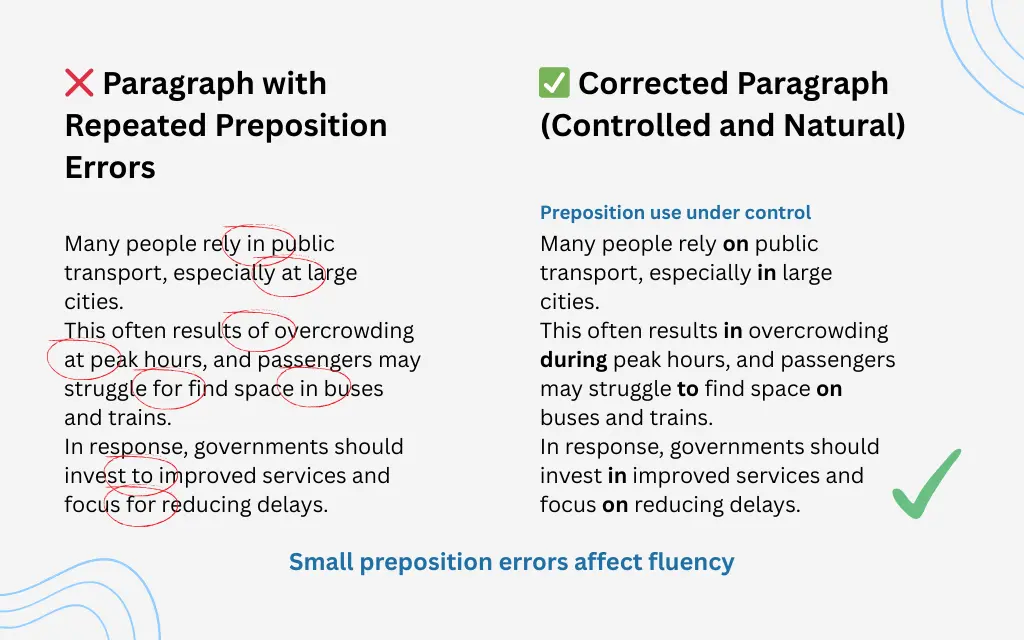
Mastering prepositions largely comes down to learning collocations (words that naturally go together) and fixed phrases. While it's impossible to memorize every combination, being aware of common errors is a great start.
A Strategy for Improvement
The most effective way to eliminate these errors is through systematic self-correction. When you write practice essays, don't just move on to the next one. Instead:
- Diagnose: Actively look for your own patterns of error. Do you consistently misuse
the? Do you struggle with prepositions of time likein,on, andat? - Focus: Target one error category at a time. For one week, make it your mission to double-check every single article in your writing. The next week, focus only on verb tenses.
- Revise: Don't just identify the mistake. Rewrite the entire sentence correctly. This builds muscle memory. Keep an error log to track recurring issues.
Use the quick self-assessment questions from the "IELTS Grammar Guide" (in the section "Quick Grammar Self-Assessment: Are You Band 7 Ready?") before and after writing to keep these points top of mind.
Conclusion
In this lesson, we have established the importance of grammatical accuracy for achieving a high band score in IELTS writing. We've seen that progress from Band 7 to 8.5 often hinges on eliminating small, recurring errors rather than deploying overly complex grammar.
Key Takeaways:
- Accuracy is paramount: To score above Band 7, your writing must be "frequently error-free."
- Focus on the culprits: The most common errors that limit scores are related to tense consistency, article usage, and preposition choice.
- Master tense control: Understand not only how to maintain a consistent tense but also when and how to shift tenses appropriately to convey complex timelines.
- Systematic practice works: The most reliable path to improvement is to diagnose your personal error patterns, focus on correcting one type at a time, and actively revise your work.
In our next lesson, we will build upon this foundation of accuracy. We will explore how to add emphasis and stylistic variety to your writing by using cleft structures (e.g., 'It was X that...', 'What is important is...'). This will help you enhance your grammatical range while maintaining the control we've discussed today.