Welcome to the final lesson in our module on the foundations of cold calling. So far, you've learned how to interrupt a prospect's pattern, craft a value proposition, engage them with questions, and navigate past gatekeepers to reach the decision-maker. But what happens when you finally get the right person on the line, and they immediately say, "I'm not interested"?
This is a make-or-break moment in a cold call. How you respond determines whether the conversation ends abruptly or pivots into a future opportunity. Today, our goal is to help you master that pivot. We will focus on how to recognize signs of disinterest and pivot to a micro-commitment, such as scheduling a brief follow-up. This skill is the bridge between a potential rejection and your follow-up system, turning a "no for now" into a "maybe later."
Decoding Disinterest: What "I'm Not Interested" Really Means
First, it's crucial to understand that "I'm not interested" is rarely a final, well-reasoned judgment of your offer. More often than not, it's a knee-jerk reaction—a polite (or not-so-polite) way of saying, "I'm busy, and you're an interruption." Your experience in DM setting has likely shown you that initial resistance is common; the key is how you handle it. On a live call, the response needs to be immediate and graceful.
To understand why this objection isn't the dead end it seems, let's explore its underlying causes.
How to Handle “Not Interested” on a Cold Call (Scripts & Examples) | Juno School
This article from Juno School does an excellent job of reframing this common objection.
Please read the first section, Why It Isn't a Dead End. Focus on the idea that this phrase is often an initial filter, not a final verdict.
As the article points out, the worst thing you can do is push harder or sound desperate. This confirms the prospect's assumption that you're just another pushy salesperson. Instead, you need a strategy that disarms them and changes the dynamic of the conversation.
The Acknowledge & Pivot Strategy
The most effective method for handling disinterest is a two-step technique: first, you acknowledge and validate their position, and second, you pivot the conversation in a new, low-pressure direction. This shows you respect their time and makes them more receptive to what you say next.
This approach is summarized well in this framework from an article by Syrenn.
How to Handle "Not Interested" Sales Objections - Syrenn
This article provides a strategic framework for turning objections into opportunities.
Read the section titled The Strategic Framework. Pay attention to the three steps: Listen and Acknowledge, Probe and Explore, and Respond and Reframe. This is the underlying psychology of the 'Acknowledge & Pivot' technique.
Let's break this down:
- Acknowledge: When a prospect says they're not interested, your first words should be empathetic. Use phrases like: "I understand," "That's fair," or "I appreciate your honesty." This immediately lowers their guard.
- Pivot with Curiosity: Instead of defending your pitch, ask a question to uncover the real reason for their dismissal. This is where you pivot from being a seller to being a curious conversationalist.
In this video, sales trainer Trent Dressel uses a simple analogy to explain the power of asking "why not?"
3 ways to overcome “I’m not interested…” | Cold Call Objection Handling
This video offers three practical ways to overcome the "I'm not interested" objection.
Watch the first strategy explained from this segment. Notice how asking "why?" in a curious, non-confrontational way can uncover the root objection, just like finding out your friend is on a diet when they refuse pizza.
By asking questions like "Is it the timing, or have I just caught you at a bad moment?" or "Out of curiosity, what about this doesn't seem like a fit for you?", you can turn a reflexive "no" into a real conversation.
The Goal: Securing a Micro-Commitment
Sometimes, despite your best efforts, the prospect is genuinely too busy or the timing is truly wrong. In these cases, your goal shouldn't be to force a sale or even a full discovery call. Instead, you pivot to a micro-commitment.
A micro-commitment is a small, low-friction agreement that keeps the door open for future interaction. It lowers the psychological barrier for the prospect because you're asking for something minimal.
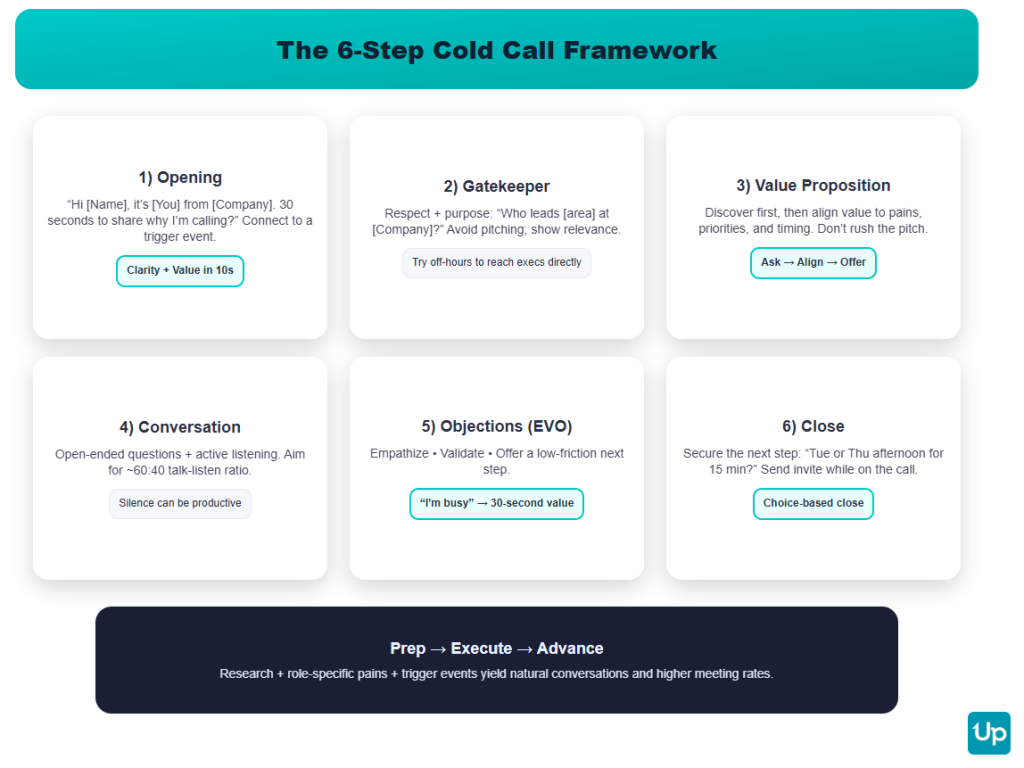
Examples of micro-commitments include:
- Asking to send a single valuable resource (not a generic brochure).
- Scheduling a brief, 15-minute introductory call for the following week.
- Getting permission to follow up in a specific timeframe (e.g., "next quarter").
The "Graceful Exit" script is a perfect example of pivoting to a micro-commitment.
How to Handle “Not Interested” on a Cold Call (Scripts & Examples) | Juno School
This article provides three excellent scripts. We'll focus on the third one for now, but all are valuable.
In the section "3 Ready-to-Use Scripts," read The Graceful Exit. This script perfectly demonstrates how to respect the prospect's "no" while securing permission for a small next step (sending an email). Also, review the other two scripts, "The Feedback Angle" and "The 'Just One Thing' Question," as they provide alternative ways to pivot.
From Disinterest to Discovery: A Masterclass
Now let's see how a master salesperson transitions a prospect from initial contact to a scheduled appointment by using these principles. Even when there isn't outright disinterest, the technique of disarming the prospect and asking for small, sequential steps is the same.
In this video, watch how sales expert Jeremy Miner coaches a salesperson to set a follow-up call.
Effective Cold Calling Techniques for Minimizing Sales Resistance
This video from Jeremy Miner demonstrates advanced cold calling techniques. We will focus on the transition to setting an appointment.
Watch the section from this point. Pay close attention to how the caller disarms the prospect by acknowledging there's a chance they can't help. He then asks for a small commitment (sending a statement for analysis) before asking for a bigger one (booking a meeting). This sequence is key to getting the prospect to agree to the next step.
The key here is that the request is framed as a low-risk, logical next step that benefits the prospect. This is far more effective than simply asking for "15 minutes of their time."
Finally, remember that sometimes, the best strategy is to concede gracefully. If a prospect is adamant, don't keep pushing until they hang up on you. A polite exit ("I understand, thanks for your time.") leaves a professional impression and allows you to try again in 6-12 months.
Conclusion
Handling disinterest is one of the most important skills in phone setting. It allows you to salvage calls that might otherwise be lost, build your pipeline, and maintain a professional reputation.
Key Takeaways:
- "I'm not interested" is a reflex, not a rejection. Your first goal is to understand the real reason behind it.
- Use the Acknowledge & Pivot strategy. Validate their feelings, then ask curious questions to open up the conversation.
- When you can't advance, pivot to a micro-commitment. Secure a small, low-friction next step, like sending a resource or scheduling a brief future call.
- Your tone is crucial. Maintain a calm, confident, and empathetic tone to show you're a professional, not a desperate salesperson.
Successfully creating these follow-up opportunities is the first step. In our next module, we will build on this by designing a systematic way to manage those follow-ups. Our first lesson will be to define the principles of an effective multi-channel follow-up cadence.