Welcome back to our series on advanced combat positioning. In our previous lessons, you've mastered a legend-agnostic framework for evaluating and controlling space. You know how to identify high-ground advantages, use cover dynamically, and—most importantly—recognize the critical moment a position is compromised and requires a repositioning maneuver.
Today, we will build upon that foundation. The principles of good positioning are universal, but their application is highly specific to the tools at your disposal. This lesson focuses on adapting those core principles to your legend's class. You'll learn how a Skirmisher's approach to taking an off-angle differs from a Controller's method for locking down that same space. As a solo queue player, this ability to adapt your role based on your legend's strengths is what allows you to fill the gaps in an uncoordinated team and consistently create advantages that lead to RP gain.
1. Beyond Classes: Understanding Your Squad's "Jobs"
Before diving into specific classes, we need to shift our thinking. The official labels in Apex—Assault, Skirmisher, Recon, Controller, and Support—are useful categories, but they don't tell the whole story. A class describes a legend's general toolkit, but your role or job describes what you are actually trying to accomplish for your squad in any given moment.
This diagram provides a great overview of the general functions associated with each class.
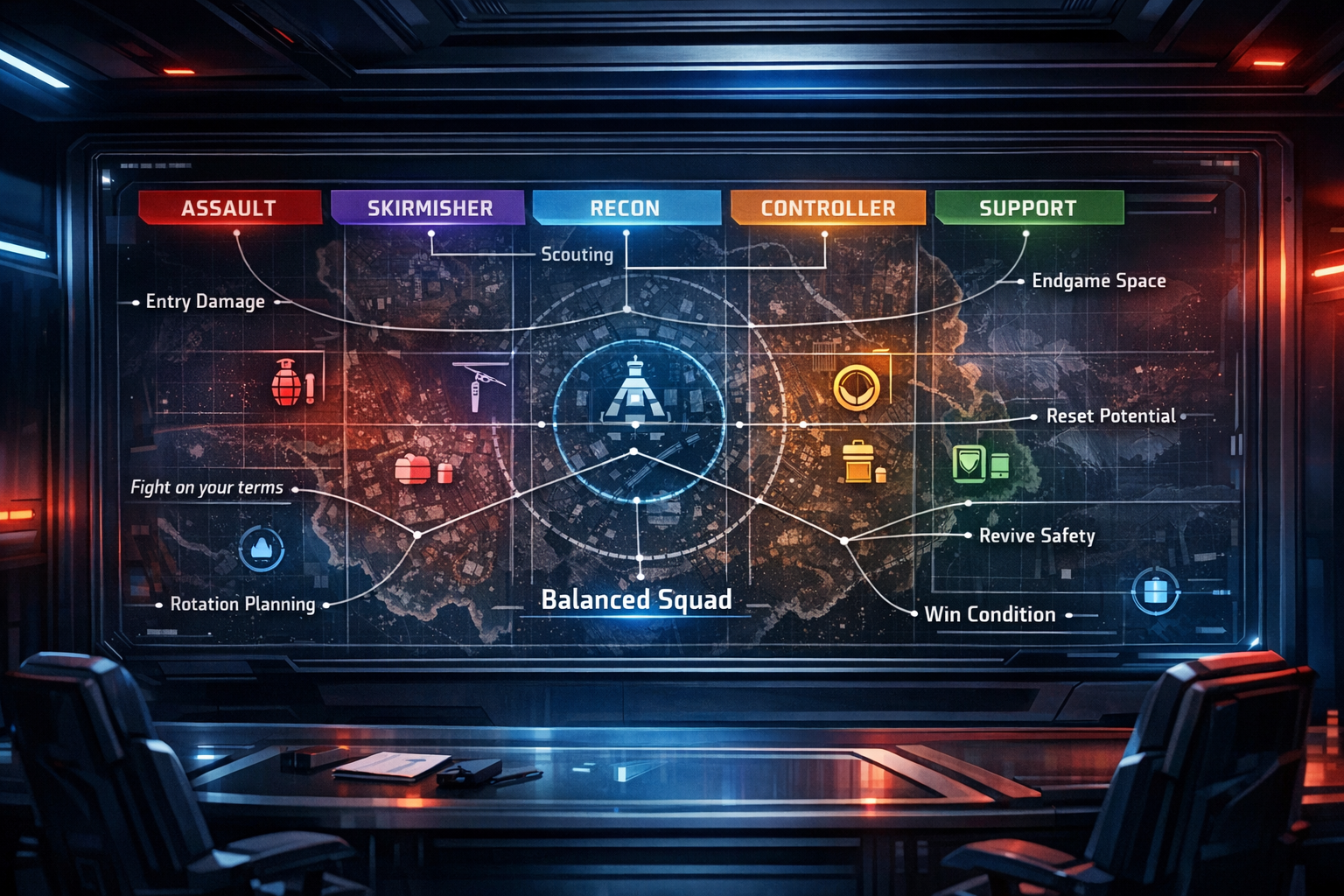
To go deeper, a highly effective way to think about team composition is to consider the five critical jobs that every successful squad needs to perform. As a solo player, you should quickly assess your random teammates' legends and identify which of these jobs are unfulfilled—that is often the role you will need to adopt.
Apex Legends Legend Roles & Synergy Guide for Balanced Squads
This guide from Boosteria provides an excellent breakdown of thinking in terms of functional roles rather than just class labels.
First, read the section Legend Roles vs. Official Classes to understand the distinction between a class and a role. Then, continue to the section The Five Jobs. As you read, mentally map your most played legends to these five jobs. Which ones are they best equipped to handle?
The five jobs—Information, Space Creation/Denial, Sustain/Reset, Rotation Safety, and Fight Conversion—form the strategic bedrock of your decision-making. Your positioning in a fight should be a direct reflection of the primary job your legend is designed to do.
2. Adapting Your Position to Your Role
Your legend's abilities are the tools that determine how you can apply the positioning principles we've discussed. A well-timed Wraith phase is a different kind of repositioning tool than a well-placed Caustic barrel, but both are used to gain an advantage.
The following video provides a concise overview of this core concept, explaining how different legend types should position themselves relative to their team and the enemy.
Why Your POSITIONING is TRASH - 3 EASY Tips That Will BLOW Your Mind - Apex Legends Guide
This clip from a GameLeap guide clearly explains the fundamental positioning philosophies for different legend archetypes.
Watch from the start of the section on specific legends. Pay close attention to the distinction between front-line, back-line, and off-angle positioning based on a legend's toolkit.
Let's break this down further, applying it to each of the major roles.
Skirmishers & Mobility Legends: The Angle Creators
- Primary Job: Space Creation, Rotation Safety.
- Positioning Philosophy: Your primary advantage is movement. You should constantly seek to establish new, unexpected angles of attack. Your goal is to force the enemy team to divide their attention, creating an opening for your teammates to exploit. You can take more aggressive, isolated positions because your abilities provide a reliable escape route.
- Execution:
- Horizon/Pathfinder: Your goal is verticality. Use your tactical abilities to take high ground that other legends can't reach. From there, you provide suppressing fire and create pressure. You are not just taking a "god spot"; you are creating a new axis of attack. (LINK, sections 4, 14)
- Wraith/Octane: Your goal is speed and surprise. Use your tactical abilities to take aggressive forward positions or wide flanks, knowing you can disengage if you draw too much pressure. Your ultimate abilities can then be used to either help your team collapse on the angle you've created or execute a larger-scale rotation. (LINK, sections 0, 8)
- Solo Queue Insight: In an uncoordinated team, you can act as the catalyst. By taking a smart off-angle and drawing fire, you create a window of opportunity that even random teammates will often recognize and act upon.
Controllers: The Space Deniers
- Primary Job: Space Denial, Rotation Safety, Endgame Control.
- Positioning Philosophy: You are an anchor. Your abilities transform neutral ground into hostile territory for the enemy. You should position yourself to secure critical chokepoints, buildings, and final-ring territory. Your power comes from preparation and foresight.
- Execution:
- Caustic/Wattson: You excel at fortifying enclosed spaces. Position yourself within a building or defensible position before the fight begins. Your traps serve as an early-warning system and a powerful deterrent, allowing your team to hold a power position against a superior force. (LINK, sections 6, 9)
- Catalyst: Your abilities allow you to create cover and deny sightlines in more open areas. Use your ultimate to split an enemy team, isolate a player, or provide a safe path for your team to cross dangerous open ground. (LINK, section 22)
- Solo Queue Insight: You provide stability. By locking down a building, you create a safe "home base" where your teammates can reliably fall back to heal and reset, a crucial element when you can't rely on voice comms for coordinated retreats.
Recon: The Information Brokers
- Primary Job: Information.
- Positioning Philosophy: Your goal is to gain intel without becoming a casualty. You typically play from a safe position, often slightly behind your team's most aggressive player. You use your abilities to scout ahead, identify threats, and determine the safest path or most opportune moment to strike.
- Execution:
- Bloodhound/Seer: You are the initiator's best friend. Position yourself to scan an area just before your team pushes, confirming enemy locations and preventing ambushes. During a fight, your scans help track enemies who are repositioning or attempting to heal. (LINK, sections 2, 17)
- Crypto: You are the ultimate back-line support. Your physical position should be extremely safe while you use your drone to scout, retrieve banners, or initiate with your EMP. The key is to position your body where you won't be surprised while you are gathering intel for your team. (LINK, section 10)
- Solo Queue Insight: You are the non-verbal shot-caller. A ping on a scanned enemy is a universal signal to focus fire. Scanning a survey beacon and pinging the next ring location provides your team with a clear macro objective without saying a word.
Support & Assault: The Enablers
- Primary Job: Sustain/Reset (Support), Fight Conversion (Assault).
- Positioning Philosophy: These classes are focused on directly influencing the flow of the fight through resources and pressure.
- Execution:
- Support (Lifeline/Newcastle): Your number one priority is staying alive to enable resets. You should always play the safest position, utilizing hard cover and staying in the backline. Your value is highest when a fight goes wrong. Position yourself so you can safely revive a downed teammate or deploy cover to stabilize a bad situation. (LINK, sections 1, 20)
- Assault (Bangalore/Mad Maggie): You are the tip of the spear. Your abilities are designed to break defensive setups and create chaos. Position yourself at the front of an engagement, ready to use your smoke to obscure sightlines for an advance or your drill to force an enemy out of a power position. (LINK, sections 5, 18)
- Solo Queue Insight: As a Support legend, you are the insurance policy for your teammates' aggressive plays. As an Assault legend, you can provide the decisive push or tool that your team needs to break a stalemate.
3. Exploiting Enemy Positioning Weaknesses
Understanding your own class-based positioning also gives you the key to unlocking the weaknesses in enemy compositions. Every legend's strength in one area implies a weakness in another.
Why PREDATORS EASILY WIN FIGHTS - PUNISH ENEMY TEAM COMPS - Apex Legends Guide
This GameLeap video explains how to identify and punish the inherent weaknesses in different team compositions.
Watch the segment from "when you know that a team is strong...". This explains the yin-and-yang nature of legend abilities: defensive legends are weak in the open, and offensive legends are weak at holding down a position.
By scouting an enemy team before you engage, you can tailor your attack to their weak points.
- Versus a Controller Team (Caustic/Wattson): If you catch them rotating in the open, far from a building they can fortify, you have a massive advantage. Use mobility to create multiple angles and overwhelm them before they can set up.
- Versus a Skirmisher Team (Wraith/Octane/Horizon): This team is designed for aggressive pushes, not for defense. If you can force them to defend a building, you can use grenades and controlled pushes to exploit their lack of holding power. They will be forced to use their mobility abilities defensively to escape, rather than offensively to engage.
This level of analysis—scouting the enemy, understanding their compositional weaknesses, and positioning your own squad to exploit them—is a hallmark of Predator-level decision-making.
Conclusion
You have now moved beyond the generic rules of positioning and into the realm of tactical adaptation. By understanding your legend's primary job within the team, you can tailor your use of cover, high ground, and repositioning to maximize your impact. For a solo queue player, this is not just an optimization—it is a survival strategy. It is how you provide value, lead by example, and turn the inherent chaos of playing with randoms into a consistent source of RP.
Key Takeaways:
- Think in terms of the five core jobs (Information, Space Creation/Denial, Sustain, Rotation, Conversion) rather than just class labels.
- Your legend's toolkit dictates your positioning philosophy. Skirmishers create angles, Controllers deny space, Recon legends gather intel from safety, and Support/Assault legends enable resets and apply pressure.
- Adapt your positioning to fill the gaps in your random team's composition.
- Use this same knowledge to identify and punish the weaknesses in enemy team compositions.
Preview of the Next Lesson:
We've explored the "why" and "where" of class-based positioning. In our next lesson, we will get even more granular and focus on the "how." We will analyze specific, high-impact abilities like Bangalore's Smoke, Gibraltar's Dome of Protection, and Catalyst's Dark Veil, breaking down the micro-positioning and advanced techniques required to use them to create, deny, and manipulate sightlines and control the entire combat space.