Hello! In our last lesson, we explored the lifecycle of a thread, tracing its journey through states like ready, running, and blocked. We saw how synchronization primitives cause transitions between these states, which are managed by the operating system. This raises a fundamental question: who is responsible for managing the threads themselves? Is it the application or the operating system kernel?
The answer to this question introduces a crucial distinction in thread implementation. This lesson will compare user-level threads and kernel-level threads. You will learn how each type is managed, what their primary advantages and disadvantages are, and how they ultimately interact to execute on a CPU. Understanding this architectural trade-off is essential for grasping the performance implications of concurrent programming and for making sense of how different threading libraries and language runtimes operate.
The Two Arenas: User Space and Kernel Space
At the heart of this topic is the separation between user space, where your applications run, and kernel space, where the core of the operating system resides. A thread's identity and behavior are defined by which of these two spaces is responsible for managing it.
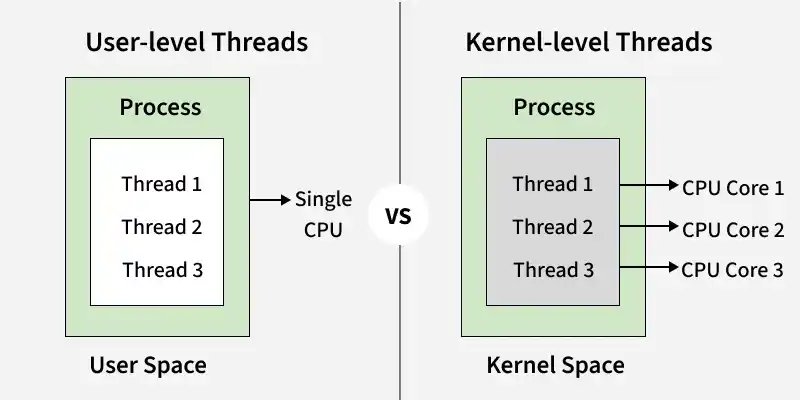
- User-Level Threads (ULTs) are managed entirely by a runtime library in user space. The kernel is unaware of their existence; it only sees the single process (or a single kernel thread) that contains them.
- Kernel-Level Threads (KLTs) are managed directly by the operating system. The kernel is aware of every KLT and schedules them individually.
Let's explore the characteristics and trade-offs of each approach.
User-Level Threads: Fast and Flexible
Since user-level threads are managed by a library without kernel intervention, operations like creation, destruction, and context switching are incredibly fast. A context switch between ULTs within the same process doesn't require a costly trap into kernel mode; it's as simple as saving the CPU registers to one thread's context structure and loading them from another's.
However, this abstraction from the kernel comes with significant drawbacks.
The following reading from StudyRaid provides a concise overview of user-level threads.
Understand user-Level vs. Kernel-Level Threads
This first section defines user-level threads and clearly outlines their key advantages and limitations.
Read the section on user-level threads. As you read, focus on the two main limitations: what happens when a thread makes a blocking system call, and why ULTs cannot achieve true parallelism on a multi-core system.
As you've just read, the two major weaknesses of ULTs are:
- Blocking System Calls: If any single user-level thread performs a blocking I/O operation, the kernel, which is unaware of the other threads, blocks the entire process. All other ULTs within that process are stalled, even if they were ready to run.
- No Multi-core Parallelism: Because the kernel only schedules the process as a single unit, all ULTs within it must share time on a single CPU core. They cannot run in parallel on a multi-core architecture.
Kernel-Level Threads: Powerful and Parallel
Kernel-level threads are the OS's native model of execution. Each KLT is a schedulable entity that the kernel manages directly. This solves the primary problems of user-level threads.
Let's continue with the same StudyRaid article.
Understand user-Level vs. Kernel-Level Threads
This section defines kernel-level threads and contrasts them with the user-level model you just read about.
Now, read the section on kernel-level threads. Pay attention to how KLTs specifically address the blocking and parallelism issues of ULTs.
With KLTs:
- Robust Blocking: If one KLT blocks on an I/O call, the kernel can simply schedule another KLT from the same process to run on a CPU core. The process as a whole does not stall.
- True Parallelism: The kernel can dispatch multiple KLTs from the same process to run concurrently on different CPU cores, achieving true hardware parallelism.
The main disadvantage is performance overhead. Every thread management operation (creation, switching) requires a system call and a transition into kernel mode, which is significantly slower than a user-space function call.
The following video offers a very clear and direct comparison of these critical points.
L-1.12: User Level Vs Kernel Level Thread in Operating System | All Imp Points
This video from Gate Smashers is excellent at summarizing the core differences you'll often encounter in OS courses and technical interviews.
Watch the following segments: The introduction, which covers the difference in management and creation speed. The explanation of context switching speed. The most critical part, the discussion of blocking operations, which clearly explains why a blocking ULT stalls the entire process.
This image provides a great visual summary of the architectural difference.
Connecting the Two: Threading Models
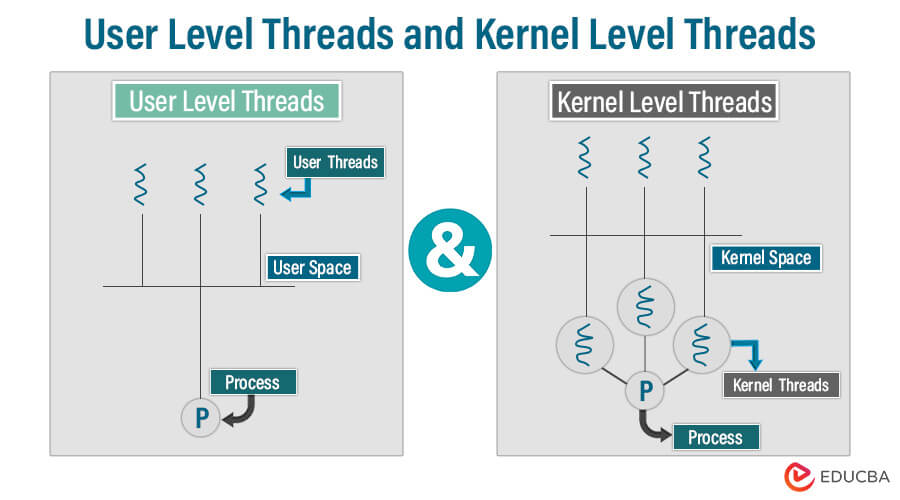
In practice, user-level threads must ultimately run on a kernel-level thread to be executed by a CPU. The strategy for mapping ULTs to KLTs defines the threading model of a system. There are three main models.
This next video explains these models clearly.
Multithreading Models & Hyperthreading
This Neso Academy video provides a great walkthrough of the three primary multithreading models.
Watch the explanations for each of the three models: The Many-to-One Model The One-to-One Model The Many-to-Many Model
Let's solidify those concepts with a quick reading that defines each model.
Understand user-Level vs. Kernel-Level Threads
This section provides text definitions for the three models you just saw in the video.
Read the section on mapping models. This will reinforce your understanding of Many-to-One, One-to-One, and Many-to-Many.
To summarize:
- Many-to-One: Maps many ULTs to a single KLT. This is the model that suffers from the blocking and parallelism problems we discussed. It's efficient for thread switching but not robust.
- One-to-One: Maps each ULT directly to a dedicated KLT. This is the model used by most modern general-purpose operating systems, including Linux, Windows, and macOS. It provides true parallelism and solves the blocking problem, at the cost of higher overhead for thread creation. The POSIX Threads (pthreads) library you'll use soon typically uses this model.
- Many-to-Many (M:N): Multiplexes a larger number of ULTs onto a smaller or equal number of KLTs. This hybrid model attempts to balance the benefits of both worlds: lightweight user threads and true kernel concurrency. It's more complex to implement and manage. While less common in OS kernels today, this model is seeing a renaissance in programming language runtimes like Go (goroutines) and Rust (async runtimes like Tokio).
A Look Under the Hood
Given your interest in how things are implemented, it's worth briefly touching on how a user-level thread library is built. You don't need to memorize this, but it provides valuable context.
Libraries for ULTs need to handle context switching themselves. On Unix-like systems, this was historically done using functions like getcontext(), setcontext(), and makecontext(), which allow a program to save and restore the execution context (CPU registers, stack pointer, instruction pointer). A user-level scheduler, often triggered by a timer signal (SIGPROF), would save the context of the currently running ULT, pick the next one from a queue, and restore its context to resume its execution.
The following article describes building such a library. You don't need to read it in depth, but looking at a few key parts can be enlightening.
A (Bare-Bones) User-Level Thread Library
This article provides a fascinating look at the internal mechanics of a user-level threading library. We will just skim it to understand the core components.
Read the short section Kernel Level vs. User Level for a quick recap. Skim the section What Makes a Thread. Note the mention of the ucontext_t structure, which is the key data structure for saving a thread's state. Finally, skim the section Setting an Alarm. This explains how a timer and a signal handler (SIGPROF) can be used to implement a simple preemptive scheduler entirely in user space. This is a powerful demonstration of OS concepts in action.
This hands-on perspective shows that user-level threading isn't magic; it's a clever piece of engineering that reimplements a scheduler and context-switching mechanism outside the kernel.
Key Takeaways and Trade-offs
The choice between user-level and kernel-level threads is a classic engineering trade-off between performance and power.
| Feature | User-Level Threads | Kernel-Level Threads |
|---|---|---|
| Management | By a user-space library | By the OS kernel |
| Creation & Switching | Very fast (procedure call) | Slow (system call) |
| Parallelism | None (run on one core) | True parallelism (run on multiple cores) |
| Blocking Call | Blocks the entire process | Blocks only the calling thread |
| Typical Model | Many-to-One | One-to-One |
In summary:
- User-level threads offer low overhead and high-speed context switching, making them suitable for applications that need to manage thousands of concurrent tasks that are not CPU-bound and do not make frequent blocking calls.
- Kernel-level threads provide robust support for parallelism and blocking operations, making them the standard for general-purpose concurrent programming on modern multi-core systems.
Conclusion
In this lesson, we have dissected the fundamental differences between user-level and kernel-level threads. You've learned that where a thread is managed—in user space or by the kernel—has profound consequences for performance, parallelism, and blocking behavior. We also explored the mapping models that bridge these two worlds, with the one-to-one model (KLTs) being the dominant approach in modern operating systems for its robustness and support for true concurrency.
This theoretical foundation is the perfect springboard for our next lesson, where we will move from theory to practice. You will implement your first multi-threaded program using POSIX threads (pthreads), the standard C/C++ interface for creating and managing what are, on most modern systems, kernel-level threads.