Hello. The previous lesson traced Ann Richards’s rise from campaign organizing through county office and the state treasury to the Democratic gubernatorial nomination. Winning that nomination did not guarantee the governorship: Texas still elected Democrats to state offices, but Republican Clayton Williams was a formidable opponent. This lesson examines who supported Richards, what changed during the campaign, and why a close result needs more than a one-incident explanation.
What the result does—and does not—show
Richards received 1,925,670 votes, or 49.47 percent; Williams received 1,826,431, or 46.92 percent. She won by 99,239 votes, about 2.55 percentage points. Because other candidates also received votes, Richards won a plurality, not a majority of all votes cast.
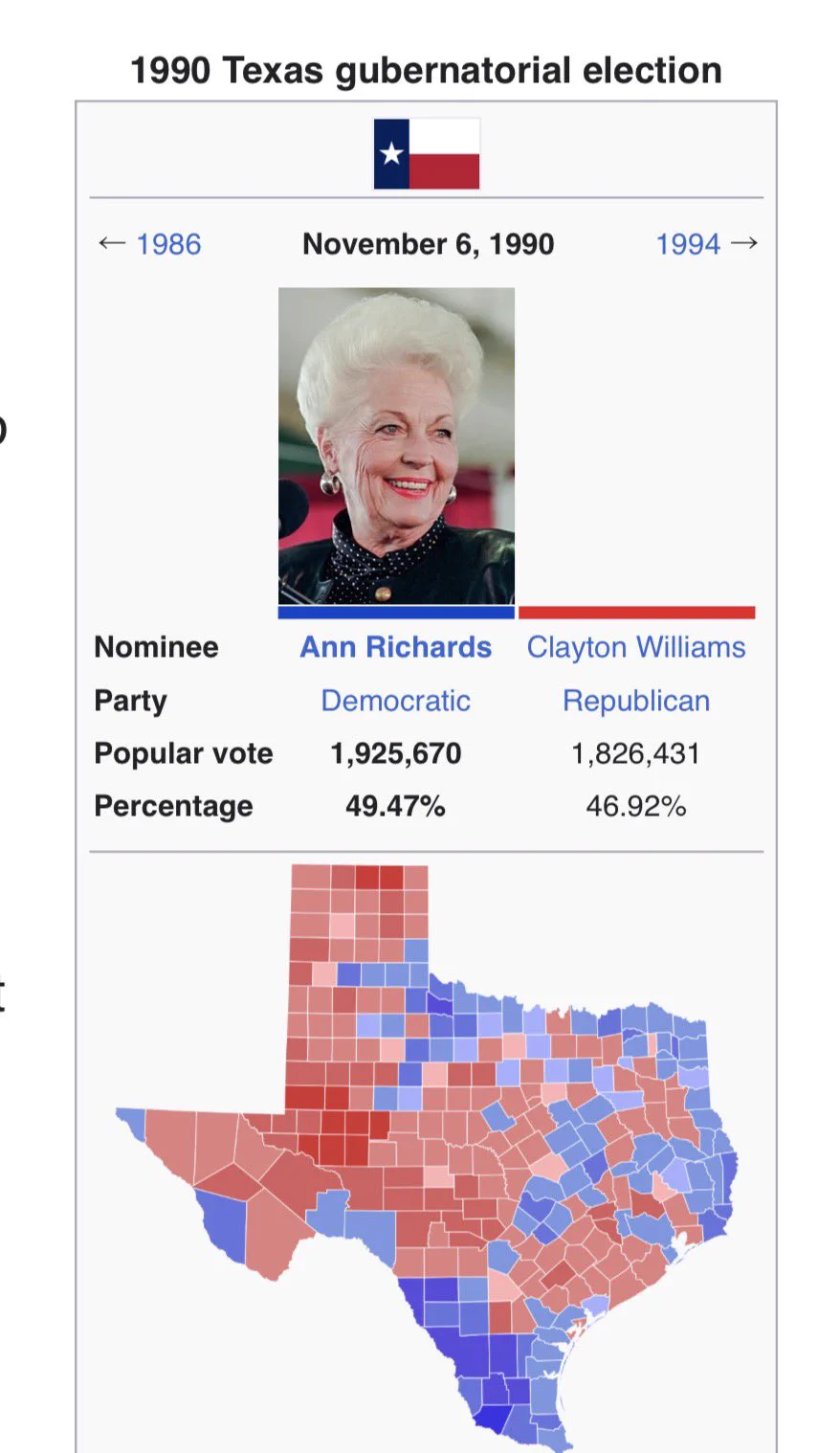
The map is a useful warning against a common mistake. Large areas of one color need not represent large numbers of voters, and a county result cannot tell us how its women, men, or racial and ethnic groups voted. To investigate the coalition, we need voter-group estimates as well as the official totals.
Guest Column: Anglo Women the Key for Texas Democrats
Read this retrospective Texas Tribune guest column for its estimates of how different groups voted in 1990. Treat exit polls as estimates, distinct from the counted statewide result.
In the paragraph beginning with the 1990 and 1994 results, read the 1990 breakdown through the final comparison of Anglo men. Focus on the 1990 figures; the column's comparison with 1994 belongs to a later lesson.
A coalition built from strong support and a narrow loss
The exit-poll estimates show striking differences. Richards led Williams among women 58 to 39 percent, while Williams led among men 53 to 43 percent. Richards also had large estimated leads among Black voters, 90 to 10 percent, and Hispanic voters, 71 to 26 percent. Williams, by contrast, led among Anglo men 61 to 35 percent.
The most revealing figure may be one Richards lost. Anglo women made up an estimated 36 percent of voters, and Williams edged her among them 48 to 47 percent. Richards did not have to win every large group. A near-even result among Anglo women, combined with her substantial support among Black and Hispanic voters, helped offset Williams’s advantage among Anglo men.
This is more precise than saying simply that “women elected Richards.” The overall women’s figure includes women across racial and ethnic groups; it does not mean Anglo women voted the same way as Black or Hispanic women. Nor can we calculate exactly how many votes each group contributed from these percentages alone. Exit polls sample voters, whereas the statewide totals count ballots. Together, though, the two kinds of evidence establish the shape of the victory: a broad enough coalition to win narrowly, not an overwhelming statewide mandate.
That coalition also helps explain why campaign events involving Williams’s treatment of women mattered politically. They gave Richards an opportunity to appeal to voters whose support, or willingness not to vote against her, could be consequential in a close race. But the polling figures alone cannot prove what changed any individual voter’s mind.
Williams’s remarks—and the limits of a single turning point
An account of the campaign often begins with Williams’s offensive joke about rape at a March 1990 ranch event. The remark deserves attention, both for its substance and for the way Richards challenged it. It does not, by itself, explain a November election.
The following account contains a description of sexual violence and Williams’s remarks about it.
Midland Oilman Clayton Williams (1931-2020): Winner in Business, Not in Politics – Texas Monthly
Read this Texas Monthly retrospective for an account by a journalist who covered Williams. It describes the ranch incident, Richards's response, and a crucial check on the claim that one remark immediately decided the race.
In the account of the March 24 ranch event, begin where the writer turns from the fog-delayed roundup to Williams's conversation with reporters. Read the ranch account through the discussion of a statewide poll roughly six months later. Then, in the passage beginning with the general-election setting, read the campaign contrast through Williams's further public remarks. Notice the difference between evidence of a damaging incident and evidence that it immediately cost him his lead.
Richards presented the contest as a choice about whose voices would count in a “New Texas,” in contrast to the established political network she criticized. Williams offered an appeal to traditional values and his business experience. When he made dismissive remarks about women and later referred to Richards’s history of alcohol treatment, her campaign could use his own words to sharpen that contrast.
Yet the Texas Monthly writer reports a statewide poll taken nearly six months after the ranch remark in which Williams still led 48 to 33 percent. One poll is not an election result, and it does not show that the remark had no effect. It does rule out the neat story that the race was effectively over that March. Williams remained competitive; Richards still had to win voters during the rest of the campaign.
Near election day, a different issue gave Richards an opening on Williams’s claim to business credibility.
Midland Oilman Clayton Williams (1931-2020): Winner in Business, Not in Politics – Texas Monthly
Return to the Texas Monthly account for its description of the late campaign, especially the tax disclosure and Richards's response.
In the passage beginning with Richards's comparisons involving Williams's businesses, read the closing stretch through the announcement of the result. Pay particular attention to the paragraph beginning “The final straw had nothing to do with gender” and to the campaign's radio-ad argument. Stop before the article turns to Richards's later term and defeat.
After resisting requests to release his tax returns, Williams acknowledged on the Friday before the election that he had paid no federal income taxes in 1986, the year of the oil bust. Paying no federal income tax in a particular year is not, on its own, evidence of wrongdoing. The political problem was the contrast Richards could draw between a wealthy, self-funded candidate and “average Texans” who paid taxes. Her campaign quickly put that argument into a radio ad.
This was a different attack from her criticism of his remarks about women. It questioned whether Williams’s business image translated into fairness or good judgment in public office. The timing also mattered: unlike the ranch incident, the disclosure arrived just before voting. The source reports a potent closing argument, but it does not give us a measured number of voters who changed their choice because of the ad.
How much credit belongs to the opponent?
Richards later offered a blunt account of her victory: Williams’s tendency to say things he should not say helped defeat him. Hearing her perspective is useful, provided we distinguish a candidate’s recollection from a complete explanation.
Former Governor Ann Richards Discusses the Rise of the Republican Party in Texas
Watch “Former Governor Ann Richards Discusses the Rise of the Republican Party in Texas,” from the Texas Politics Project, for Richards's retrospective account of the 1990 race.
Watch Richards's explanation of her victory. Notice that she emphasizes the odds against her and Williams's self-defeating remarks; compare that emphasis with the voter-group estimates and the campaign chronology.
Her account captures something real: Williams supplied material that Richards used effectively. But an opponent’s mistakes become an electoral explanation only when a campaign can turn them into reasons to vote, and enough voters respond. Richards had an established statewide record, a message about opening government, and a coalition that included strong Black and Hispanic support and a nearly even result among Anglo women. Williams’s remarks and late tax disclosure were opportunities within that contest, not substitutes for the coalition that won it.
There is an important limit to what this evidence permits us to say. We can identify the result, describe estimated group support, and place reported campaign developments in sequence. We cannot assign an exact share of Richards’s 99,239-vote margin to the ranch remark, the tax ad, or any other single event. The defensible explanation is that a narrow coalition victory became possible—and remained contestable—as Richards capitalized on several openings over the course of the race.
In perspective
Richards won in 1990 by combining large margins among Black and Hispanic voters, a strong overall showing among women, and a near-even result among Anglo women, despite Williams’s substantial lead among Anglo men. His remarks and final-week tax disclosure helped her campaign make its case, but neither the exit polls nor the campaign accounts support a one-gaffe explanation.
The next lesson moves from winning office to exercising it. Richards’s promise of a “New Texas” would have to operate within the actual distribution of power in Texas government.