Hello. This course follows Ann Richards from her rise in Texas politics through her governorship, defeat, and legacy. First, we need to understand the political landscape she entered. Before the 1990 governor’s race, Texas could favor Republicans for president while still electing many Democrats to state office. That was not an electoral contradiction: party labels, candidates, and political organizations worked differently across those contests.
A Democratic state did not always vote Democratic for president
For much of the twentieth century, the contest that mattered most in Texas state politics was the Democratic primary. Democratic nominees often faced little opposition in the general election, so rival factions fought over nominations within the party. “Democrat” was therefore a broad political label, not a guarantee that candidates shared one set of views.
Read the Handbook of Texas entry “Political Parties” for its explanation of Democratic primary dominance and the voters it calls “Presidential Republicans.”
This is a single-entry page without subsections. In its main paragraph, read the primary discussion. Then continue from “Texas support for Republican presidential candidates grew after 1932” through Presidential Republicans. Finally, find the sentence beginning “In 1978” and read through the governor milestone. Notice that a voter’s presidential preference and choice of state-party candidates could differ.
A Presidential Republican might support a Republican nominee for president yet vote in Democratic primaries and support Democrats for state office. There were reasons to do so: the Democratic primary offered a meaningful choice among state candidates, while the Republican organization was, for many years, too weak to compete for numerous offices. A voter could also prefer a particular national candidate without wanting to replace familiar Democratic state officials.
This arrangement did not make the Democratic Party ideologically uniform. Conservative and liberal Democrats competed over its direction. Nor should “the primary was the real election” be mistaken for a claim that everyone had equal access to it: discriminatory voting practices excluded many Black Texans during much of the one-party era. The point here is about where effective electoral competition often occurred, not an endorsement of that system.
Eisenhower and Shivers: the distinction in practice
The 1952 election makes the national–state divide concrete. Texas governor Allan Shivers was a Democrat, but he helped deliver the state’s presidential vote to Republican Dwight Eisenhower. Conservative Democrats could oppose the national Democratic ticket while maintaining their position inside Texas’s Democratic Party.
Read the Handbook of Texas entry “Democratic Party” to see how divisions among Texas Democrats made this combination possible.
In the portion beginning with the 1948 Senate race, read from “To appeal to a conservative but Democratic electorate” through the party factions. Later, in the paragraph beginning “After becoming governor,” read Shivers's strategy, ending with its account of cross-filing in the 1952 primaries. Focus on the difference between helping a Republican presidential candidate and building a Republican slate for state office.
Shivers’s strategy illustrates why presidential support alone did not immediately produce Republican control of Texas government. He strengthened his position in the Democratic party machinery. He also promoted cross-filing: candidates could seek places in both the Democratic and Republican primaries in 1952. That helped conservative Democrats maintain their state-level position rather than simply abandoning the party for the Republicans. Cross-filing concerned where candidates appeared; it does not mean voters cast ballots in both primaries.
Political disagreements also crossed state and national lines. The source describes the dispute over ownership of offshore “Tidelands” as one issue on which conservative Texas Democrats opposed the Truman administration’s position. You need not master that dispute here. Its significance is that loyalty to a state Democratic coalition did not require loyalty to every national Democratic policy or nominee.
Change was gradual, not a switch flipped in 1990
The presidential pattern was neither perfectly steady nor a complete account of Texas politics. The graph below plots Republican presidential candidates’ share of the two-party vote—Republican votes divided by votes for the Republican and Democratic candidates—in Texas and the rest of the South. It does not plot votes for governor or other state offices.
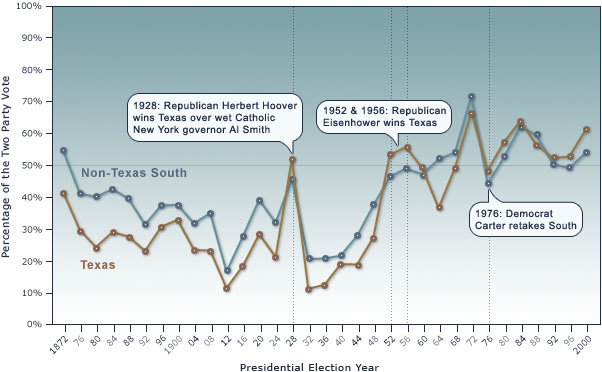
Texas backed Eisenhower in 1952 and 1956, but the Republican share fell sharply in some later presidential elections. In 1976, Democrat Jimmy Carter carried Texas; Republican presidential candidates then won the state in the 1980s. The uneven line cautions against describing realignment as a single, uninterrupted march.
Meanwhile, Republicans became more competitive within Texas state politics. Bill Clements’s victory in the 1978 governor’s race showed that the governorship was no longer safely Democratic. Yet Democrats could still assemble successful statewide tickets: in 1982, they won a series of offices, including the state treasurer’s race won by Ann Richards.
Return to “Democratic Party” for its account of the late-1970s and 1980s statewide contests and growing Republican competition below the presidential level.
In the portion beginning “In the 1972 presidential election,” start with “Republicans also proved they could successfully challenge Democrats” and read through the 1982 victories. In the next paragraph, start at “Nevertheless, the state GOP continued to gain strength” and read through Republican gains. Compare the governor’s race, the Democratic statewide ticket, and the legislative seats rather than treating any one result as the whole story. One correction if you read the preceding sentence on presidential elections: the entry says Democratic nominees failed to win Texas “from 1976 through 1992.” That wording is inaccurate. Carter won Texas in 1976, as the graph’s Texas figure—below half for the Republican—also indicates.
By 1990, Republicans held about a third of the seats in both houses of the Texas legislature, according to the Handbook account. That is substantial growth, but it is not a Republican legislative majority. Equally, Democratic success in state races did not mean presidential results were irrelevant. Both facts belonged to a changing, increasingly competitive political system.
There is one further limit to the evidence: a presidential vote total beside a state-office result cannot tell us exactly how individual people split their tickets. Turnout and candidates differed between elections. The historical account of Presidential Republicans establishes that cross-party voting occurred; the broader results show why it mattered, without measuring every individual voter’s choices.
The starting point for Richards’s story
Before Richards ran for governor, Texas was neither an unchanged Democratic stronghold nor a state already controlled throughout by Republicans. Democrats retained offices, organizations, and a capacity to win statewide; Republicans had demonstrated strength in presidential elections and a growing ability to win state contests. The distinction between presidential preference, party organization, and state-office results explains how both could be true.
Next, we will follow Richards’s path from political organizing and county service to the state treasurer’s office, and then to the 1990 Democratic gubernatorial nomination.