Last lesson established a useful distinction: Richards could propose laws and budgets, but she could not enact them alone. Appointments were a different kind of power. Where the governor had authority to choose officials, she could change who took part in governing without first winning a new statewide election. This lesson examines how Richards used that power to bring more women and racial minorities into Texas government—and how far the evidence lets us say that effort succeeded.
Opening the doors
A photograph from the night Richards won the governorship captures one part of her political message.
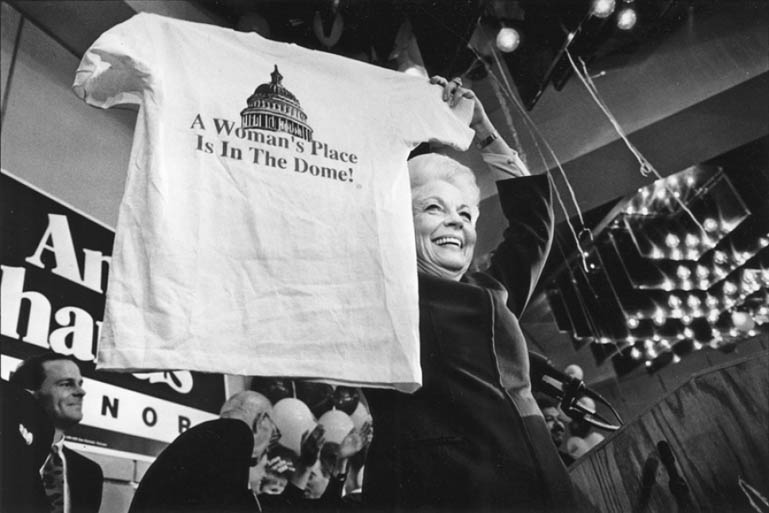
The slogan points to a barrier at the top of government. Richards’s aim as governor went further: she wanted women and racial minorities to hold positions throughout the institutions that made and carried out public decisions. Her inaugural vision of a “new Texas” linked opportunity across lines of race and gender to a practical act—opening government’s doors and letting people in.
Read the two short passages below in the University of Texas at Arlington Libraries’ account. Together they connect that promise to an early measure of what Richards did.
Ann Richards and the "New Texas" | UTA Libraries
Read “Ann Richards and the ‘New Texas’” from UTA Libraries to see how Richards defined access to government and how the article describes her early appointments.
Near the beginning, just before the inauguration photographs, find the paragraph beginning “In 1990, Richards ran for the Texas governorship.” Read her inaugural vision within that paragraph. Then move past the inauguration photographs and the paragraph about her first State of the State address. Read the appointments account, stopping at the end of that paragraph. Notice both the time period attached to the figure and the kinds of positions included.
The article reports that, in her first 18 months, Richards appointed a record number of women and minorities—given there as 37%—to her staff and to positions on state boards and commissions. It also describes an aggressive affirmative-action approach to making those selections. The point was not simply that a woman had won the most visible office. Richards used offices she could fill to widen access to the less visible work of state government.
What an appointment could change
The previous lesson’s account of Texas’s divided executive still applies. Richards could not appoint the independently elected lieutenant governor or replace legislators with people of her choosing. Nor were all appointments identical: a staff position, a seat on a commission, and leadership of a state body carried different responsibilities. Appointments to some offices also required Senate consent.
Within those limits, selection mattered. Staff members could help determine which concerns reached the governor and how proposals were developed. Board and commission members could participate in oversight and decisions within the authority the law gave their bodies. Appointing someone to such a position could therefore change who had access to information, a voice in deliberation, and a share of institutional responsibility. It was more than a public gesture, even though the effect of any particular appointment depended on the office and the person’s authority.
Consider the distinction between an appointment and a statute. A law can set a statewide rule; an appointee usually works within rules and budgets already in place. Yet a body administering those rules still has judgments to make. Broadening who sits on that body can bring experiences and concerns into its deliberations that might otherwise have been absent. That is a plausible route from representation to changed governance—not proof that every decision changed, but a reason the composition of government matters.
Richards’s approach also treated exclusion as an institutional problem. If people have rarely been selected for positions of authority, announcing that an application process is open may not be enough to alter who is chosen. Deliberately seeking and appointing qualified people from groups historically underrepresented in those positions changes the selection practice as well as the resulting roster. UTA Libraries describes Richards’s early record in those terms. It does not, however, provide a position-by-position account of how her approach operated, so the reported figure should not be turned into a claim about a specific quota or procedure.
Measuring the change carefully
A second account looks across Richards’s term rather than only its first 18 months. Read it with particular attention to what it counts—and what it does not.
In Memoriam: Ann Richards, 1933–2006 - Dolph Briscoe Center for American History
Read the Dolph Briscoe Center for American History’s account for a term-wide view of Richards’s appointments and her own explanation of why they mattered.
In the short memorial, find the opening paragraph that gives the dates of Richards’s governorship, then read the following paragraph through its closing quotation. Focus on the approximate number of appointments, the figure for women, and the different wording used to describe minority leadership.
The Briscoe Center says Richards made 3,000 appointments during her governorship and that nearly half were women. It also says more minorities assumed leadership positions in state government during her term than at any earlier time. Richards herself later described changing the face of state government through appointments as the accomplishment she would choose to emphasize.
These accounts reinforce each other, but their figures should not be treated as interchangeable:
| Evidence | Period and scope | What it supports |
|---|---|---|
| UTA Libraries’ 37% | Women and minorities among appointments to staff, boards, and commissions in the first 18 months | A substantial early effort to broaden participation in positions she could fill |
| Briscoe Center’s nearly half of 3,000 | Women among Richards’s appointments over her term | A sustained term-wide record of appointing women |
| Briscoe Center’s statement on minority leadership | Her governorship as a whole | A reported increase in minorities holding leadership positions, without a numerical share |
The first percentage combines the groups described by UTA Libraries; it does not tell us the separate proportion of women or of racial minorities in that early set. Women and racial minorities can also be overlapping categories, so their numbers cannot simply be added. The term-wide figure concerns women, not all women and minorities together. Neither account gives a breakdown by the authority of each position, and the Briscoe Center does not give a term-wide percentage for minority appointees.
Those distinctions do not diminish the record. They make the assessment more precise: the sources support a substantial change in who was appointed, while leaving some questions about the distribution and effects of those appointments unanswered.
Representation as a governing achievement—and its limits
Richards’s appointments advanced her goal in the most direct sense: more women and racial minorities gained places in state government, including positions of leadership. That altered the composition of institutions rather than merely changing the language used to describe them. Appointees could participate in decisions, build experience in public office, and make future leadership seem less restricted to the groups that had traditionally held it.
There is also a distinction between access and outcomes. Evidence that an institution became more representative does not by itself establish that every community received better services, that every appointee pursued the same policies, or that long-standing inequalities disappeared. Assessing those further claims would require evidence about particular offices, decisions, and results. Richards’s own statement about changing the face of government expresses the importance she placed on appointments; it is not, on its own, a measure of every policy effect.
Her institutional constraints sharpen the point. She could select people for offices within her appointment authority, sometimes subject to confirmation. She could not personally fill every position in Texas government or direct independently elected officials as if they were her staff. But unlike a legislative proposal that could stall before becoming law, each completed appointment put someone into an actual role. Richards used a power she possessed to pursue a goal she had announced, while the reach of that power remained bounded by the offices available to her.
The strongest assessment is therefore neither “appointments were only symbolic” nor “appointments solved unequal access.” They were a concrete opening of state government, visible in both the early and term-wide accounts. Their wider policy consequences cannot be assumed from appointment totals alone.
Conclusion
Richards made inclusion an administrative choice as well as a public promise. In the first 18 months, UTA Libraries reports a record level of appointments of women and minorities to staff, boards, and commissions; across her term, the Briscoe Center reports that nearly half of roughly 3,000 appointees were women and that minority leadership increased. These measures use different periods and categories, but together they show sustained use of the governor’s appointment power to broaden participation.
The next lesson turns to school finance, where Richards faced a different governing problem: court rulings and disparities in local property wealth demanded changes that appointments alone could not make.