Welcome back! In our last lesson on double-entry bookkeeping, we saw how to systematically record your business's transactions. You might have noticed that when we recorded a day's sales, we included revenue from credit card payments even though the cash hadn't arrived in your bank account yet. This was a deliberate choice and serves as a perfect entry point to today's topic.
This lesson addresses a fundamental choice in accounting: do you record financial events when cash changes hands, or when the actual business activity occurs? We will formally distinguish between cash-based and accrual-based accounting. Understanding this distinction is not just a technical detail; it's critical for accurately measuring your profitability, making sound strategic decisions, and preparing your business for the scaling you envision.
Let's begin with a simple visual overview of the core difference.

The Core Difference: Timing is Everything
The choice between cash and accrual accounting boils down to one thing: the timing of when you recognize revenue and expenses. While both methods will report the same total profit over the entire life of a business, they can paint dramatically different pictures of profitability within a specific period, like a month or a quarter.
Cash-Basis Accounting
This is the more intuitive method and is likely similar to how you've tracked finances in your spreadsheets. The rule is simple:
- Revenue is recorded only when you receive cash from a customer.
- Expenses are recorded only when you pay cash to a supplier or employee.
If you deliver a large catering order but the client pays you 30 days later, under the cash basis, the sale doesn't exist until that payment arrives. Similarly, if you buy ingredients on credit, the expense isn't recorded until you pay the supplier's invoice. This method directly tracks the flow of cash in and out of your bank account.
Accrual-Basis Accounting
This is the standard for most businesses, including growing ones like yours, and is required by international financial reporting standards. The rule here is based on the economic event, not the cash movement:
- Revenue is recorded when it is earned, meaning when you have delivered the product or service to the customer, regardless of when they pay you.
- Expenses are recorded when they are incurred, meaning when you've used a resource or received a service, regardless of when you pay for it.
In the catering example, you would record the revenue on the day you delivered the food, creating an "Account Receivable." When you buy ingredients on credit, you record the expense and create an "Account Payable." This is exactly what we did in our previous lesson's examples.
The following video uses a wonderful story about a small business to illustrate how these two methods would record the exact same set of transactions, leading to very different profit figures for the day.
Cash vs Accrual Accounting Explained With A Story
This video from Leila Gharani, "Cash vs Accrual Accounting Explained With A Story," provides a clear and engaging narrative to explain the two methods.
Please watch from the beginning until 09:10. The video will first introduce the concepts and then walk you through a story about "Claudio's beach business." Pay close attention to: The simple definition of cash accounting. The definition of accrual accounting. The core part of the story, where the same day's business is analyzed first using the cash method and then the accrual method. Notice how the reported profit changes dramatically.
As the video shows, cash accounting can be misleading. It might show a large profit in one month simply because a big client payment from a previous period came in, or a large loss because you paid for a lot of inventory that you haven't used yet. Accrual accounting avoids these distortions.
The Theory Behind Accrual: The Matching Principle
To truly grasp why accrual accounting is the professional standard, we need to understand the "deeper theory" you're interested in. Accrual accounting is built upon a crucial concept called the expense recognition principle, more commonly known as the matching principle.
The matching principle states that expenses should be recognized in the same period as the revenues they helped to generate.
Think about your business. To sell a meal, you incur costs for ingredients, labor to prepare it, and packaging for delivery. The matching principle dictates that the revenue from that sale and all the direct costs associated with it should be recorded in the same accounting period. This gives you a true picture of the profitability of that sale.
The resource below provides an excellent explanation of this principle and the methods for applying it.
What is The Expense Recognition Principle and How Does ...
This article from Brex delves into the logic of expense recognition, which is the foundation of accrual accounting.
First, read the section "How the expense recognition principle works". This will formalize the concept of matching. Then, focus on the section "What are the three methods of recognizing expenses?". This explains the three ways expenses are timed under the accrual method: Cause and Effect (Direct Matching): This is the purest form. Think of your Cost of Goods Sold (COGS). The cost of the flour, beef, and vegetables is directly tied to the revenue from the empanadas you sell. The expense is recognized at the moment of sale. Systematic Allocation: This is for long-term assets. When you buy a new industrial oven for ARS 1,000,000, you don't record a million-peso expense that day. The oven will help you generate revenue for years. So, you allocate its cost over its useful life (e.g., 10 years). This process is called depreciation. Immediate Recognition: This is for costs that don't have a clear link to future revenue. Your monthly electricity bill or administrative salaries are examples. Their benefit is considered consumed in the current period, so they are expensed immediately.
Practical Implications for Your Food Business
So, why does this distinction matter for your goal of organizing and scaling your family business? While cash accounting seems simpler, it can create dangerous blind spots.
For a business like yours with multiple revenue streams (B2C delivery, B2B catering, events) and significant inventory, accrual accounting is essential.
Restaurant Accounting Guide for Growth & Profitability - PABS
This guide from PABS is written specifically for restaurant owners and explains why this choice is so critical in your industry.
Please read the short section under the heading "Accrual accounting reveals many truths". Then, find the FAQ at the bottom of the page and read the answer to the question "Which accounting method should my restaurant use?"
The article warns that with cash accounting, "You might have strong cash from customer prepayments while operating unprofitably." This is a classic scenario for a catering business. You might receive a large deposit for an event, making your bank account look healthy. But you haven't yet paid for the food, the extra staff, or the rentals. Accrual accounting forces you to recognize those expenses when they are incurred, providing a much more honest and accurate measure of your financial health.
The table below provides a concise summary of the key differences and their implications.
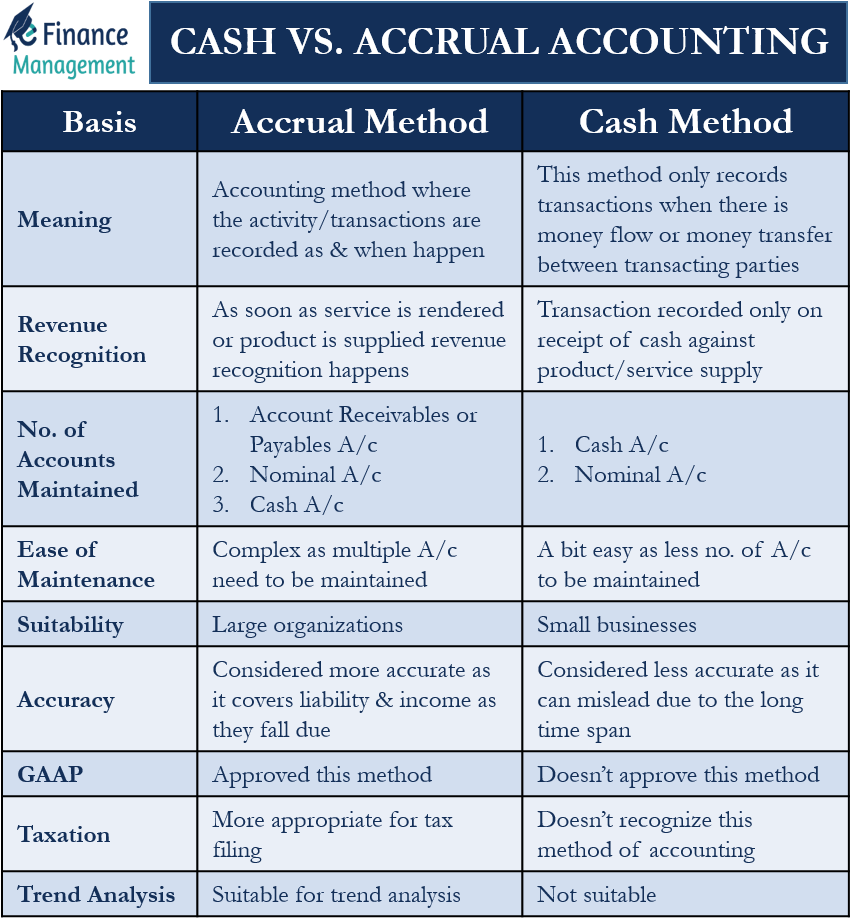
As you can see from the table, for a business that aims to grow, analyze trends, and potentially seek partnerships or funding, the accrual method is the only viable option. It provides the accurate picture needed for strategic decisions like menu pricing, labor scheduling, and evaluating the profitability of different channels (like delivery vs. B2B sales).
Conclusion
In this lesson, we have dissected the fundamental difference between cash and accrual accounting. While they seem like two sides of the same coin, they offer very different perspectives on your business's performance.
Here are your key takeaways:
- Cash-basis accounting recognizes revenue and expenses only when cash moves. It is simple but can provide a misleading picture of profitability.
- Accrual-basis accounting recognizes revenue when earned and expenses when incurred, regardless of cash flow. It is based on the matching principle.
- The matching principle ensures that the costs of generating revenue are recorded in the same period as that revenue, giving a true measure of profitability.
- For a growing food business with inventory, credit sales (B2B clients), and credit purchases, accrual accounting is the professional standard and essential for making informed decisions.
This understanding is the final piece of our foundational module. You now know the core equation, the double-entry system for recording transactions, and the two primary methods for timing that recognition.
In our next lesson, we will begin Module 2 by learning to read the first of the three core financial statements: the Income Statement. This report is the primary output of the accrual accounting process and is the key to understanding your business's profitability over a period of time.