Welcome to your first lesson. We're starting at the very heart of financial accounting, a principle that provides the logical foundation for everything else you will learn about managing your company's finances. Your goal is to move from fragmented spreadsheets to a structured system that can support and guide your business's growth. This lesson is your first major step in that direction.
Today, we will explore the accounting equation. You'll learn what its components—Assets, Liabilities, and Equity—mean, how they relate to each other, and most importantly, why this simple equation is the key to understanding the financial health of your business at any given moment. This concept is the blueprint for one of the most critical financial reports, the balance sheet, which we will cover in a few lessons.
The Foundation: What You Own and What You Owe
At its core, accounting provides a framework to answer two fundamental questions:
- What resources does the business have?
- Who has a claim on those resources?
The answer to the first question is Assets. The answer to the second has two parts: claims from outsiders (like banks or suppliers), which are Liabilities, and claims from the owners (you and your mother), which is Equity.
These two sides must always be equal. The resources a business controls must equal the total claims on those resources. This fundamental relationship is captured in the accounting equation.

The equation is:
Think of it this way: everything the business owns (its assets) had to be paid for, or financed, somehow. It was financed either by borrowing money from others (creating liabilities) or by using money invested by the owners (creating equity).
Because your business operates in Argentina, you'll also see this expressed with local terminology. The logic is identical.
[PDF] UNIDAD 2: - UTN Facultad Regional San Francisco
This document from a local Argentine university will introduce the core concepts using the terminology you'll encounter in business dealings. It formally derives the equation.
Please read the initial section "Estructura del Patrimonio" to see the definitions of Activo, Pasivo, and Patrimonio Neto. Then, skip down to the section titled "2.2.1 El Pasivo" and focus on how the equation is presented. Read the two definitional bullet points for Patrimonio Neto and the formulas that follow, ending with the sentence that states the final equation. This will ground the concept in its local context: Activo = Pasivo + Patrimonio Neto.
Now that we have the main formula, let's deconstruct each of its three core components.
Deconstructing the Equation: Assets, Liabilities, and Equity
To truly understand the financial story of your business, you need to be fluent in the language of its components. This next video provides a comprehensive breakdown of each element, including nuances that address your interest in the "deeper theory" behind the mechanics.
Assets, Liabilities & Equity: Made Easy!
The video "Assets, Liabilities & Equity: Made Easy!" from the Accounting Stuff channel offers a clear and detailed explanation of each part of the equation.
Please watch the following three segments: Assets (watch here): This section explains what qualifies as an asset, the distinction between current and non-current assets (e.g., cash vs. a kitchen oven), and the concept of liquidity. Liabilities (watch here): Here, you'll learn about different types of liabilities, such as money owed to suppliers (accounts payable) versus a bank loan. The examples are very practical. Equity (watch here): This is a crucial part for a family business. It explains the difference between the initial money put in by owners (capital contributions) and the profits the business has accumulated over time (retained earnings).
Let's summarize and apply these definitions directly to your food business:
-
Assets: These are the economic resources your business controls.
- Current Assets: Resources expected to be used or converted to cash within a year. For you, this includes cash in the register, your bank account balance, inventory of perishable food items, and money owed to you by a corporate catering client (
accounts receivable). - Non-Current Assets: Long-term resources not expected to be converted to cash within a year. This includes your kitchen equipment (ovens, refrigerators), delivery vehicles, and potentially the restaurant property if you own it.
- Current Assets: Resources expected to be used or converted to cash within a year. For you, this includes cash in the register, your bank account balance, inventory of perishable food items, and money owed to you by a corporate catering client (
-
Liabilities: These are the obligations your business owes to external parties.
- Current Liabilities: Debts due within one year. This would be the amount you owe to your produce supplier for the last delivery (
accounts payable), short-term loans, or wages owed to employees for the last pay period. - Non-Current Liabilities: Debts due in more than one year, such as a long-term bank loan you took out to renovate the restaurant.
- Current Liabilities: Debts due within one year. This would be the amount you owe to your produce supplier for the last delivery (
-
Equity: This is the owners' residual claim on the assets after all liabilities have been paid. It represents the net worth of the business. It can be expressed as:
Equity = Assets - Liabilities.
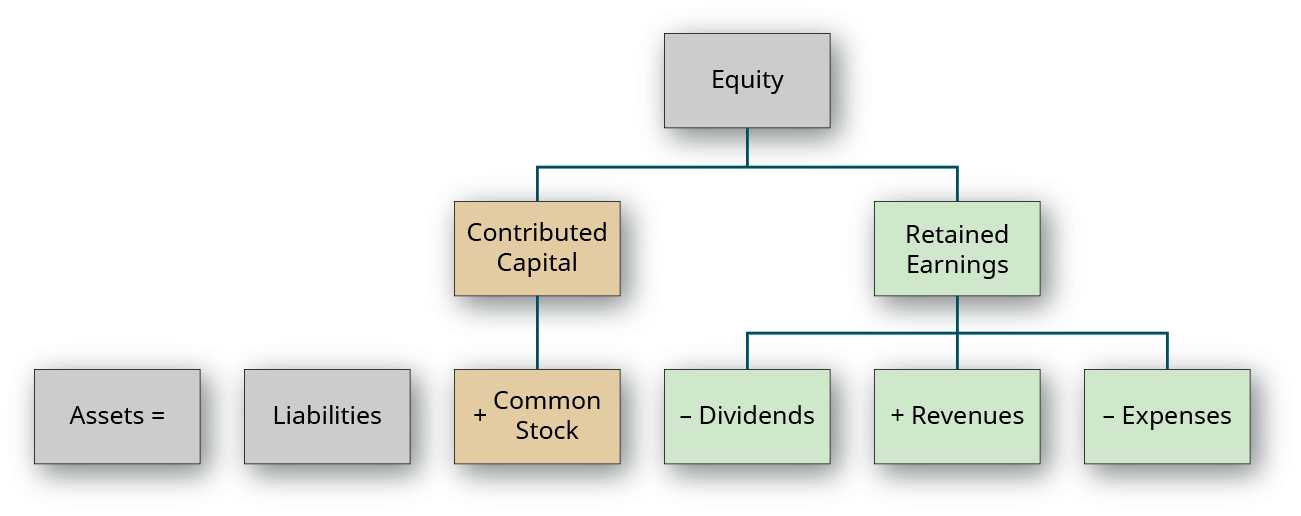
Equity has two primary components, which are vital for understanding your business's performance and value:
- Contributed Capital: The money invested into the business by its owners. This is the initial cash or other assets you and your mother used to start the business, plus any subsequent investments you've made.
- Retained Earnings: The cumulative net income (profits) that the business has earned over its lifetime, minus any amount paid out to the owners as withdrawals (sometimes called
drawingsordividends). When your business is profitable and you reinvest that money back into operations—to buy more inventory or a new machine—you are increasing your retained earnings.
This chart visually breaks down how Equity is structured. Notice how Revenues and Expenses, which determine your profit, directly impact Retained Earnings.
The Significance: Why It Always Balances
The accounting equation is not static; it is a dynamic reflection of your business's activities. Every single financial event, or transaction, causes a change in your financial position, but the equation always remains in balance. This is the principle of double-entry accounting, which we will focus on in our next lesson.
To see this in action, watch this short segment that provides clear, simple examples.
The Accounting Equation SIMPLIFIED
The video "The Accounting Equation SIMPLIFIED" by Your CFO Guy explains the practical implication of the equation—double-entry accounting.
Watch the section from this point, where the host walks through several examples of how transactions affect two parts of the equation simultaneously, ensuring it always balances.
Let's trace a few transactions for your own business to see how this works. Imagine you start with nothing.
Transaction 1: Initial Investment
You and your mother invest ARS 2,000,000 of your personal savings into the business's bank account.
| Assets | = | Liabilities | + | Equity |
|---|---|---|---|---|
| Cash +2,000,000 | = | 0 | + | Contributed Capital +2,000,000 |
| Balance: 2,000,000 | = | 0 | + | 2,000,000 |
The business now has an asset (cash), and the owners have a claim to that asset (equity).
Transaction 2: Buying Equipment on Credit
The business buys a new professional oven for ARS 800,000 from a supplier, who agrees to be paid in 60 days.
| Assets | = | Liabilities | + | Equity |
|---|---|---|---|---|
| Equipment +800,000 | = | Accounts Payable +800,000 | + | 0 |
| Balance: 2,800,000 | = | 800,000 | + | 2,000,000 |
The business has a new asset (equipment), but it also has a new liability (an obligation to pay the supplier). The equation remains in balance.
Transaction 3: Cash Sale
You sell ARS 50,000 worth of food for a delivery order, and the customer pays in cash. This is revenue. Revenue increases your profit, which in turn increases Retained Earnings (a component of Equity).
| Assets | = | Liabilities | + | Equity |
|---|---|---|---|---|
| Cash +50,000 | = | 0 | + | Retained Earnings +50,000 |
| Balance: 2,850,000 | = | 800,000 | + | 2,050,000 |
An asset (cash) increased, and the owners' claim (equity) also increased because the business generated a profit.
As you can see, every transaction has a dual effect. Understanding this logic is the first step toward building a reliable financial system that gives you a true picture of your business.
Conclusion
In this lesson, we established the foundational principle of accounting. You now have a theoretical framework to replace your intuitive but incomplete spreadsheets.
Here are the key takeaways:
- The accounting equation is Assets = Liabilities + Equity. It represents the fundamental balance between a company's resources and the claims on those resources.
- Assets are what your business owns (cash, equipment, inventory).
- Liabilities are what your business owes to outsiders (loans, supplier debts).
- Equity is the owners' residual stake, comprising their investment (Contributed Capital) and the accumulated, reinvested profits (Retained Earnings).
- The equation must always balance. Every transaction affects at least two accounts, keeping the financial picture complete and accurate.
This equation is not just an academic exercise; it is the logical backbone of the balance sheet, a financial statement that provides a snapshot of your company's financial position. Being able to read and understand this statement is critical for making strategic decisions, managing cash flow, and ultimately, scaling your business.
In our next lesson, we will formalize the process of tracking transactions using double-entry bookkeeping. You'll learn how to apply this dual-effect principle systematically to record the daily activities of your food business.