In our last two lessons, we analyzed Kapalabhati and Bhastrika, concluding that despite their mechanical differences, they are functionally similar tools for inducing a state of acute sympathetic arousal. Today, we pivot dramatically to explore a technique with an almost opposite physiological aim. We will investigate Bhramari Pranayama, the "Bee Breath," a practice that leverages sound and vibration to shift the autonomic nervous system toward a parasympathetic, restorative state.
Our objective is to learn the performance of Bhramari and to analyze the clinical evidence for its two primary proposed mechanisms: the endogenous production of nitric oxide (NO) and the direct stimulation of the parasympathetic nervous system. This will add a powerful calming technique to your "cheat sheet," standing in stark contrast to the activating methods we've covered.
The Mechanics of Bhramari: The Humming Breath
The name Bhramari is derived from the Sanskrit word Bhramara, meaning "large black bumblebee." The name is an apt description of the practice, which involves producing a low-pitched humming sound on the exhalation.
The core technique is straightforward, but precision is key to maximizing its effect. Let's watch a clear demonstration.
Bhramari pranayama | Boosting the nitric oxide | Breathing technique
This short video from The Yoga Institute provides a concise overview and demonstration of the basic Bhramari practice.
Please watch from the beginning to the full demonstration. Pay attention to the posture, the deep inhalation, and the instruction to create a slow, smooth, and continuous humming sound on exhalation. Note the emphasis on creating a vibration.
As you saw, the basic steps are:
- Sit in a comfortable, upright posture.
- Close your eyes and relax your face and jaw.
- Take a slow, deep inhalation through the nose.
- Keeping your mouth gently closed, exhale slowly while producing a steady, low-pitched humming sound, like a bee.
- Focus on feeling the vibration created by the hum, particularly in your face, sinuses, and skull.
- The exhalation should be as long as is comfortably possible.
- Practice in rounds, with moments of normal breathing in between.
There are also more complex variations. A common one involves using the hands to block out external sensory input, a practice known as Shanmukhi Mudra ("six-gated mudra"). One of the research papers we will examine uses a modified version of this.
Mechanism 1: The Nitric Oxide Pathway
One of the most fascinating aspects of Bhramari is its documented effect on nitric oxide (NO), a critical signaling molecule in the body. Before we dive into the data, let's establish why NO is so important.
How To Increase Nitric Oxide Naturally In The Body? | Bhramari Pranayama | Dr. Anil K. Garg
This video, "How To Increase Nitric Oxide Naturally In The Body?", by Dr. Anil Garg, offers a physician's perspective on the physiological roles of NO and how humming influences its production.
First, watch the introduction (the introduction) to understand the scope of the presentation. Next, watch the segment on NO's functions to appreciate its role as a vasodilator (affecting blood pressure), neurotransmitter, and component of the immune system. Finally, watch the section that directly links humming to NO production. The speaker mentions a 15- to 20-fold increase in nasal NO levels during humming, a figure that originates from a well-known 2002 study in the American Journal of Respiratory and Critical Care Medicine.
The core hypothesis is that the acoustic vibrations produced during humming cause the air in the nasal cavity and paranasal sinuses to oscillate, dramatically increasing the release of NO from the sinus membranes into the airways. This gas then travels with the inhaled air into the lungs, where it can enter the bloodstream.
Now, let's analyze a clinical trial that measured this effect directly. The following study investigated the immediate impact of a modified Bhramari Pranayama (MBhrP) on salivary NO levels in patients with type 2 diabetes.
Immediate Effect of Modified Bhramari Pranayama on Salivary Nitric ...
This paper is a randomized controlled trial, providing a high level of evidence. Your expertise in analyzing study methodology and results will be crucial here.
First, read the Abstract (the summary) to grasp the study's objective, design, and top-line conclusion. Next, examine the specific technique used in the Intervention section. Read the description of MBhrP. This is the Shanmukhi Mudra variation mentioned earlier. Then, review the methodology for the Primary outcome (NO measurement). Note the use of salivary test strips, a non-invasive proxy for systemic NO availability. Finally, analyze the results. Focus on Table 2 (the NO table). Compare the baseline and post-intervention NO levels for the study group versus the control group. The Δ change and the highly significant p-value (<0.001) are the key data points.
The results are unambiguous. The MBhrP group saw their mean salivary NO levels increase from 35.88 μmoL/L to 129.41 μmoL/L, a nearly four-fold increase after just 20 minutes of practice. The control group, which performed slow breathing, showed no significant change.
To corroborate this, another study investigating the effects of Bhramari on post-operative wound healing (which is heavily dependent on NO) measured endothelial nitric oxide synthase (eNOS), the enzyme responsible for producing NO in blood vessels.
The Impact of Bhramari Pranayama and Om Chanting on Post ...
This study provides further objective data on the NO pathway.
Read the section on the Assessment Of NO Pathway (the method) to understand what was measured. Then, examine Table 7 (the eNOS table). Compare the pre- and post-intervention eNOS levels for the Bhramari group versus the control group.
Again, the data is compelling. The Bhramari group showed a significant increase in median eNOS levels (from 1.11 to 3.41 ng/mL), while the control group's levels actually decreased slightly. This provides strong supporting evidence that Bhramari stimulates the body's entire NO production system.
Mechanism 2: Parasympathetic Activation
The second major effect of Bhramari is a profound shift toward parasympathetic dominance. This is driven by at least two factors: the stimulation of the vagus nerve by the physical vibration, and the extended exhalation inherent in the practice. We can measure this shift using Heart Rate Variability (HRV).
Let's return to the first study and analyze its HRV findings.
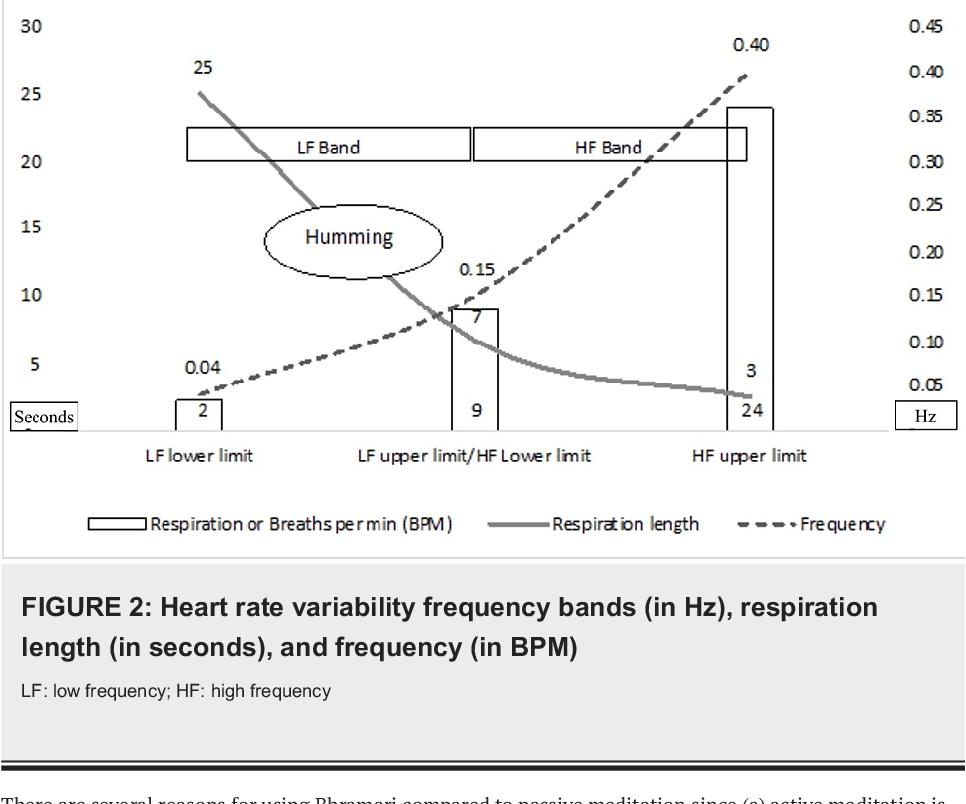
Immediate Effect of Modified Bhramari Pranayama on Salivary Nitric ...
This paper's secondary objective was to evaluate Bhramari's effect on HRV.
Examine Table 3 (the HRV table). This table contains a wealth of data. Focus on these key parameters for the "Study group" and compare the "Before" and "After" values: Average RR (ms): The increase indicates a slowing of the heart rate. RMSSD (ms) and pRR50 (%): These are time-domain measures of vagal activity. Note the significant increase in both. HF (nu): This is a frequency-domain measure of vagal activity. Note the significant increase from 34.22 to 45.1. LF (nu) and LF/HF ratio: Note the significant decrease in both, indicating a reduction in sympathetic drive relative to parasympathetic tone. After analyzing the table, read the Discussion section's interpretation of these findings, starting from this paragraph.
The data clearly demonstrates a powerful shift towards parasympathetic dominance. Heart rate slows, and every key HRV metric indicates increased vagal tone and reduced sympathetic output. The authors conclude that Bhramari "regulates autonomic balance" by "stimulating parasympathetic activity."
The study on post-operative recovery confirms this effect. Its analysis of the LF/HF ratio, a marker of sympathovagal balance, showed a significant reduction in the Bhramari group compared to the control group, indicating a relative increase in parasympathetic activity.
Conclusion: A Calming Powerhouse
In contrast to the activating, "heating" practices of Kapalabhati and Bhastrika, Bhramari Pranayama is a potent calming, "cooling" technique. Its unique use of humming vibration engages two powerful physiological pathways simultaneously.
Key Takeaways:
- Performance: Bhramari involves a slow, deep inhalation followed by a long, slow exhalation accompanied by a steady, low-pitched humming sound.
- Nitric Oxide Production: The vibrations from humming dramatically increase the production and release of nasal nitric oxide, a key molecule for vasodilation, immune function, and neurotransmission. Clinical data shows a significant, immediate increase in systemic NO availability.
- Parasympathetic Activation: The combination of extended exhalation and vagal stimulation from the vibration causes a strong shift in the autonomic nervous system towards a parasympathetic state. This is objectively measured by a slower heart rate and significant improvements in HRV metrics (increased HF, decreased LF/HF ratio).
For your goal of creating a "cheat sheet," Bhramari should be categorized as a primary tool for inducing relaxation, reducing stress, and lowering blood pressure. Its unique mechanism also suggests potential applications for improving nasal breathing and sinus health.
In our next lesson, we will continue our exploration of calming pranayamas by examining Sitali and Sitkari. These "cooling breaths" propose a different mechanism for inducing a state of calm, purportedly through the direct cooling of air and its effect on thermoregulatory pathways in the brain.