Welcome back. In our last two lessons, we established a high-level framework for breathwork by categorizing techniques as either primarily activating (engaging the sympathetic nervous system) or calming (engaging the parasympathetic nervous system). You've analyzed evidence showing how practices like the Wim Hof Method create arousal, while techniques like Resonance Breathing induce relaxation.
Now, we will move from these broad categories to the fundamental mechanics. This lesson deconstructs every breathing technique into its constituent parts, or parameters. Your goal is to map these core variables—rate, depth, ratio, holds, and route—to their specific physiological effects and intended outcomes. Mastering this granular level of understanding is the critical step toward your ultimate goal: being able to analyze, compare, and creatively combine different methods to build your own protocols.
The Five Core Parameters of Breathwork
Any breathing pattern, from a spontaneous sigh to a complex yogic kriya, can be described by five fundamental variables. By deliberately manipulating these "dials," we can control the physiological and psychological output. We will now dissect each one, using the "Breath Tools" framework proposed in a comprehensive 2022 review in Frontiers in Physiology as our guide.
Breath Tools: A Synthesis of Evidence-Based Breathing Strategies ...
This review article provides an excellent, evidence-based framework for deconstructing breathing techniques. We will refer to it throughout this lesson.
To begin, please familiarize yourself with the basic terminology. In the section "Exercise Breathing Pattern," review Table 1. This will give you the precise definitions for variables like Breathing Rate (BR), Tidal Volume (VT), and Duty Cycle (Dc), which we will be exploring.
1. Rate: The Pace of Your Physiology
Rate, or breathing frequency, is the most intuitive parameter, measured in breaths per minute (BPM). It acts as a primary controller for the overall state of arousal.
- Slower Rates (< 10 BPM): Promote parasympathetic dominance. As we saw with Resonance Breathing, rates around 5-6 BPM are particularly effective at increasing Heart Rate Variability (HRV) and enhancing vagal tone. Slowing the breath also improves the efficiency of gas exchange.
- Faster Rates (> 20 BPM): Drive sympathetic activity. This is the basis for activating techniques like Kapalabhati and the hyperventilation phase of the Wim Hof Method.
The reason slow breathing is more efficient is due to a concept called anatomic dead space—the volume of your airways (trachea, bronchi) where no gas exchange occurs. Every breath must first fill this space (about 150 ml) before fresh air reaches the alveoli. The following reading and its accompanying table provide a clear, quantitative illustration of this effect.
Breath Tools: A Synthesis of Evidence-Based Breathing Strategies ...
The "Rate" section of this paper explains the biochemical and psychophysiological effects of modifying your breathing rate.
Please read the subsection "Rate" under "Breath Tools." Pay close attention to the paragraph explaining the effect of dead space and analyze Table 2. Given your background, you will appreciate how this table numerically demonstrates the impact of breathing pattern on alveolar ventilation. Notice how for the same total minute ventilation (10 L/min), a slow, deep pattern provides more than double the alveolar ventilation of a fast, shallow pattern.
As the table shows, taking fewer, deeper breaths is far more efficient at oxygenating your blood than taking many shallow breaths. This is a foundational principle for most calming and meditative practices.
2. Depth: The Power of the Diaphragm
Depth refers to the volume of air per breath (Tidal Volume, VT) and, just as importantly, how that volume is achieved. Breathing can be driven primarily by the chest and neck muscles (thoracic or clavicular breathing) or by the main respiratory muscle, the diaphragm (diaphragmatic or abdominal breathing).
- Diaphragmatic Breathing: This deep, "belly" breathing is biomechanically efficient and is strongly linked to parasympathetic activation. The downward movement of the diaphragm stimulates the vagus nerve, promoting relaxation. It is associated with reduced oxidative stress, improved postural control, and greater baroreflex sensitivity.
- Thoracic Breathing: This shallow, upper-chest breathing is characteristic of the stress response ("fight or flight"). It relies on accessory muscles in the neck and shoulders, increasing the work of breathing and often leading to or accompanying feelings of anxiety and hyperventilation.
The "Breath Tools" paper elaborates on this distinction.
Breath Tools: A Synthesis of Evidence-Based Breathing Strategies ...
This section details the benefits of proper diaphragmatic breathing versus the drawbacks of upper-thoracic breathing.
Please read the subsection "Deep" under "Breath Tools." The text explicitly links upper-thoracic breathing to increased work of breathing and hyperventilation, while diaphragmatic breathing is correlated with numerous positive health benefits.
Practices like Zazen, with its focus on the tanden (lower abdomen), are fundamentally exercises in cultivating deep, diaphragmatic breathing.
3. Ratio: The Inhale/Exhale Balance
Ratio refers to the relative duration of your inhalation versus your exhalation (I:E ratio). This is perhaps the most direct and powerful lever for steering your autonomic nervous system in real-time. As you'll recall from our previous lesson, this is due to Respiratory Sinus Arrhythmia (RSA).
- Inhale > Exhale (Low I:E Ratio): Emphasizing the inhalation speeds up the heart rate, promoting alertness and sympathetic tone.
- Exhale > Inhale (High I:E Ratio): Emphasizing the exhalation slows down the heart rate, strongly activating the parasympathetic "brake" and inducing relaxation.
Dr. Tracey Marks provides a concise explanation of how to leverage this for different goals.
The Neuroscience of Breath: How to Use Breathing to Control Emotions
This video explains several techniques that are differentiated primarily by their ratio and use of holds.
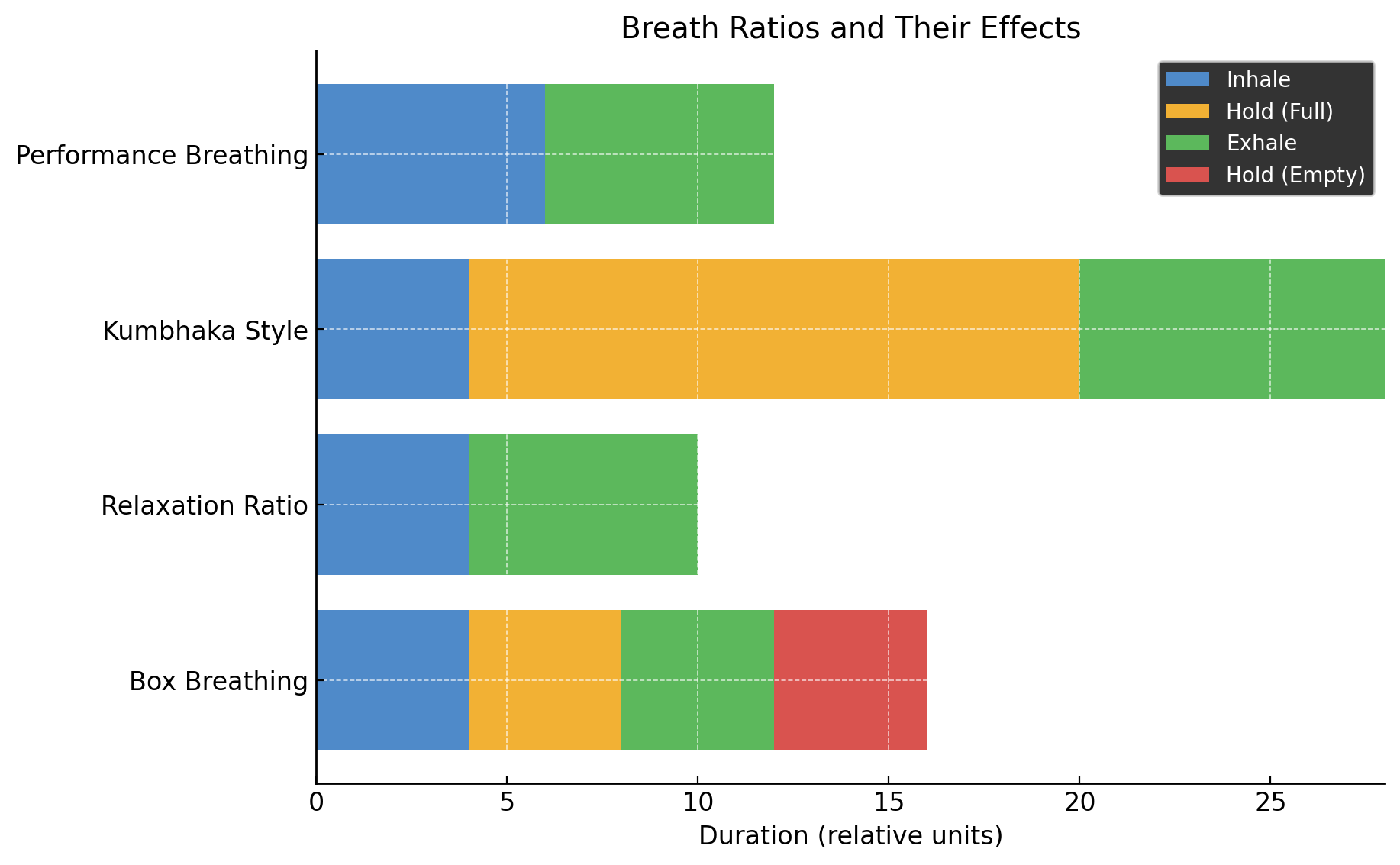
Watch the following segments to see how ratio manipulation creates different outcomes: First, listen to the description of Box Breathing (4:4:4:4), which uses a balanced 1:1 inhale-to-exhale ratio for calm focus. Next, compare this to 4-7-8 Breathing (4:7:8), where the significantly longer exhale is explained to trigger a stronger relaxation response. Finally, she provides clear guidance on when to use each technique based on their intended outcomes (When to use).
The chart below visually deconstructs the ratios of four different breathing styles. Notice how "Relaxation Ratio" allocates the majority of the cycle to the exhale, while "Performance Breathing" does the opposite.
4. Holds: The Power of the Pause
Holds, also known as retentions or apnea, are intentional pauses in the breathing cycle. They can occur after an inhalation (inspiratory hold, or Antara Kumbhaka) or after an exhalation (expiratory hold, or Bahya Kumbhaka). Their effects are potent and depend on when they occur.
- Expiratory Holds (Post-exhale): This practice is a primary method for increasing CO2 tolerance. The buildup of CO2 in the blood (hypercapnia) during the hold acts as a strong stimulus for the parasympathetic nervous system and can "reset" chemoreceptors to be less sensitive over time. This leads to a more stable and calm autonomic state.
- Inspiratory Holds (Post-inhale): These are often used to build pressure and are featured in both activating and calming techniques. The physiological effect is more complex and depends on the duration and accompanying muscular tension.
A recent narrative review proposing a new protocol, the "A52 Breath Method," provides a solid rationale for including a brief post-exhalation hold for stress reduction.
The A52 Breath Method: A Narrative Review of Breathwork ... - PMC
This paper proposes a new breathwork protocol and explains the evidence-based rationale for each of its parameters, including a post-exhalation hold.
Please read the subsection "Introducing the A52 Breath Method." Focus on the paragraph that begins with an explanation of the 2-second post-exhalation hold. The author states it enhances relaxation, reduces sympathetic drive, and supports "chemoreflex resetting."
5. Route: The Nasal Advantage
The final parameter is the route of airflow: nasal or oral. While mouth breathing is necessary during very high-intensity exercise, for most breathwork applications, nasal breathing is far superior.
- Nasal Breathing: The nasal passages warm, humidify, and filter incoming air. Critically, breathing through the nose significantly increases the uptake of Nitric Oxide (NO), a gas produced in the paranasal sinuses. NO is a potent vasodilator (widens blood vessels) and bronchodilator (widens airways), which improves circulation and makes breathing easier. Nasal breathing also adds resistance, which can help engage and strengthen the diaphragm.
- Oral Breathing: Mouth breathing is a low-resistance, high-volume pathway. However, it bypasses all the benefits of nasal breathing. Habitual mouth breathing is linked to a state of sympathetic dominance, airway irritation, and dysfunctional breathing patterns.
The "Breath Tools" paper summarizes the evidence for the "Nose" strategy.
Breath Tools: A Synthesis of Evidence-Based Breathing Strategies ...
This section consolidates the research on the physiological benefits of nasal breathing over oral breathing.
Please read the subsection "Nose" under "Breath Tools." Note the multiple benefits listed, including increased nitric oxide, improved diaphragmatic function, and even positive effects on cognitive function.
Mapping Parameters to Outcomes: Your Cheat Sheet
We can now synthesize this information into a clear map. This table serves as the core of the "cheat sheet" you're building, directly linking each parameter to its primary effect and intended outcome.
| Parameter | Manipulation | Primary Physiological Effect(s) | Intended Outcome(s) | Example Technique(s) |
|---|---|---|---|---|
| Rate | Decrease (<10 BPM) | ↑ Parasympathetic tone, ↑ HRV, ↑ Alveolar ventilation efficiency | Calming, Stress Reduction, Focus | Resonance Breathing, Zazen |
| Increase (>20 BPM) | ↑ Sympathetic tone, ↓ Arterial CO2 (respiratory alkalosis) | Activation, Energizing, Alertness | Kapalabhati, WHM Hyperventilation | |
| Depth | Diaphragmatic (Deep) | ↑ Vagal tone, ↓ Work of breathing, ↑ Gas exchange efficiency | Calming, Grounding, Respiratory Efficiency | Zazen, Diaphragmatic Breathing |
| Thoracic (Shallow) | ↑ Accessory muscle use, ↓ Gas exchange efficiency | Sympathetic Activation (often unintentional) | Stress/Anxiety Breathing | |
| Ratio | Exhale > Inhale | ↑ Parasympathetic activation (via RSA) | Calming, Anxiety Reduction, Sleep Onset | 4-7-8 Breathing, Physiological Sigh |
| Inhale > Exhale | ↑ Sympathetic activation (via RSA) | Activation, Focus, Performance | Performance Breathing | |
| Holds | Post-Exhalation | ↑ CO2 tolerance (Hypercapnia), ↑ Parasympathetic tone | Deep Relaxation, Chemoreflex Resetting | A52 Method, Genchi Test |
| Post-Inhalation | Varied; ↑ Intrathoracic pressure, ↑ O2 absorption time | Activation or Calming (context-dependent) | Box Breathing, Kumbhaka | |
| Route | Nasal | ↑ Nitric Oxide (NO) uptake, ↑ Air filtration/warming, ↑ Resistance | Calming, Improved Perfusion, Respiratory Health | Nadi Shodhana, Most Pranayama |
| Oral | ↓ Airflow resistance | High-volume ventilation (for intense exercise) | WHM Hyperventilation |
You can find a similar, though more detailed, summary in Table 3 of the "Breath Tools" paper. I encourage you to review it as it provides further nuance on applications and potential disadvantages.
Breath Tools: A Synthesis of Evidence-Based Breathing Strategies ...
This table provides a comprehensive summary of the different "breath tools" (parameters), their mechanisms, and applications.
Review Table 3 in the "Practical Applications" section. Compare it to the simplified table above. This will help consolidate your understanding of how each parameter functions as a distinct 'tool'.
Conclusion
In this lesson, we have moved beyond broad labels and deconstructed breathwork into its five essential parameters: rate, depth, ratio, holds, and route. You now have a functional map connecting the manipulation of each variable to a predictable physiological outcome.
Key Takeaways:
- All breathing techniques are compositions of the five core parameters.
- To calm the system: Decrease the rate, breathe deeply from the diaphragm, extend the exhale relative to the inhale, use post-exhalation holds, and breathe through your nose.
- To activate the system: Increase the rate, use more forceful inhales, and potentially use the oral route for higher flow.
- Understanding these building blocks empowers you to analyze any existing technique and understand why it works the way it does.
This detailed map is the foundation for the final steps in our synthesis. In the next lesson, we will use this knowledge to create a decision matrix. You will learn how to select and combine these parameters to choose the right technique for a specific goal, be it reducing acute stress, improving focus, or preparing for physical activity.