Welcome back. In our previous lesson, you learned to architect a single, multi-technique breathwork session by structuring it around a logical physiological arc. This moved you from simply practicing techniques to intentionally orchestrating physiological states.
Now, we will zoom out from the tactical design of one session to the strategic design of a multi-week program. Any effective training plan, whether for physical fitness or autonomic regulation, must be built on two pillars: a clear, primary objective and a robust set of metrics to track progress. This lesson focuses on defining that "why" and selecting the "what" to measure. You will learn to formulate a primary goal for a training plan and identify the specific key performance indicators (KPIs) that will serve as your evidence of adaptation. This is the crucial next step in building the personalized, data-driven breathwork system you aim to create.
Step 1: Defining Your Primary Goal
Before you can build a plan, you must define its purpose. While a single session might have an immediate goal like "achieve alert calm," a multi-week training plan targets a more durable physiological adaptation. It's about changing your baseline, not just your momentary state.
As you've learned, your physiological state is the intersection of your biology and your behavior. The ultimate goal of a training plan is to gain more conscious control over that state. Brian Mackenzie, in a video you watched previously, refers to this as moving from autopilot to conscious control.
The Science of Breathwork - A Neurohacker Event with Brian Mackenzie
Let's revisit a key concept from Brian Mackenzie's talk on the science of breathwork.
Listen to his description of state as the intersection of biology and behavior. He emphasizes that you have more control than you think, and that autonomic tone is not a switch, but a dial. Your primary goal is to learn how to operate that dial with intention.
A primary goal for a breathwork protocol should be a single, clear statement of the long-term adaptation you are seeking. Based on the topics we've covered, these goals generally fall into one of three categories:
-
Autonomic Regulation & Stress Resilience: This is about fundamentally changing your nervous system's baseline.
- Example Goal: "To increase resting vagal tone and improve my ability to recover from sympathetic activation."
-
Respiratory Chemistry & Efficiency: This focuses on improving your body's tolerance for respiratory gases, which underpins both physical and mental endurance.
- Example Goal: "To increase my tolerance to CO₂ to improve physiological resilience under stress and reduce latent anxiety."
-
Cardiorespiratory Coherence: This is a more advanced goal focused on optimizing the synchronization between your heart and lungs to enhance baroreflex sensitivity.
- Example Goal: "To increase the amplitude of my heart rate variability (HRV) at my resonance frequency to improve baroreflex function and cognitive focus."
Choosing a primary goal provides the guiding principle for your entire protocol. It dictates which techniques you'll emphasize, how you'll structure your sessions, and, most importantly, what you will measure.
Step 2: Selecting Your Key Performance Indicators (KPIs)
With a primary goal defined, you need a way to measure progress. As a statistician, you understand that what isn't measured can't be meaningfully improved. Key Performance Indicators (KPIs) are the dependent variables in your personal experiment. We can separate them into two types: objective (quantitative data) and subjective (qualitative data). A robust plan uses both.
Objective KPIs: The Quantitative Data
These are the hard numbers that reflect physiological change. Your main tools for this will be Heart Rate Variability (HRV) analysis and breath-hold tests.
Heart Rate Variability (HRV)
HRV is the most direct window you have into the state of your autonomic nervous system. The following resource provides a comprehensive overview of the key metrics. Given your background, you will find the detailed breakdown of the different measurement domains particularly useful.
An Overview of Heart Rate Variability Metrics and Norms - PMC
This paper from Frontiers in Public Health is an excellent, in-depth guide to HRV metrics. It's the kind of academic source that will allow you to critically evaluate the data you collect.
First, read the introductory paragraph of the section "Time-domain indices" and familiarize yourself with the metrics listed in Table 1. Then, read the introduction to "Frequency-domain measurements" and review Table 2. Finally, read the detailed descriptions under the main heading "Time-Domain Measurements". Focus on the definitions for SDNN, pNN50, and especially RMSSD. Pay attention to the discussion of what each metric reflects and its typical measurement duration.
Let's distill the most critical HRV metrics that will serve as your primary KPIs:
- RMSSD (Root Mean Square of Successive Differences): This is arguably the most important time-domain metric for your purposes. It primarily reflects the beat-to-beat changes in heart rate managed by the vagus nerve, making it a strong indicator of parasympathetic activity. Because it is calculated from successive differences, it is less influenced by slower trends in heart rate than SDNN. A rising trend in your morning RMSSD is a powerful indicator of improved vagal tone and stress resilience.

-
SDNN (Standard Deviation of NN intervals): This metric reflects all cyclic components of variability, so it is influenced by both sympathetic and parasympathetic inputs. It is considered the "gold standard" for 24-hour recordings but can be less reliable for the short-term (e.g., 5-minute) measurements you will likely be taking. It's a good measure of overall autonomic health but is less specific than RMSSD for tracking vagal tone.
-
HF Power (High-Frequency Power): This frequency-domain metric (0.15-0.40 Hz) also reflects parasympathetic activity and is closely associated with respiratory sinus arrhythmia (RSA). It is strongly correlated with RMSSD. An increase in HF power indicates greater vagal influence.
-
LF Power (Low-Frequency Power): This metric (0.04-0.15 Hz) is more complex. While once thought to represent sympathetic activity, it's now understood to reflect a mix of sympathetic and parasympathetic inputs, largely driven by the baroreflex. When you perform resonance frequency breathing, you are deliberately maximizing the power in this band. The controversy surrounding the interpretation of the LF/HF ratio as a simple measure of "sympatho-vagal balance" is something you'll appreciate, as it highlights the non-linear and complex interactions within the ANS.
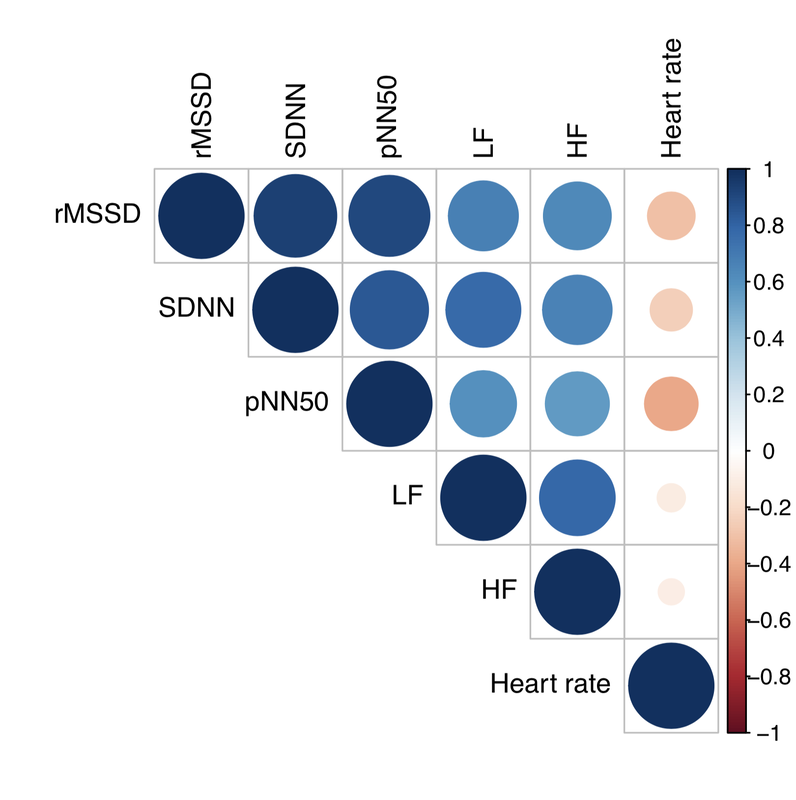
This correlation matrix provides a helpful visual summary of the relationships between these metrics. Notice the strong positive correlation (large, dark blue circles) between rMSSD, SDNN, and pNN50, as they all capture aspects of vagal activity.
CO₂ Tolerance and Breath Holds
As you learned in Module 4 and from Brian Mackenzie's talks, your sensitivity to carbon dioxide is a fundamental marker of your physiological and psychological state.
The Science of Breathwork - A Neurohacker Event with Brian Mackenzie
Let's revisit Mackenzie's explanation of CO₂ tolerance.
First, listen to his definition of CO₂ tolerance and his reframing of CO₂ as the "metabolic stress messenger". This is the "why" behind tracking it. Next, jump ahead to where he discusses a free CO₂ tolerance test. The specific test he mentions is a maximum exhale test, similar to the Genchi test. This directly translates into a quantifiable KPI for your training.
Your key objective KPIs here are:
- BOLT Score (Control Pause): The time you can comfortably hold your breath after a normal, passive exhalation. This is the most direct and practical measure of your functional CO₂ tolerance. An increasing BOLT score is a primary KPI for any goal related to respiratory efficiency or anxiety reduction.
- Maximum Breath Holds (Stange & Genchi): The maximum time for an inspiratory and expiratory hold, respectively. These measure the absolute limits of your capacity and can also be used as KPIs, particularly for goals related to athletic performance or freediving adaptations.
Subjective KPIs: The Qualitative Data
Objective numbers tell only part of the story. Your subjective experience is equally important. Your background in social research gives you a unique appreciation for the value of qualitative data in understanding complex systems. These KPIs are typically tracked through journaling or rating scales.
- Sleep Quality: Rated on a scale (e.g., 1-5) or with notes on time to fall asleep, number of awakenings, and how rested you feel upon waking.
- Perceived Stress/Anxiety: Using a standardized scale or simply rating your daily stress level from 1-10. Note specific instances of reactivity or calm.
- Mood and Emotional State: General mood, feelings of well-being, emotional stability.
- Focus and Cognitive Performance: Perceived ability to concentrate, mental clarity, or resistance to distraction.
Step 3: Mapping Goals to KPIs
The final step is to connect your primary goal to a specific set of KPIs. This ensures your measurement strategy is aligned with your training objective.
Here is a framework mapping the example goals from Step 1 to their corresponding KPIs:
Goal 1: Enhance Stress Resilience & Vagal Tone
- Primary Objective KPI: Increase in average morning RMSSD (measured daily over 5 mins).
- Secondary Objective KPIs:
- Decrease in average resting heart rate.
- Increase in HF power.
- Subjective KPIs:
- Higher sleep quality ratings.
- Lower daily perceived stress ratings.
- Journal entries noting reduced emotional reactivity to daily stressors.
Goal 2: Improve CO₂ Tolerance & Respiratory Efficiency
- Primary Objective KPI: Increase in BOLT score (measured 2-3 times per week).
- Secondary Objective KPIs:
- Increase in maximum expiratory hold time (Genchi test).
- Decrease in average resting respiration rate.
- Subjective KPIs:
- Feeling less "air hunger" during physical activity.
- Reduced feelings of anxiety or panic in triggering situations.
- Greater sense of calm throughout the day.
Goal 3: Maximize Cardiorespiratory Coherence
- Primary Objective KPI: Increase in LF power (absolute, in ms²) during resonance frequency breathing practice.
- Secondary Objective KPIs:
- Increase in HR Max-HR Min (the amplitude of heart rate swings) during practice.
- Closer heart rate-respiration phase synchrony (closer to 0°) during practice. (This requires advanced biofeedback software).
- Subjective KPIs:
- Improved ability to maintain focus during practice.
- Enhanced mental clarity and focus immediately following practice.
To select your KPIs effectively, you need a deep understanding of what they measure and how to assess them. The following guide is an invaluable resource for advanced KPIs related to resonance frequency.
A Practical Guide to Resonance Frequency Assessment for Heart ...
This paper details the process of finding and training at your resonance frequency. The metrics used for assessment are precisely the KPIs you can use for a coherence-focused training plan.
First, read the section "Terms and Definitions" to solidify your understanding of metrics like HR Max–HR Min and phase synchrony. Next, review the six weighted criteria in the section "Resonance Frequency Selection". These six criteria (Phase synchrony, Peak-trough amplitude, LF power, etc.) are a ready-made list of advanced KPIs for a goal centered on improving cardiorespiratory coherence.
Your Turn: Define Your Goal and KPIs
Now, it's time to apply this framework.
- Choose a Primary Goal: Select one of the three example goals above, or formulate your own specific, long-term adaptive goal for a 4-week training block.
- Select Your KPIs: Based on your chosen goal, list the following:
- One Primary Objective KPI that will be your main indicator of success.
- At least two Secondary Objective KPIs.
- At least two Subjective KPIs.
For each objective KPI, specify when and how you would measure it (e.g., "Morning RMSSD, measured daily for 5 minutes upon waking using a chest strap and HRV app").
This exercise will form the strategic foundation upon which you will build your detailed, week-by-week training plan.
Conclusion
In this lesson, you have learned how to move from designing a single session to laying the strategic groundwork for a multi-week training protocol. This involves establishing a clear primary goal and selecting a corresponding set of objective and subjective key performance indicators (KPIs) to track your progress. Without this crucial step, a training plan is merely a collection of exercises; with it, it becomes a purposeful, evidence-based journey of physiological adaptation.
Key Takeaways:
- A long-term breathwork plan must be guided by a single, clear primary goal focused on a durable physiological adaptation.
- Key Performance Indicators (KPIs) are essential for measuring progress and should include both objective and subjective measures.
- Objective KPIs like HRV (specifically RMSSD for vagal tone) and BOLT score (for CO₂ tolerance) provide hard data on autonomic and respiratory function.
- Subjective KPIs like sleep quality and perceived stress provide essential qualitative context to the quantitative data.
- The choice of KPIs must be directly aligned with your primary goal to ensure you are measuring what matters.
Now that you have the tools to define where you are going (your goal) and how you'll know you're getting there (your KPIs), our next lesson will address the "how." You will learn to design the progression logic for a protocol, detailing how to incrementally increase the challenge over a four-week period to drive adaptation and achieve your goal.