Introduction
In our last lesson, we explored Respiratory Sinus Arrhythmia (RSA), establishing that the brain's respiratory centers send a direct, rhythmic signal to the vagus nerve, causing your heart rate to fluctuate with your breath. This provides us with a powerful, non-invasive way to influence our autonomic nervous system (ANS). Today, we will build directly on that foundation to understand how we can move from passive observation to active intervention.
The learning outcome for this lesson is to explain how deliberate changes in breathing patterns can shift your autonomic balance. We will investigate the two primary directions of this shift: enhancing parasympathetic ("rest and digest") activity to promote calm, and stimulating sympathetic ("fight or flight") activity to increase alertness. For a statistician like you, accustomed to analyzing clinical trial data, we will ground these principles in physiological mechanisms and examine the evidence from meta-analyses and review articles. This lesson provides the core principles you'll need to start classifying techniques for your ultimate goal: creating a personalized "cheat sheet" and custom breathwork protocols.
The Autonomic Seesaw
Before we learn to manipulate the system, let's briefly revisit its core components. The ANS functions like a seesaw, constantly adjusting the balance between two opposing branches to meet the body's demands.
- Sympathetic Nervous System (SNS): This is the body's accelerator. It prepares you for action by increasing heart rate, blood pressure, and alertness.
- Parasympathetic Nervous System (PNS): This is the body's brake. It promotes states of "rest and digest," slowing the heart rate, aiding digestion, and facilitating recovery. The vagus nerve is the primary conduit for the PNS.
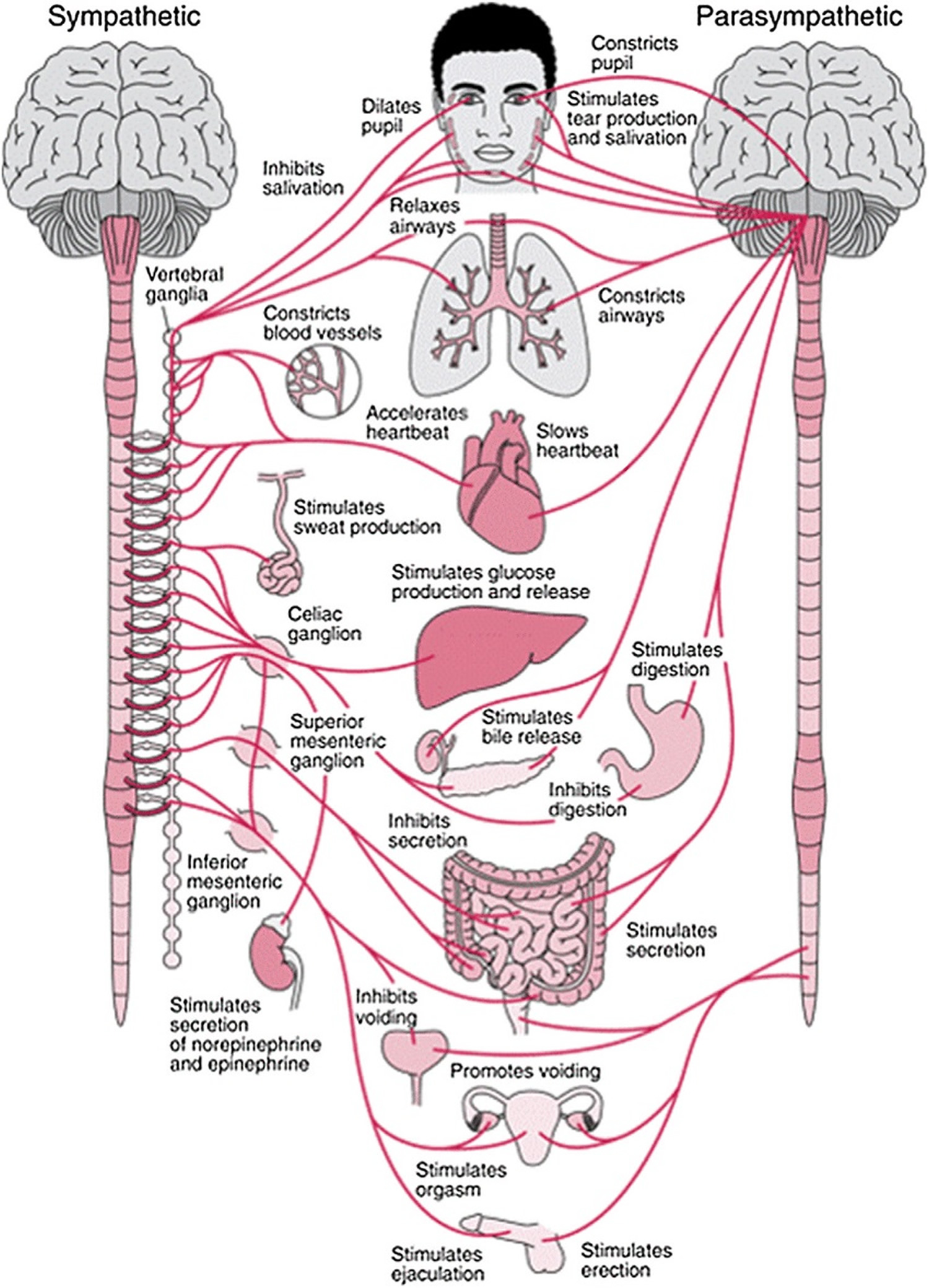
It is a common oversimplification to say that activating the vagus nerve always leads to a state of calm. While the vagus nerve is the main player in the parasympathetic response, certain vagal pathways are also involved in alerting the brain. The following short video provides a concise overview of this dualistic system.
Control Your Vagus Nerve to Improve Mood, Alertness & Neuroplasticity
This segment from Dr. Andrew Huberman's discussion on the vagus nerve introduces the concept of the autonomic nervous system as a "seesaw" and challenges the pervasive myth that vagus nerve activation is solely for calming.
Please watch from this section to understand the dynamic balance between the sympathetic and parasympathetic systems and the nuanced role of the vagus nerve.
Understanding that we can intentionally push this "seesaw" in either direction is the key to all goal-oriented breathwork.
Shifting Towards Calm: Enhancing Parasympathetic Tone
The most direct application of our knowledge of RSA is to deliberately enhance the "braking" action of the vagus nerve. As we established, exhalation is the phase of the breathing cycle where the vagal brake is applied most strongly. Therefore, the guiding principle for inducing a state of calm is:
To increase parasympathetic activity, emphasize the duration and/or intensity of your exhalations.
This action leverages the central feedforward mechanism we discussed in the last lesson. By consciously extending the exhale, you are instructing the respiratory centers in your brainstem to prolong the signal that activates the vagal neurons in the nucleus ambiguus, which in turn slows your heart rate.
Dr. Huberman explains this mechanism and introduces the physiological sigh—a technique you specifically asked about—which is perhaps the most efficient known respiratory tool for rapid stress reduction.
Control Your Vagus Nerve to Improve Mood, Alertness & Neuroplasticity
This clip details how conscious control of exhalation, particularly through extended exhales and the physiological sigh, rapidly activates the parasympathetic nervous system to induce a state of calm.
Please watch from this explanation. Note the distinction between the mechanical effect of an extended exhale and the combined mechanical and chemical effects of the physiological sigh.
The physiological sigh (two sharp inhales followed by one long, extended exhale) is effective because it accomplishes two things at once:
- Chemical: The double inhale maximally inflates the small air sacs (alveoli) in the lungs, allowing for a more efficient offloading of carbon dioxide during the subsequent long exhale. The brain senses this rapid reduction in CO2 and interprets it as a signal for safety and calm.
- Mechanical: The extended exhale triggers the powerful vagal brake on the heart, directly slowing its rate and shifting the autonomic seesaw toward the parasympathetic side.
The efficacy of slow breathing, particularly with an emphasis on exhalation, is well-supported by robust research. As someone with expertise in clinical trial literature, you will appreciate the findings of a recent systematic review and meta-analysis.
[PDF] Effects of voluntary slow breathing on heart rate and heart rate ... - HAL
This 2022 paper, published in Biological Psychology, synthesizes data from over 200 studies to quantify the effect of voluntary slow breathing (VSB) on vagally-mediated heart rate variability (vmHRV).
First, please read the Abstract to grasp the study's scope and top-line results. Next, focus on the first two paragraphs of the Discussion section (4 DISCUSSION). The authors explain why VSB increases vmHRV during, immediately after, and even chronically after an intervention period. Finally, read the Conclusion (5 CONCLUSION), which summarizes the main finding and its implications for health.
This meta-analysis confirms that VSB leads to a statistically significant increase in vmHRV (as measured by parameters like RMSSD and LF-power during slow breathing). The authors conclude that "the vagus nerve is likely the common mechanism underlying the positive physical and mental health effects" of these techniques.
For a statistician, one of the most interesting parts of a meta-analysis is the assessment of publication bias. The authors of this study provide funnel plots for their analyses.

Shifting Towards Alertness: Stimulating the Sympathetic System
Now for the less intuitive but equally critical side of the equation: using breathing to increase alertness and energy. This moves beyond the simple RSA mechanism and involves a more complex neuro-hormonal cascade.
The guiding principle here involves using physical effort and forceful breathing to trigger the release of adrenaline.
To increase sympathetic activity, engage in forceful, rapid breathing patterns that activate the large muscles of the trunk and diaphragm, triggering an adrenaline-mediated alertness response.
This pathway shows how the vagus nerve, contrary to popular belief, is also a key player in the alerting response.
Control Your Vagus Nerve to Improve Mood, Alertness & Neuroplasticity
In this segment, Dr. Huberman details a fascinating pathway that explains how physical movement and associated breathing patterns can robustly increase alertness in the brain, with the vagus nerve acting as a crucial intermediary.
Please watch this clip from the explanation. Pay close attention to the sequence of events: Movement of large muscles. Adrenaline release from the adrenal glands. Adrenaline binding to receptors on the vagus nerve. Vagal signal to the brainstem (NTS, then locus coeruleus). Norepinephrine (noradrenaline) release throughout the brain.
This mechanism is fundamental to understanding the effects of activating techniques like Kapalabhati, Bhastrika (which you may remember from Pranayama), or the Wim Hof Method. These practices are not just about breathing fast; they are about using the respiratory muscles forcefully to create a state of physiological stress that culminates in a profound sense of alertness, focus, and energy. The body releases adrenaline, but because adrenaline itself cannot cross the blood-brain barrier, the vagus nerve acts as the essential communication link, telling the brain to match the body's state of arousal.
Conclusion
Today, we've moved from theory to application, establishing the fundamental principle of autonomic control via the breath. You now have the foundational rulebook for classifying and understanding the purpose of any breathwork technique.
Key Takeaways:
- The Autonomic Seesaw: Deliberate breathing allows you to consciously shift the balance between your sympathetic (alertness) and parasympathetic (calm) nervous systems.
- The Path to Calm: To activate the parasympathetic system, use slow breathing that emphasizes and prolongs the exhalation phase. This directly engages the vagal brake on the heart, increasing HRV and promoting relaxation. The physiological sigh is a potent example.
- The Path to Alertness: To activate the sympathetic system, use forceful and often rapid breathing to engage the body's large muscles. This triggers an adrenaline release, which signals the brain—via the vagus nerve—to increase global alertness and focus.
- Evidence-Based: These principles are not theoretical. Meta-analyses confirm that slow breathing increases vagal activity, and physiological studies have mapped the specific neural pathways responsible for both calming and alerting responses.
You are now equipped with the "why" behind manipulating your autonomic state. In our next lesson, we will begin a systematic deconstruction of the "how." We will identify the five core variables of any breathing technique—rate, depth, ratio, holds, and route (nasal vs. oral)—and begin to explore how each parameter can be adjusted to achieve a desired physiological outcome. This will be the next critical step in building your comprehensive "cheat sheet."