Hello. In the previous lesson, a 12-week care diary showed why fewer new comedones, persistent sebaceous filaments, and treatment irritation must be interpreted separately. This final lesson adds a different decision: when is gentle care reasonable, when should a clinician assess the skin, and when should care be urgent?
The aim is not to diagnose a spot from a photograph. It is to recognize when the consequences of waiting—or treating an uncertain lesion as a clogged pore—matter more than trying another product. Allow about 35–40 minutes, including the readings and short video excerpts.
Start with the pattern, not the closest-looking photograph
A few familiar, small comedones without significant pain or skin injury usually leave room for gentle self-care. A deep painful lump, a new indentation where acne healed, or a spot that changes or bleeds belongs in a different category. The appearance of surrounding skin matters too: spreading warmth, swelling, and tenderness is not the usual pattern of a simple blackhead.
The NHS page Acne provides useful visual context across several skin tones. Its examples are illustrations of features, not a test that can confirm what an individual spot is.
Read the NHS descriptions and spot gallery to compare small comedones with deeper lesions and possible scarring.
In “Symptoms of acne,” read the severity clues, from the opening paragraph through the symptom list. Then, in “Types of acne spots,” read the spot gallery from its introductory sentence through the final scar photograph and finish that photograph’s caption. Focus on the distinction between small surface spots, painful nodules or cysts, and changes in skin texture after spots heal.
The side-by-side image below also shows why texture deserves attention. Its two faces are examples, not a before-and-after treatment result; lighting and photographs alone cannot establish the cause or age of a mark.
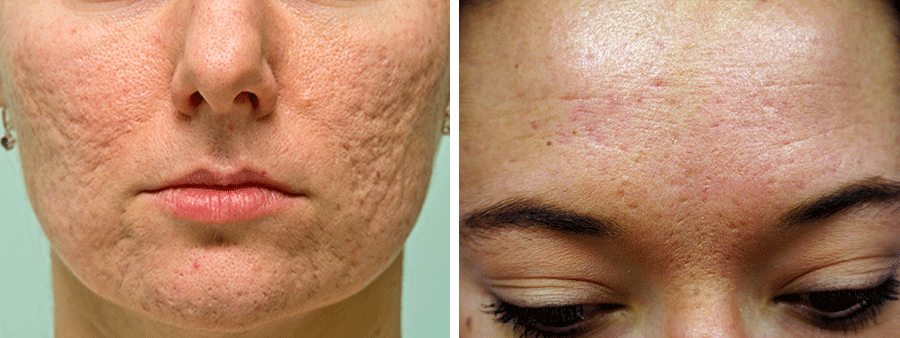
Color alone is a less reliable guide than a cluster of signs. Inflammation may appear pink or red on lighter skin and brown or purple on darker skin; redness from a possible infection can also be harder to see on brown and black skin. Pay attention to pain, heat, swelling, spread, and feeling unwell, not only to whether an area looks bright red.
When gentle self-care is a reasonable choice
Consider numerous fine, fairly even dots across the nose that have looked much the same for months. The skin is comfortable, with no enlarging lumps or changing individual spot. That pattern may fit normal sebaceous filaments better than acne. It does not call for extraction or a stronger treatment simply because the dots remain visible.
Likewise, a few likely comedones without deep pain or scarring can generally be managed with the gentle routine already covered: cleanse without scrubbing, use moisturizer and sunscreen, avoid picking, and give a tolerable acne treatment time to work according to its directions. Self-care is an option, not an obligation to achieve perfectly smooth skin. A person who wants help distinguishing the spots or choosing treatment can seek a clinician’s advice even when the problem is mild.
Time matters only when the pattern remains reassuring. An unchanged comedone after several days is not a reason to intensify treatment. A spot that is changing in an unfamiliar way, however, should not be assigned an 8–12-week “acne trial” just because it happens to be on the face.
When to arrange a medical or dermatology appointment
The threshold for an appointment is not “severe acne only.” The NHS recommends medical advice when self-treatment is not helping, spots are numerous or deep and painful, scars are developing, or acne affects mental health. Depending on the healthcare system, a primary-care clinician may treat acne directly or arrange dermatology assessment.
Return to the NHS page for its guidance on when acne needs medical help.
In “When and where to get medical help,” start at “You may need to get help from a GP for acne.” Read the help criteria through the “See a GP if” list and the paragraph immediately after it. Note that deep painful spots, scarring, unsuccessful self-treatment, and mental-health impact are each reasons to seek help; the list also mentions signs of skin infection, which require attention to how quickly symptoms are developing.
Suppose someone’s diary shows consistent, tolerable care over roughly 10 weeks but many new comedones continue to form. An appointment is more useful than repeatedly squeezing them or escalating products beyond their labels. If new deep, tender lumps or depressions in skin texture appear, arrange assessment sooner rather than waiting for the trial period to end. Scarring risk changes the balance: preventing further injury matters more than proving that an over-the-counter plan has “failed.”
The American Academy of Dermatology puts treatment expectations alongside reasons to see a dermatologist. Read its short opening section to distinguish giving a suitable treatment time from waiting indefinitely despite a problem.
9 things to try when acne won’t clear
Read the American Academy of Dermatology’s guidance for treatment timing and reasons to seek dermatology care.
Under tip 1, “Give an acne treatment at least 4 weeks to work,” read the timing and referral advice through the three bullets beneath “When to see a dermatologist about acne?” Stop before tip 2, “Attack the different causes of acne.” Notice that early improvement and complete clearing have different timelines, and that distress about acne is a valid reason to ask for help.
Diagnostic uncertainty is another reason for assessment. A single dark or skin-colored spot that looks unlike surrounding pores should not automatically be called a blackhead. Arrange a clinician or dermatology appointment for a lesion that is new and changing, repeatedly or spontaneously bleeding, persistently crusting, or otherwise unusual for you. This does not mean every such spot is dangerous; it means an examination is more appropriate than extraction or acne medication. If it bleeds once because it was picked, stop picking and allow it to heal—but obtain assessment if bleeding recurs or it does not heal. If an appointment is difficult to obtain promptly for a rapidly changing lesion, seek earlier clinical advice rather than waiting through an acne-treatment trial.
When symptoms need urgent assessment
A localized pimple can be tender. That is different from an area of skin becoming increasingly hot, swollen, painful, and spreading, particularly with a possible fever or feeling ill. This pattern raises concern for a skin infection such as cellulitis. It needs prompt medical assessment, not a pore strip, an extraction tool, or another acne active.
In Cellulitis Explained By Infectious Disease Doc. Red, Sore And Swollen, Talking With Docs describes the typical combination of pain, swelling, and visible inflammation, then emphasizes the significance of rapid spread.
Cellulitis Explained By Infectious Disease Doc. Red, Sore And Swollen
Watch these brief excerpts from Talking With Docs to connect the signs of a possible skin infection with the need for prompt assessment.
Watch infection signs for the description of painful, swollen skin and how infection can occur when the skin barrier is compromised. Then watch rapid spread for why enlargement over minutes or hours needs urgent care. A video cannot establish whether a particular area is infected; do not use watching or marking an area’s edge as a reason to delay care when concerning symptoms are present.

For spreading painful warmth and swelling, especially with fever or feeling unwell, seek same-day urgent medical advice or assessment. If spread is rapid over hours, the person is significantly unwell, or swelling involves the area around an eye, use emergency services or an emergency department according to local arrangements. Do not wait for a routine dermatology visit. A painful, enlarging area after picking or tool use warrants the same caution: cleaning the tool beforehand would not rule out injury or infection.
This distinction also prevents overreaction to every warm acne bump. A stable, isolated deep acne lesion may call for a timely routine appointment because of pain or scarring risk. Diffuse, expanding inflammation or systemic illness changes the decision to urgent assessment. If the pattern is unclear but infection seems possible, seek prompt clinical advice rather than trying to classify it from an image.
A compact decision rule
The three choices depend on what is happening now, not on how confidently a spot can be named:
| Pattern | Appropriate next step |
|---|---|
| Familiar, mild, non-painful pore or acne pattern; skin otherwise comfortable and stable | Gentle self-care and observation without squeezing |
| Uncertain or changing lesion; persistent acne despite a reasonable treatment trial; deep painful spots, emerging scars, or substantial distress | Arrange a medical or dermatology appointment; do not wait out a treatment trial for a changing or bleeding lesion |
| Spreading painful warmth and swelling, particularly with possible fever or illness | Same-day urgent assessment; use emergency care for rapid spread, significant illness, or swelling near an eye |
When signs from different rows coexist, the more urgent sign takes priority. For example, a person may have ordinary blackheads and a separate enlarging, hot, swollen area. The familiar blackheads do not make the new area safe to extract or ignore.
Key takeaways
Gentle care is reasonable for stable, mild, familiar pore changes without warning signs; normal sebaceous filaments need not disappear. Persistent or scarring acne, deep painful lesions, meaningful distress, and spots that are changing or bleeding deserve a clinician’s assessment. Spreading painful warmth and swelling—especially with possible fever—calls for urgent care, not acne self-treatment.
That completes the course’s central distinction: the goal is not to become skilled at removing what appears in a close-up video, but to care for skin without unnecessary injury and recognize when an in-person assessment is the safer tool.