Introduction
In our previous module, we concluded by designing a transformation plan for an architecture function, shifting its focus from control to enablement. A recurring theme in that plan was the critical need to reduce the cognitive load on development teams by providing them with a solid, self-service platform. This concept serves as the perfect bridge to our new module, which is entirely dedicated to the principles and practices of Platform Engineering.
This lesson marks our entry into this topic. Our goal is to define platform engineering and distinguish it from traditional infrastructure and DevOps roles. For you, with your extensive background in software engineering, this isn't about learning what a server or a CI/CD pipeline is. Instead, we will focus on the strategic and organizational distinctions: the "why" behind this movement and how it reshapes team responsibilities, incentives, and ultimately, a company's ability to deliver value. This will lay the groundwork for understanding the platform as a core element of modern system architecture.
The Rise of Platform Engineering: Taming Complexity
Over the last decade, DevOps has rightfully become the standard for high-performing teams. The "you build it, you run it" philosophy empowers teams with end-to-end ownership. However, as systems grow in complexity and organizations scale, a significant challenge emerges: an explosion of cognitive load. Each product team finds itself responsible for a sprawling collection of concerns—infrastructure provisioning, CI/CD pipelines, security scanning, observability, networking, and more—distracting them from their primary mission of delivering features.
Platform engineering arises as a direct response to this problem. It aims to refocus delivery teams on their core purpose by providing a curated, self-service foundation.
The CNCF Platforms White Paper provides an excellent summary of this motivation.
CNCF Platform Engineering Whitepaper - DaoCloud Enterprise
This document from the Cloud Native Computing Foundation is a foundational text on platform engineering. It explains the core business and technical drivers behind this shift.
Please read the section "Why platforms?" Pay attention to how it frames the problem as a consequence of shifting responsibilities onto product teams and the resulting reduction in their capacity to produce business value.
What is a Platform?
With the "why" established, let's define the "what." A common mistake is to think of a platform as just a pile of infrastructure. The modern definition is much more nuanced and product-oriented. It's not just about providing raw materials; it's about offering a cohesive, streamlined experience.
Leading thinkers in this space, like Martin Fowler and Evan Bottcher, emphasize this distinction. The CNCF paper you just looked at summarizes these definitions well.
CNCF Platform Engineering Whitepaper - DaoCloud Enterprise
Let's continue with the same paper to get a formal definition.
Now, read the section "What is a platform." The key phrases to focus on are "foundation of self-service APIs, tools, services, knowledge and support" and "compelling internal product." This shifts the perspective from a collection of technologies to a product designed for internal customers (developers).
To visualize what these capabilities and interfaces look like in practice, consider the following diagram from the CNCF.

A platform, therefore, is an abstraction layer. It provides developers with what they need through well-designed interfaces, without requiring them to become experts in the underlying implementation details.
For a dynamic and developer-centric take on this, Daniel Bryant's talk is highly insightful.
Platform Engineering for Software Developers and Architects - Daniel Bryant, Syntasso
In this excerpt from "Platform Engineering for Software Developers and Architects," Daniel Bryant reinforces the definition and stresses the crucial importance of having clear goals for your platform. This aligns directly with your interest in the business side of technology.
Please watch the segment from the definition of a platform. Note his emphasis on treating the platform as a "compelling internal product" and the danger of building a platform without first asking what problems it's meant to solve for its users.
Platform Engineering vs. DevOps
A common point of confusion is how platform engineering relates to DevOps. Is it "the new DevOps"? The answer is no. Platform engineering is an enabler for DevOps at scale.
In a small organization, a single team can effectively practice DevOps, managing its own tools and infrastructure. As an organization grows to dozens or hundreds of teams, having each one build and maintain its own bespoke toolchain becomes massively inefficient and inconsistent. Platform engineering addresses this by creating a shared, standardized, but flexible foundation that all teams can leverage.
The following article from Red Hat provides a clear, practical distinction.
Platform engineering vs. DevOps
This article is designed to directly compare the two concepts. It uses a helpful analogy to make the difference intuitive.
First, quickly review the section on DevOps to refresh the core principles. Next, read the section defining platform engineering. The cooking analogy presented here is a very effective way to understand the problem platform engineering solves. Finally, read the section on how they differ. The key insight is that a platform team allows development teams to focus on their application components while the platform team focuses on the platform components.
The organizational implications are profound. The diagram below illustrates the different structures.
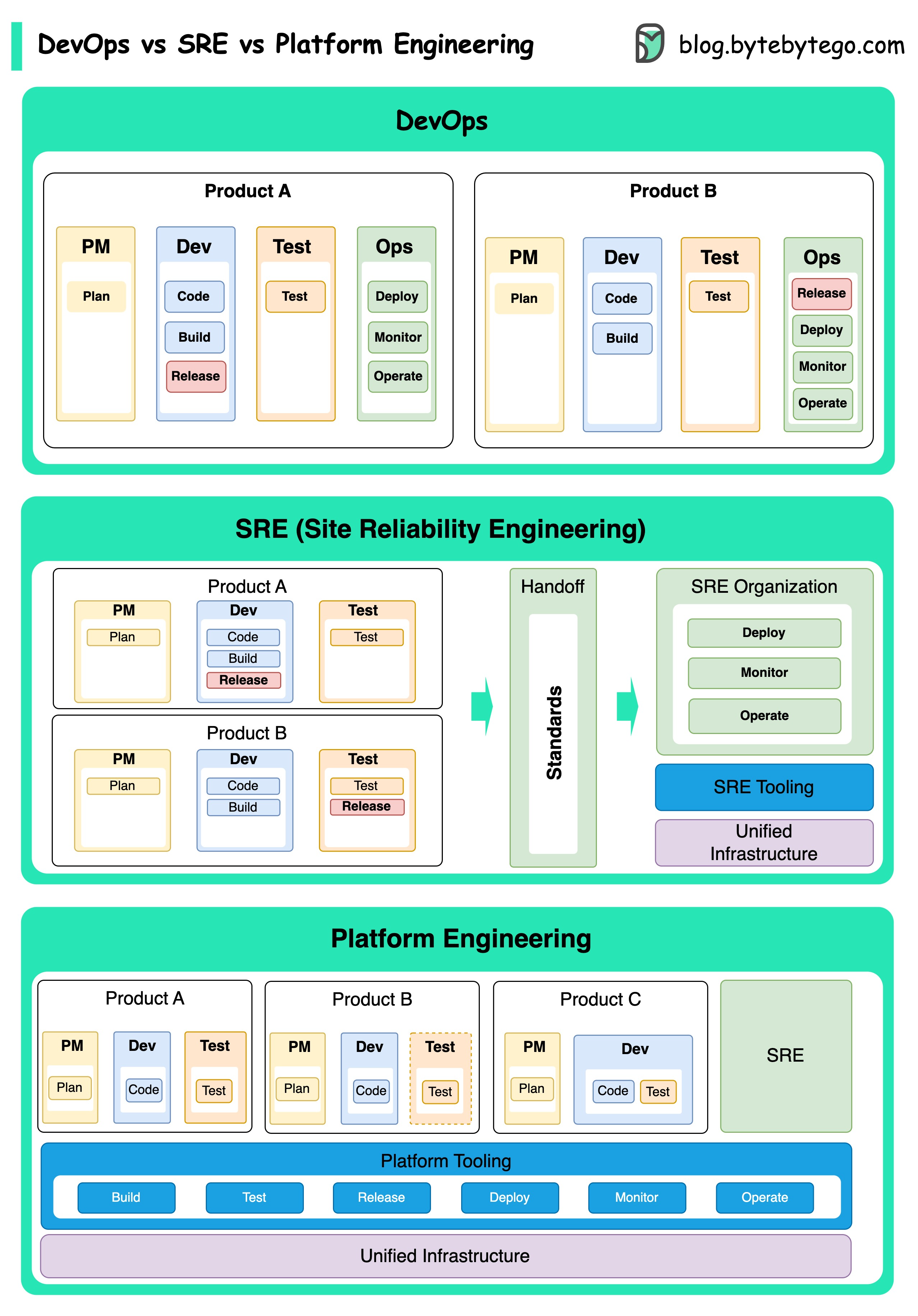
To summarize the distinction:
- DevOps is a cultural and process-oriented methodology focused on breaking down silos and enabling teams to own their services end-to-end ("You build it, you run it").
- Platform Engineering is a discipline that creates the underlying tools, services, and "paved roads" that make it feasible for many teams to practice DevOps efficiently, securely, and consistently across a large organization.
Platform Engineering vs. Traditional Infrastructure
If platform teams provide infrastructure, how are they different from the traditional Ops or central infrastructure teams that have existed for decades? The difference is not in the technology they manage, but in their mindset, mission, and relationship with developers.
Traditional infrastructure teams often operate as a cost center. Their primary goals are stability and cost optimization. The interaction model is typically ticket-based: a developer files a request for a VM or a database and waits for it to be fulfilled.
Platform engineering teams operate as a product organization. Their customers are the internal developers, and their mission is to improve developer productivity and experience (DevEx).
Camille Fournier, a respected engineering leader, articulates this difference with exceptional clarity.
Starting and Scaling a Platform Engineering Team - Camille Fournier & Ian Nowland
In this talk, "Starting and Scaling a Platform Engineering Team," Camille Fournier and Ian Nowland draw a sharp contrast between modern platform teams and old-school infrastructure teams.
Watch the segment from "cannot go the route of the old school". Pay close attention to the distinction between a "cost center mindset" and a "product focused approach." Then, to see this in action, watch the case study presented by Ian Nowland about a data platform team at Datadog, starting from the product thinking section. He defines the "product thinking" approach for platforms as balancing three key stakeholders: The Platform Team's Health: Is the work sustainable? The Internal Developers' Effectiveness: Are we providing leverage? The Business's Value: Are we delivering what the business needs in a relevant timeframe?
This case study is powerful because it shows the consequences of an Ops-centric mindset (operational hell, SLAs as weapons, building things in isolation) versus a product-centric one. A traditional infrastructure team might see its job as done once a database is running. A platform team, guided by product thinking, sees its job as ensuring developers can successfully and painlessly use that database to ship features that create business value.
This distinction can be summarized as follows:
| Dimension | Traditional Infrastructure Team | Platform Team |
|---|---|---|
| Mission | Maintain stability, control costs | Improve developer productivity & experience |
| Mindset | Cost Center | Product Organization |
| Primary Customer | The business/finance department | Internal developers |
| Interaction Model | Ticket-driven, reactive fulfillment | Self-service APIs, proactive user research |
| Key Metric | Uptime, cost per server | Developer satisfaction, adoption rate, lead time |
| Output | Raw resources (VMs, networks) | Curated capabilities, "golden paths" |
Conclusion
In this lesson, we established the foundational concepts of platform engineering. We've seen that it's not simply a rebranding of old roles but a strategic response to the complexities of developing software at scale in the cloud-native era.
Key Takeaways:
- Platform engineering solves the cognitive load problem that emerges when DevOps practices are scaled across many teams, allowing developers to focus on delivering business value.
- A platform is best understood as a "compelling internal product" for developers, providing a foundation of self-service APIs, tools, and curated experiences, not just raw infrastructure.
- Platform engineering enables and scales DevOps; it does not replace it. It provides the paved roads that allow "you build it, you run it" to be efficient and consistent.
- The most crucial distinction from traditional infrastructure teams is the product mindset. Platform teams treat developers as customers and are obsessed with improving their productivity and experience.
Preview of the Next Lesson
Now that we have a clear definition and understanding of how platform engineering fits into the organizational landscape, our next lesson will go deeper into the "platform-as-a-product" mindset. We will explore the core components of a modern Internal Developer Platform (IDP), how to measure and improve developer experience (DevEx), and the role of "golden paths" in guiding developers effectively.