Introduction
In our last lesson, we explored the primary architectural patterns for integrating AI models into your systems: the Gateway, Sidecar, and Embedded model patterns. This gave us a structural foundation for how to connect AI components. Now, we will confront the deeper architectural implications of this integration.
This lesson addresses a critical shift in system design thinking. Traditional software components are largely deterministic; given the same input, they produce the same output. AI components, particularly those using Large Language Models, are probabilistic. This fundamental difference means our established approaches to reliability, observability, and failure analysis are no longer sufficient. Our goal is to evaluate the impact of AI integration on system reliability, observability, and failure modes, providing you with the architect's perspective needed to build robust AI-powered systems.
The Core Challenge: From Deterministic to Probabilistic Systems
As an experienced software engineer, you've spent your career building and maintaining systems where reliability is engineered through predictable behavior. An API call either succeeds (200 OK) or fails (4xx/5xx). A function's output is a direct, testable consequence of its input.
AI agents change this equation. They interact with the world, reason, and act based on probabilistic models. This introduces uncertainty at the very core of your system. The most crucial mental model to adopt is that reliability in AI is a system problem, not just a model problem. The moment an agent interacts with external systems (a browser, an API, a database), it becomes a component in a distributed system—and an unpredictable one at that.
The following video segment provides an excellent framing for this challenge.
AI Reliability Architecture (ReAct, Guardrails, HITL)
The video "AI Reliability Architecture" from ByteMonk sets the stage perfectly by arguing that we must apply the same reliability engineering principles from distributed systems to AI agents.
Watch the introduction from the beginning. The speaker makes a compelling case for why simply using a "better model" doesn't solve reliability issues and reframes the problem as one of distributed system design, a perspective that should resonate with your background.
A New Taxonomy of Failure
Because AI systems are probabilistic, they fail in ways that traditional systems do not. A simple 500 Internal Server Error is the least of your worries. The failures are often subtle, semantic, and can cascade through the system in unexpected ways.
Let's explore the most common failure modes you must anticipate. The AWS Architecture Blog provides a structured framework for this.
Build resilient generative AI agents | AWS Architecture Blog
This article from AWS provides a clear, actionable breakdown of the top resilience problems specific to generative AI agents. It translates classic reliability concerns into the new context of AI.
Please read the section "Top 5 resilience problems for agents and mitigation plans." As you read through the five failure modes—Shared Fate, Insufficient Capacity, Excessive Latency, Incorrect Agent Response, and Single Point of Failure—focus on how they differ from their traditional software counterparts. For example, "Insufficient Capacity" isn't just about RPM, but about unpredictable, recursive token consumption.
Let's synthesize the key failure modes from this reading and other resources:
-
Incorrect or Unreliable Responses: This is the most well-known failure. It includes:
- Hallucinations: The model generates factually incorrect or nonsensical information.
- Lack of Groundedness: The response is plausible but not based on the provided context (e.g., from a RAG system).
- Semantic Drift: Over time, as prompts or models are tweaked, the meaning or style of the output changes in undesirable ways.
-
Failure Cascades (Shared Fate): AI agents often operate in loops (e.g., think, act, observe). An error in one step doesn't just cause that step to fail; it "poisons" the input for the next step, leading the agent down a completely wrong path. A bad tool result or a misinterpretation of the environment can cause the agent to confidently and repeatedly perform the wrong action.

-
Brittle Tool and Service Integrations: An agent is only as good as the tools it can use. If an API it relies on is poorly designed (e.g., lacks proper filtering, sorting, or pagination), the agent's reasoning may break down. The model might correctly deduce it needs the "latest order," but if the
get_orderstool doesn't support sorting by date, the agent will fail. This is a common and often overlooked failure point, as highlighted in the Softcery article "Why AI Agents Fail in Production." -
Resource and Cost Exhaustion: Unlike a standard API with predictable costs, LLM costs are tied to token consumption. A poorly designed prompt can lead to unintended recursive loops or excessively verbose reasoning from the agent, causing costs to spiral. Similarly, resource-intensive requests (e.g., "summarize this 100-page document") can create denial-of-service vectors that are not based on request volume but on request complexity.
-
Security Vulnerabilities: The primary interface to an LLM is natural language, which opens the door to prompt injection. A malicious user can craft input that tricks the model into ignoring its original instructions, revealing sensitive data, or performing unauthorized actions.
Observability: You Can't Fix What You Can't See
Your existing Application Performance Monitoring (APM) stack, which tracks metrics like CPU usage, API latency, and error rates, is necessary but critically insufficient for AI systems. It can tell you if your AI service is available, but not if it's correct or safe.
We need a new layer of observability focused on behavioral quality.
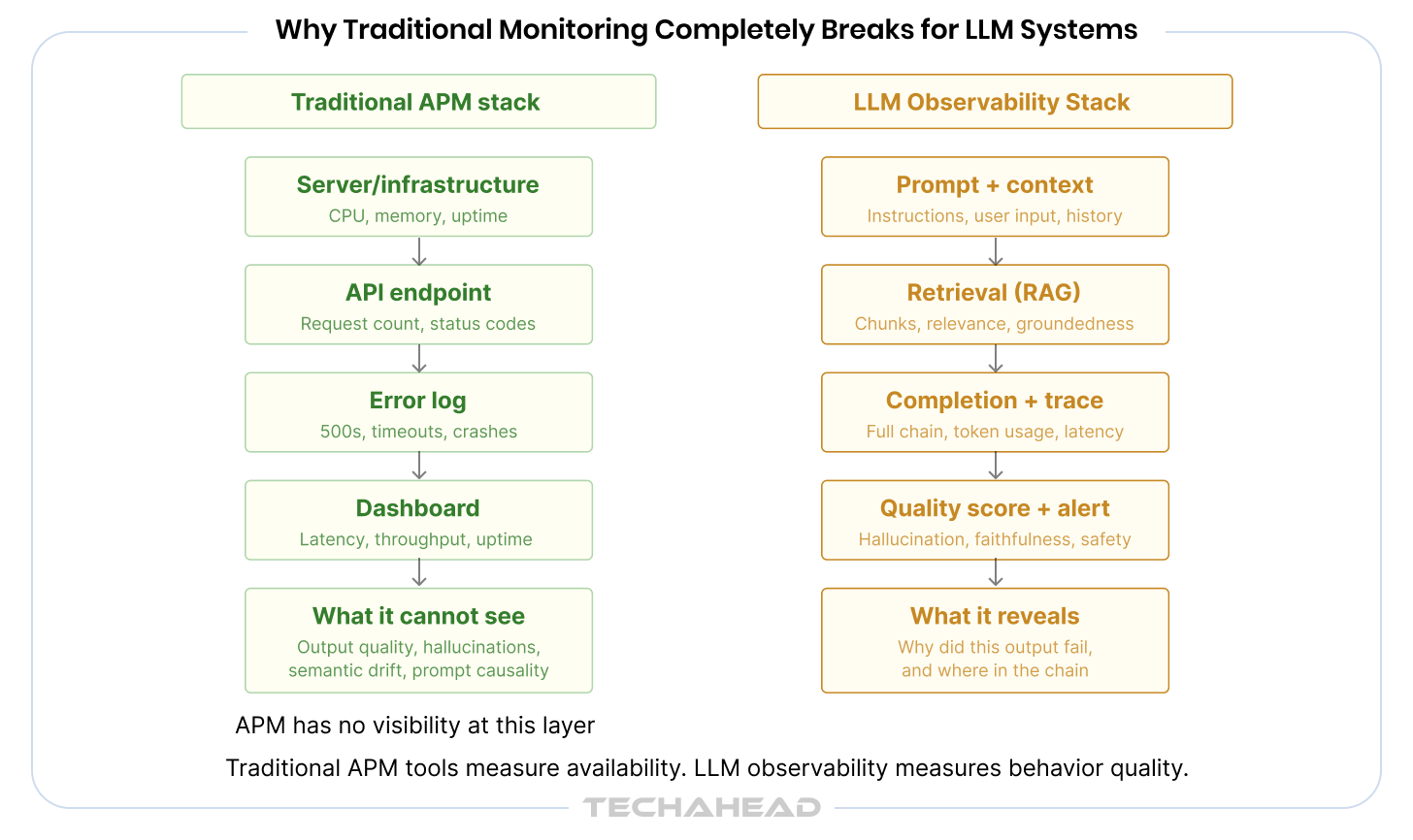
So, what should we be monitoring? The key is to capture the entire reasoning process. This includes:
- The initial prompt and all context provided.
- Each intermediate "thought" or reasoning step the model takes.
- Every tool call made, including the parameters and the results returned.
- The final response generated.
- Metrics like token counts, latency per step, and user feedback (e.g., thumbs up/down).
This detailed tracing allows you to reproduce a failure and debug the agent's logic, not just its code.
For evaluating the quality of the output itself, we need a new set of metrics. The following video provides an outstanding overview of how to measure the accuracy and trustworthiness of a RAG-based system, but the principles apply broadly.
How to Make Smart Architecture Decisions when Building Gen AI Apps • Gillian Armstrong • GOTO 2024
In her GOTO 2024 talk, Gillian Armstrong provides a practical guide to the metrics that matter for evaluating the quality of AI-generated answers.
Please watch the segment from "Accurate and Trustworthy Information." Pay close attention to the definitions of: Context Recall and Context Relevance: Did we retrieve the right information? Faithfulness: Did the model use the provided information correctly (i.e., not hallucinate)? Answer Relevance: Did the model actually answer the user's question?
These metrics—Faithfulness, Relevance, and Recall—form the bedrock of AI observability. They move us from "did it run?" to "did it do the right thing?"
Engineering for Reliability: A Layered Defense
We cannot eliminate non-determinism, but we can build a system around the AI component that contains it. This involves applying familiar reliability patterns and introducing new ones designed specifically for AI. Your experience with distributed systems is a strong asset here; think of this as building a sophisticated set of fault tolerance mechanisms.
The ByteMonk video on "AI Reliability Architecture" presents a clear, multi-layered approach to this problem.
AI Reliability Architecture (ReAct, Guardrails, HITL)
This video details a production-grade architecture for reliable AI agents, moving beyond a simple reasoning loop to a full stack of verification, safety, and escalation.
Watch the core architectural breakdown starting from the stack overview. Focus on the role of each layer: Verification Layer: Checks post-conditions to ensure an action had the intended effect. Guardrails: Enforces safety constraints, acting like "IAM for agents." Human-in-the-Loop (HITL): The critical escalation path for when the agent's confidence is low or a high-stakes decision is required.
Let's solidify these concepts.
-
Verification: Don't assume an action succeeded. After an agent performs an action (e.g., "click the 'Submit' button"), the system should observe the new state and verify that the expected outcome occurred (e.g., "the page now shows 'Order Confirmed'"). This closes the loop that prevents many failure cascades.
-
Guardrails: These are programmatic safety checks that prevent the agent from taking dangerous or prohibited actions. A powerful example is preventing text-to-SQL agents from executing
DELETEorUPDATEqueries. Gillian Armstrong's talk contains a stark warning about this. In her example, a simple user request could be translated by the LLM intoDELETE all the orders. A guardrail would inspect the generated SQL and block it before it ever reaches the database. -
Human-in-the-Loop (HITL): No production AI system should be fully autonomous for critical tasks. A well-designed system knows when it's out of its depth. When the model's confidence score is low, or when it encounters a situation it has never seen, it should pause and escalate to a human operator for a decision. This not only ensures accountability but also creates a vital feedback loop for improving the system.
Conclusion
In this lesson, we've moved beyond the mechanics of AI integration to the architectural strategies required to manage its inherent unpredictability. You've learned how the shift from deterministic to probabilistic components introduces new and complex failure modes, demands a more sophisticated approach to observability, and requires a layered defense system to ensure reliability.
Key Takeaways:
- AI Introduces Non-Determinism: The core challenge is that AI components are probabilistic, making reliability a system-wide design problem, not just a model-tuning one.
- New Failure Modes Emerge: You must architect for failures like hallucinations, reasoning cascades from poisoned inputs, brittle tool integrations, and security risks like prompt injection.
- Observability Must Evolve: Traditional APM is insufficient. AI systems require observability into behavioral quality, using metrics like faithfulness and relevance, and detailed tracing of the agent's reasoning process.
- Reliability is Engineered in Layers: Robust AI systems use a layered defense, including verification of actions, guardrails to enforce safety, and human-in-the-loop escalation paths for accountability.
Preview of the Next Lesson:
We have now established the fundamental challenges and architectural patterns for integrating a single AI component reliably. In our next lesson, we will begin our deep dive into Designing AI Agentic Architectures. We will formally define what an "agent" is, distinguishing it from simpler AI integrations, and explore common agent design patterns like ReAct (Reason-Act), which you've had a glimpse of in this lesson, to build more sophisticated and capable systems.