Welcome to the first lesson in our journey to build your "Modern Software Architect" certification course. We'll begin by establishing the foundational shift in thinking that underpins the entire program: the evolving role of the software architect.
This lesson directly addresses the first learning outcome: describing how the architect's role has moved from that of a centralized gatekeeper to a distributed enabler. Understanding this transformation is crucial, as it provides the "why" behind the subsequent topics we'll cover, including decentralized decision-making, platform engineering, and even how to integrate AI agents effectively. Given your extensive experience as a software engineer, you've likely witnessed and felt the effects of this evolution firsthand. Our goal here is to formalize that intuition into a clear, teachable framework.
1. The Traditional Model: The "Ivory Tower" Architect
For many years, the term "software architect" conjured a specific image: a senior figure, somewhat detached from the daily reality of coding, who would create comprehensive designs upfront. This "ivory tower" architect handed down diagrams and specifications for development teams to implement, acting as a centralized authority and a gatekeeper for all significant technical decisions.
While this model offered a sense of control, the rapid acceleration of software delivery has exposed its limitations. To explore this traditional stereotype and the beginnings of its decline, let's turn to an interview with Neal Ford, a prominent voice in the field.
Neal Ford of ThoughtWorks on the growing role of software architects
Please watch this segment from the O'Reilly video, "Neal Ford of ThoughtWorks on the growing role of software architects."
In this clip, Ford discusses the negative connotation the term "architect" once had. Pay close attention to his description of the ivory tower architect and his explanation for why this role has become less relevant. He points out that you can't operate purely at a level of abstraction and must consider operational concerns and the evolution of the system over time. This insight sets the stage for the modern architect's role.
The core problem with the ivory tower model in today's environment is that it creates a bottleneck. As organizations and systems scale, a central authority cannot possibly maintain deep expertise across all domains, nor can it make decisions quickly enough to keep pace with agile teams.
2. The Driving Forces of Change
What caused this model to break? The answer lies at the intersection of technology and business—a connection that aligns with your interest in economics. The world simply started moving too fast.
- Business & Market Velocity: Business models now have shorter lifespans. Customer expectations are set by fast-moving consumer apps, not by competitors in your specific industry. A system whose architecture is rigid and difficult to change cannot adapt to these pressures.
- Technological Evolution: The rise of paradigms like cloud computing, containers (e.g., Docker), and microservices fundamentally changed the cost and complexity of deploying and evolving software. Architecture had to adapt to leverage these new capabilities.
This new reality demands an architecture that can evolve. To explore this imperative, please read a short excerpt from a podcast transcript featuring Rebecca Parsons, CTO of ThoughtWorks.
#201 - Building Evolutionary Architectures: Automated Software ...
This transcript explains why the need for an evolutionary approach to architecture has become a necessity, not a choice.
Please read the section under the heading "Why Adopt Evolutionary Architecture." The speaker clearly articulates how business and consumer expectations, which you can't control, create an environment where a static architecture is a liability.
An architecture that cannot change is a significant business risk. Consequently, the role of the person guiding that architecture had to change as well.
3. The New Model: The Architect as a Distributed Enabler
If the architect is no longer a centralized gatekeeper, what are they? The modern architect is a decentralized enabler. Their primary function shifts from making every decision to enabling teams to make great decisions.
A powerful way to frame this evolution is the "Parental Metaphor," which casts the architect's relationship with development teams as a journey from dependence to interdependence.
Architecting Autonomy at Scale: Raising Teams without Creating ...
This article from InfoQ provides a practical framework for decentralizing architecture. We will refer to it throughout the first half of this course.
First, read the section titled "The Architecture Bottleneck," which uses the analogy of a centralized lock in a distributed system. Then, continue through the section "The Parental Metaphor." This section describes the evolution from "dependence" to "interdependence" and includes two excellent diagrams illustrating the progression from centralized control in an organization's "infancy" to decentralized enablement in its "adulthood."
This transition doesn't mean architects disappear or that "anything goes." It means their methods change. Instead of dictating implementations, they focus on creating an environment where autonomous teams can thrive without creating system-wide chaos.
4. What Does an "Enabler" Actually Do?
Let's make this concrete. Moving from a gatekeeper to an enabler involves several key shifts in behavior and focus.
From Gatekeeper to Friction Remover
The goal is no longer to approve or deny every architectural choice. Instead, the architect focuses on removing friction that slows teams down. They create "paved roads" or "golden paths"—well-supported, easy-to-use solutions for common problems (like deployment, monitoring, or authentication)—so that teams can focus on delivering business value.
From "No" to "What is the Outcome?"
Traditional governance often manifested as architects telling teams "no." Modern, enabling governance focuses on outcomes. The architect helps define the desired properties of the system—the "what"—and empowers the team to determine the "how."
#201 - Building Evolutionary Architectures: Automated Software ...
Let's return to the podcast transcript to see how this works in practice through the concept of "fitness functions" in evolutionary architecture.
Find the discussion on governance that starts after the subheading "Principles of Evolutionary Architecture." Read from the beginning of that discussion down to the end of the paragraph on focusing on outcomes. Pay attention to the shift described: from governance as a group that says "no, you can't" to a discussion focused on achieving outcomes. This reframes the architect's role from a blocker to a strategic partner who helps clarify measurable goals.
From Approver to Coach
Instead of providing answers, the enabling architect asks powerful questions to build the decision-making capabilities of the team. This is the idea of the "Socratic Architect."
From Isolation to Connection
In a decentralized model, the architect becomes a crucial node in the organization's communication network. They facilitate "The Village Effect," ensuring that patterns, learnings, and decisions are shared across team boundaries to prevent silos and redundant work.
Architecting Autonomy at Scale: Raising Teams without Creating ...
Now, let's explore these coaching and connecting roles in the "Architecting Autonomy at Scale" article.
Read the section titled "Ceremonies of Connection." Focus on the descriptions of the Socratic Architect and the Village Effect. These two concepts perfectly capture the essence of the enabler role: building capability within teams and ensuring coherence across them.
5. Architecture as a Shared Responsibility
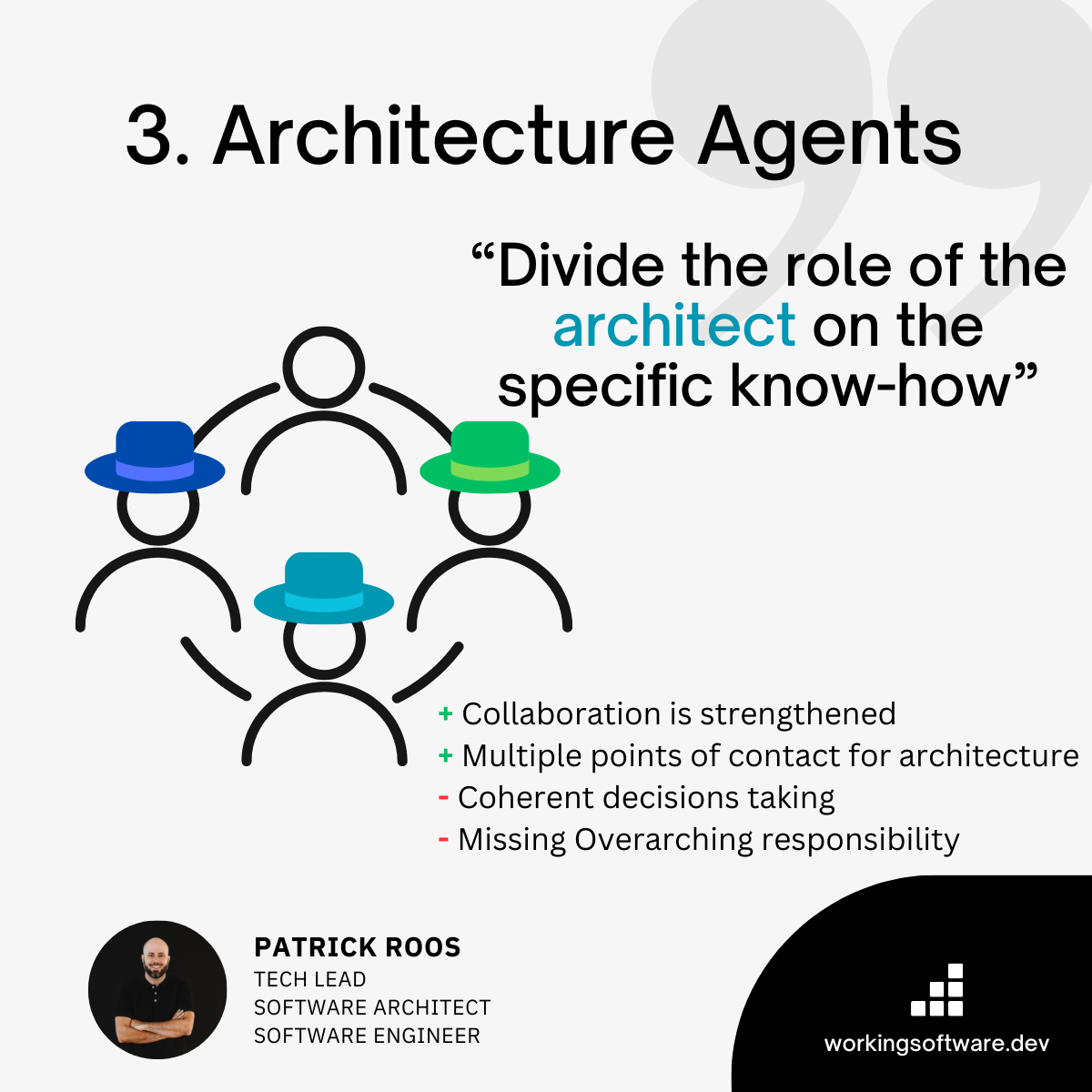
The logical conclusion of this shift is that architecture is no longer the exclusive domain of a person with "architect" in their title. It becomes a shared responsibility, a continuous activity embedded in the development process.
Dave Farley, a co-author of the book Continuous Delivery, argues this point compellingly.
What Software Architecture Should Look Like
In this video, Dave Farley makes the case for architecture as a team sport.
Watch the segment where he argues that architecture is our responsibility as software developers, regardless of title. He then defines architecture as a collection of constraints that the team agrees to adopt, and expresses his preference for engaging every developer in these discussions.
This idea is the pinnacle of the enabler model: the most effective architects are those who make themselves unnecessary for day-to-day decisions, not because architecture has become unimportant, but because they have successfully embedded architectural thinking into the team's DNA.
Conclusion
In this lesson, we have charted the critical transformation of the software architect's role.
Key Takeaways:
- The traditional "ivory tower" architect, acting as a centralized gatekeeper, has become a bottleneck in the face of modern business and technological velocity.
- The modern architect is a decentralized enabler, whose goal is to increase the autonomy and decision-making quality of development teams.
- This is achieved by shifting from controlling to coaching, from enforcing implementation to defining outcomes, and from acting as a gate to removing friction.
- Ultimately, this leads to a culture where architecture is a shared responsibility, continuously evolving and owned by the entire team.
Preview of the Next Lesson:
Understanding this new role naturally raises a question: If decisions are decentralized, does that mean every team can do whatever it wants? Of course not. In our next lesson, we will tackle this by learning to distinguish between architectural decisions that require centralized guidance and those that can and should be delegated to teams. We will explore how to draw these crucial boundaries.