In our previous lesson, we explored how architecture has evolved from a static, upfront design activity into a continuous process integrated with development. We saw how tools like architectural fitness functions allow us to verify that our system's architecture doesn't decay over time. This continuous verification is crucial for managing the incremental, "two-way door" decisions made by development teams.
This lesson addresses the other side of the coin: the significant, strategic, "one-way door" decisions. How do we make these choices in a structured, defensible way? This brings us to the core of an architect's role and the focus of this lesson: to apply a structured trade-off analysis framework to evaluate competing architectural approaches. We will examine both a classic, comprehensive method and a more modern, lightweight approach, equipping you with the mental models to navigate the complex landscape of architectural decisions.
Why Structured Analysis Matters
As a seasoned engineer, you know that there are rarely perfect solutions, only a series of compromises. This is the heart of the first law of software architecture: everything is a trade-off. The second law is that if you think something isn't a trade-off, you just haven't identified it yet.
This is especially true for architectural decisions, which differ from design decisions in their impact and reversibility. To understand this distinction and why it necessitates a more rigorous analysis, let's start with a short segment from a talk by Neal Ford.
Modern Trade-off Analysis for Software Architecture - Neal Ford - DDD Europe
In this clip from his "Modern Trade-off Analysis" talk, Neal Ford clearly distinguishes between architecture and design. This framing is essential for understanding why we can't simply "emerge" an architecture.
Please watch the segment from "what is the difference". Pay close attention to the criteria he uses to separate the two: Strategic vs. Tactical: Architecture deals with long-term, high-impact decisions. Effort to Change: Architectural decisions are hard to reverse. Significant Trade-offs: This is the defining characteristic. Capabilities vs. Behavior: Architecture enables capabilities (the "-ilities"), while design implements behavior.
Because architectural decisions involve significant, hard-to-change trade-offs that determine a system's core capabilities, we need a disciplined way to evaluate them. Relying on gut feeling is not enough. A structured process makes our reasoning explicit, helps communicate the "why" behind a decision to stakeholders, and provides a rational basis for choosing the "least worst" option among imperfect alternatives.
The Architecture Trade-off Analysis Method (ATAM)
One of the most well-known structured methods is the Architecture Trade-off Analysis Method (ATAM), developed at the Software Engineering Institute at Carnegie Mellon. While it can be quite formal, its underlying principles and steps provide a robust framework for thinking about trade-offs.
At its core, ATAM is a stakeholder-centric method that uses scenarios to connect business goals to architectural decisions. The flowchart below provides a high-level overview of the process.
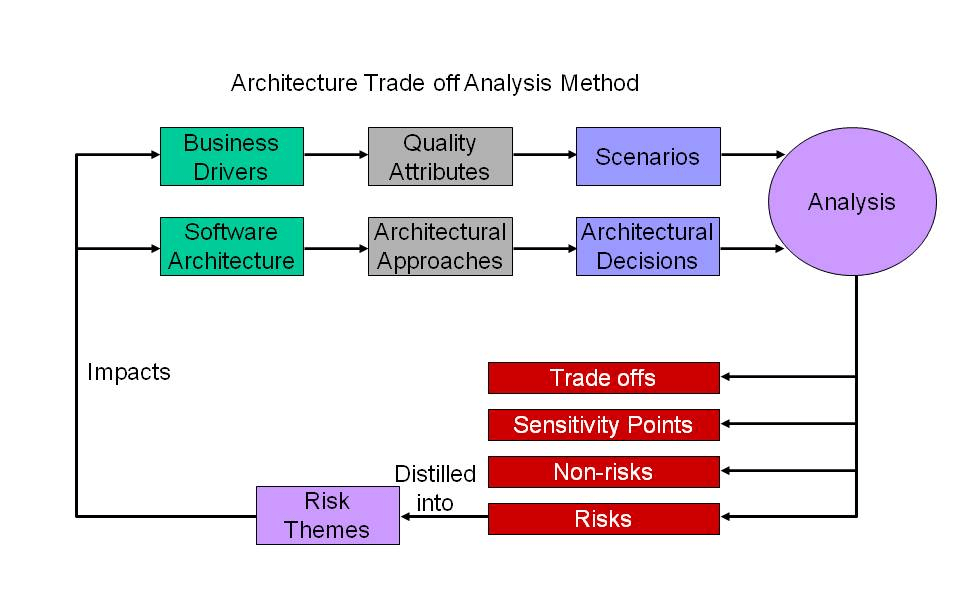
The ATAM process is organized into nine steps. Let's get a concise overview of what these entail.
[PDF] The ATAM (Architecture Tradeoff Analysis Method)
This document provides a clear, step-by-step description of the ATAM process.
Please read the section "Steps of the Evaluation Phases." As you read, focus on understanding the purpose of each of the nine steps, particularly: Steps 2 & 3: Presenting the business drivers and the architecture. Step 5: Generating the Utility Tree. This is the critical step that translates high-level business goals (like "high performance") into concrete, testable scenarios. Step 6: Analyzing the highest-priority scenarios to identify risks, sensitivity points (where a decision greatly affects a quality attribute), and trade-off points (where a decision affects multiple attributes, some positively and some negatively). Step 7: Brainstorming more scenarios with a wider group of stakeholders.
ATAM in Practice: A Case Study
To see how these steps translate into practice, we can look at a real-world example. The following resource is a bachelor's thesis that applies ATAM to evaluate a microservice-based system called "ArkivGPT." While it is a lengthy document, we will focus on the key artifacts it produced.
[PDF] ATAM evaluation of a microservice software architecture - KartAi
This thesis provides a complete, worked example of an ATAM evaluation. It demonstrates how the abstract steps are put into practice.
First, read the definitions of ATAM outputs in section 3.3.2 to solidify your understanding of risks, sensitivity points, and tradeoff points. Next, jump to Chapter 5 to see the application. Briefly review the business goals and requirements gathered in Step 2 (tables 5.1 through 5.3 and the list of major quality attributes). Examine the Utility Tree generated in Step 5 (Figure 5.7). Notice how broad attributes like "Reliability" and "Integratability" are broken down into specific, prioritized scenarios (e.g., A6, A7). The (H, H) ranking signifies high importance and high difficulty/risk. Finally, look at an example of the analysis in Step 6 (the introductory text and Table 5.6). This table shows how the architects analyzed the "internal communication" scenario (A2), identified the architectural decision (gRPC), and documented the resulting sensitivity point (S1), tradeoff (T1), and risk (R1).
This case study demonstrates the power of ATAM: it forces a systematic mapping from business goals to architectural decisions and explicitly surfaces the resulting risks and trade-offs. The final outputs—lists of risks, sensitivity points, and trade-offs—form the basis for a risk mitigation plan and guide the architecture's evolution.
Modern, Lightweight Trade-off Analysis
While ATAM provides a comprehensive foundation, its formal, meeting-heavy process can be too slow for modern, agile environments. However, we can adapt its core principles into a more lightweight, continuous practice.
Mark Richards and Neal Ford, authors of Fundamentals of Software Architecture, champion such an approach. It boils down to a three-part flow:
- Translate business drivers into key architectural characteristics (the "-ilities").
- Use scenarios to model how different architectural options behave.
- Evaluate the resulting trade-offs against the key characteristics to make a decision.
This short video from Mark Richards provides a perfect illustration.
Lesson 145 - Analyzing Tradeoffs
This "Software Architecture Monday" lesson walks through a complete, modern trade-off analysis in under 7 minutes.
Watch the entire video, paying attention to how he executes the three-part flow: Translate Business Drivers: Time-to-market is translated into maintainability, testability, and deployability. Analyze Scenarios: He compares "single service" vs. "separate services" across three scenarios (update, add, use multiple) to extract the trade-offs. Evaluate and Decide: He maps the discovered trade-offs back to the required characteristics to make a justified decision.
This approach is essentially a streamlined version of ATAM. The business drivers are the input, the architectural characteristics are the "utility," and the scenario analysis reveals the trade-offs. The key difference is the speed and format—often just a simple matrix—making it suitable for ongoing architectural decision-making.
Let's look at one more practical example of this matrix-based analysis, this time for a common trade-off in event-driven architectures.
Modern Trade-off Analysis for Software Architecture - Neal Ford - DDD Europe
Continuing with Neal Ford's talk, this section demonstrates a trade-off analysis for event contracts.
Watch the segment from "let's look at a typical trade-off". He compares two approaches: Fully Hydrated Contract: The event contains all the data needed by downstream consumers. Key Only: The event contains only an ID, and consumers must query for the data they need. Notice how he populates a matrix comparing the two options against characteristics like scalability, performance, contract management, and data consistency. This analysis also introduces the important concept of stamp coupling, a design smell where a consumer is coupled to a large data structure even though it only needs a small part of it.
Connecting to Economics: The Cost Benefit Analysis Method (CBAM)
Your interest in economics provides a perfect opportunity to go one step deeper. Architectural decisions are not just technical; they are economic. Every decision represents an investment of resources. The Cost Benefit Analysis Method (CBAM) is an extension to ATAM that formalizes this economic dimension.
CBAM builds on ATAM's outputs by asking:
- What is the cost of implementing an architectural strategy to achieve a certain quality attribute level?
- What is the benefit (or utility) gained from that improvement?
- What is the Return on Investment (ROI) for that strategy?
This allows you to prioritize architectural work based on which changes deliver the most value for the cost.
[PDF] The ATAM (Architecture Tradeoff Analysis Method)
This final reading introduces the economic dimension of trade-off analysis.
Please read the sections starting from "The CBAM" to the end of the document. Focus on understanding: The core idea of modeling costs and benefits of architectural decisions. The concept of a utility-response curve, which maps the utility gained from a particular quality attribute response. The final calculation of ROI (Benefit / Cost) and how it's used to rank-order and select architectural strategies.
By quantifying costs and benefits, CBAM elevates the discussion from "this is technically better" to "this is the best investment for our business." This perspective is invaluable for an architect who needs to justify decisions to business stakeholders.
Conclusion
In this lesson, we have established a structured foundation for making and justifying architectural decisions. You are now equipped with a powerful set of mental models for navigating the inherent trade-offs in system design.
Key Takeaways:
- Architectural decisions are strategic, hard to change, and defined by their significant trade-offs. The goal is to find the "least worst" solution that aligns with business goals.
- ATAM provides a formal, stakeholder-driven method to connect business drivers to architecture via scenarios, systematically identifying risks, sensitivity points, and trade-offs.
- The Utility Tree is a key ATAM artifact for making quality attribute requirements concrete and prioritized.
- Modern, lightweight analysis uses trade-off matrices and scenario modeling to achieve similar results in a more agile fashion, making it a continuous practice.
- CBAM extends these methods by introducing economic analysis, allowing you to calculate the ROI of architectural strategies and prioritize work based on business value.
Preview of the Next Lesson:
We have now learned how to analyze trade-offs. In the first lesson of the next module, Strategic Infrastructure and Resilience, we will begin applying this skill. We will start by identifying how non-functional requirements (our quality attributes) constrain infrastructure choices, setting the stage for detailed trade-off analyses between major architectural platforms like serverless and Kubernetes.