Introduction
In our last lesson, we explored the internal design patterns—ReAct, Planning, Tool Use, and Reflection—that govern how a single AI agent operates. We saw how these patterns are the fundamental building blocks for creating intelligent, autonomous behavior. Now, we will zoom out from the agent's internal logic to its external role within a team.
This lesson addresses how to integrate these powerful agents into your team's existing software development lifecycle. Your objective is to design a workflow where AI agents augment a development team's process for a specific task. We will move beyond the theoretical to the practical, examining how to structure human-AI collaboration for tasks like code review and incident response. This is where your system design experience becomes critical, as designing these workflows is fundamentally an architectural challenge that balances automation, human oversight, and system reliability.
The Human-in-the-Loop Paradigm
The most effective agentic systems are not about replacing developers, but augmenting them. The goal is to build a collaborative partnership where AI handles the repetitive, analytical, and time-consuming work, freeing up humans for tasks that require deep expertise, creative problem-solving, and critical judgment. A useful mental model, as mentioned in the video "Everything You Need to Know About Coding with AI," is to treat the AI as a highly capable but inexperienced team member—perhaps a junior developer who is incredibly fast but lacks context and deep judgment.
A powerful architectural model for this collaboration is the "LLM Agent Operating System," which integrates human intervention at key stages of the agent's process.

As the diagram shows, human collaboration can occur at several points:
- Co-Plan: A human validates or helps create the initial plan, ensuring the agent's proposed approach aligns with the user's intent and project constraints.
- Co-Execute: A human provides feedback during the execution of a task, course-correcting the agent if it goes off track.
- Co-Comply: A human provides final approval for sensitive or irreversible actions, such as deploying code, making payments, or applying critical configuration changes.
- Co-Memorize: A human helps the agent refine its long-term memory, correcting misunderstandings and reinforcing important concepts.
This "co-pilot" model is essential for building trust and ensuring reliability. As the article on code review automation warns, a significant pitfall is an "over-reliance on AI without human oversight," which can erode critical thinking skills. The human-in-the-loop is the primary safeguard against this.
A Methodology for Designing Augmented Workflows
Before deploying a sophisticated agentic workflow, you must first teach the agent how to perform the desired task. Simply writing a specification and expecting the agent to succeed often leads to frustration. A more effective approach is an iterative, teaching-based methodology, much like mentoring a new team member.
The video "How AI agents & Claude skills work" provides an excellent, practical guide for this process. It's not about pre-building a complex system, but about evolving one through interaction.
How AI agents & Claude skills work (Clearly Explained)
This video offers a pragmatic, step-by-step method for training an agent to perform a new workflow. The speaker's experience mirrors the common challenges of getting agents to behave as expected.
Watch the segment from "Let's say I have a specific workflow". Focus on the speaker's four-step process: Identify a workflow you want to automate. Go back and forth to teach it, walking the agent through the process step-by-step. Let it fail, then ask it why it failed to diagnose the error. Provide the correction. Once you have a successful run, tell the agent to review the successful conversation and create a skill (an automated procedure) based on it.
This iterative cycle of teaching, failure, and refinement is crucial. The agent doesn't "think" like a human; as the video explains, it's a powerful pattern-matcher that needs context. A successful, human-guided execution provides the perfect context for the agent to codify the process into a reliable, automated skill. This approach of "scaling for productivity, not for what looks cool" ensures that your agentic systems are grounded in proven, effective workflows.
Example 1: Augmenting the Code Review Process
Code review is a critical but often time-consuming part of the development cycle. It's an ideal candidate for AI augmentation because it involves a mix of deterministic checks and nuanced, context-aware analysis. We can design a "Hybrid Human-AI Review Loop" to optimize this process.
The article "AI Agent Architecture Patterns for Code Review Automation" outlines a robust workflow for this.
AI Agent Architecture Patterns for Code Review Automation: The Complete Guide | Tanagram
This guide provides an excellent, production-oriented view of how to architect AI for code review.
Read the section titled Workflow Design. This section details a multi-stage process that intelligently blends automation with human expertise.
Based on this model, a practical augmented code review workflow would look like this:
-
Automated Screening (Deterministic Agent): When a pull request is opened, a simple, deterministic agent runs first. It uses static analysis and query-based policies to check for:
- Linting errors and style guide violations.
- Missing documentation or tests.
- Violations of simple, hard-coded rules (e.g., "do not use this deprecated library").
This stage provides immediate, high-confidence feedback and catches obvious issues without involving a costly LLM.
-
Contextual Analysis (LLM Agent): If the initial screening passes, a more sophisticated LLM-powered agent analyzes the PR. Using patterns like ReAct and Tool Use, this agent might:
- Summarize the changes in plain English.
- Check for more complex issues, like potential race conditions or inefficient database queries.
- Verify that the changes align with the architectural principles defined in your documentation.
- Suggest refactorings for clarity or performance.
-
Human Validation (The Developer): The findings from both agents are posted as comments on the pull request. The developer and their peers review the code, along with the AI's suggestions. The human reviewer makes the final judgment, especially on architectural or business logic changes. They can accept, reject, or request modifications based on the AI's feedback. This maintains human oversight while significantly reducing the manual review burden.
This workflow can be further enhanced with a multi-agent approach, as suggested in the "Everything You Need to Know About Coding with AI" video. You could have one agent that proposes the code, a second agent that acts as a reviewer, and a third that writes corresponding tests, all before a human ever sees the PR.
Example 2: Augmenting Incident Response
Nothing disrupts a team like a production incident, especially outside of working hours. The process of diagnosing and resolving incidents is another prime area for agentic augmentation. The goal is to shrink the Mean Time To Resolution (MTTR) by automating the diagnostic legwork.
The article "AI Agents Are Changing Incident Response" describes a compelling vision for this.
AI Agents Are Changing Incident Response - Here's How
This article clearly articulates the value proposition of using AI agents to handle the initial stages of incident response.
Read the sections from "Enter AI Agents" through to "Human oversight." Pay close attention to the proposed workflow and the resulting shift in the on-call engineer's role.
An AI-augmented incident response workflow combines observability data with agentic reasoning:
-
Detect & Trigger: Your monitoring system detects an anomaly (e.g., a spike in latency or error rates) and fires an alert. Instead of just paging a human, the alert also triggers an incident response agent via a webhook.
-
Diagnose (Agent): The agent begins its investigation using a ReAct or Planning loop. It uses its tools to:
- Correlate metrics, logs, and traces from your observability platform to pinpoint the affected service and the nature of the error.
- Query your version control system to identify recent deployments that coincide with the start of the incident.
- Analyze the code changes in the suspect deployment to form a hypothesis about the root cause (e.g., a new, inefficient database query).
-
Propose Fix (Agent): Based on its diagnosis, the agent generates a code patch to remediate the issue. This could be a revert of the problematic commit or a specific code change to fix a bug.
-
Asynchronous Human Review: The agent opens a pull request containing the proposed fix. The PR description includes a full summary of its findings: the detected anomaly, the correlated data, its root cause analysis, and an explanation of the fix. The on-call engineer is notified. Instead of being woken at 3 AM to start a stressful, open-ended investigation, they wake up to a concrete proposed solution waiting for their review.
-
Deploy: The engineer reviews the agent's work, validates its reasoning, and, if correct, approves and merges the PR. The standard, trusted CI/CD pipeline then handles testing and deployment.
This workflow fundamentally changes the on-call experience from reactive firefighting to asynchronous review, making it far more sustainable and less stressful.
An Architecture for the Augmented SDLC
The workflows for code review and incident response are just two examples. This model of human-AI collaboration can be applied across the entire software development lifecycle. Specialized agents can assist at each stage, from initial requirements gathering to final implementation, with humans providing oversight and direction.
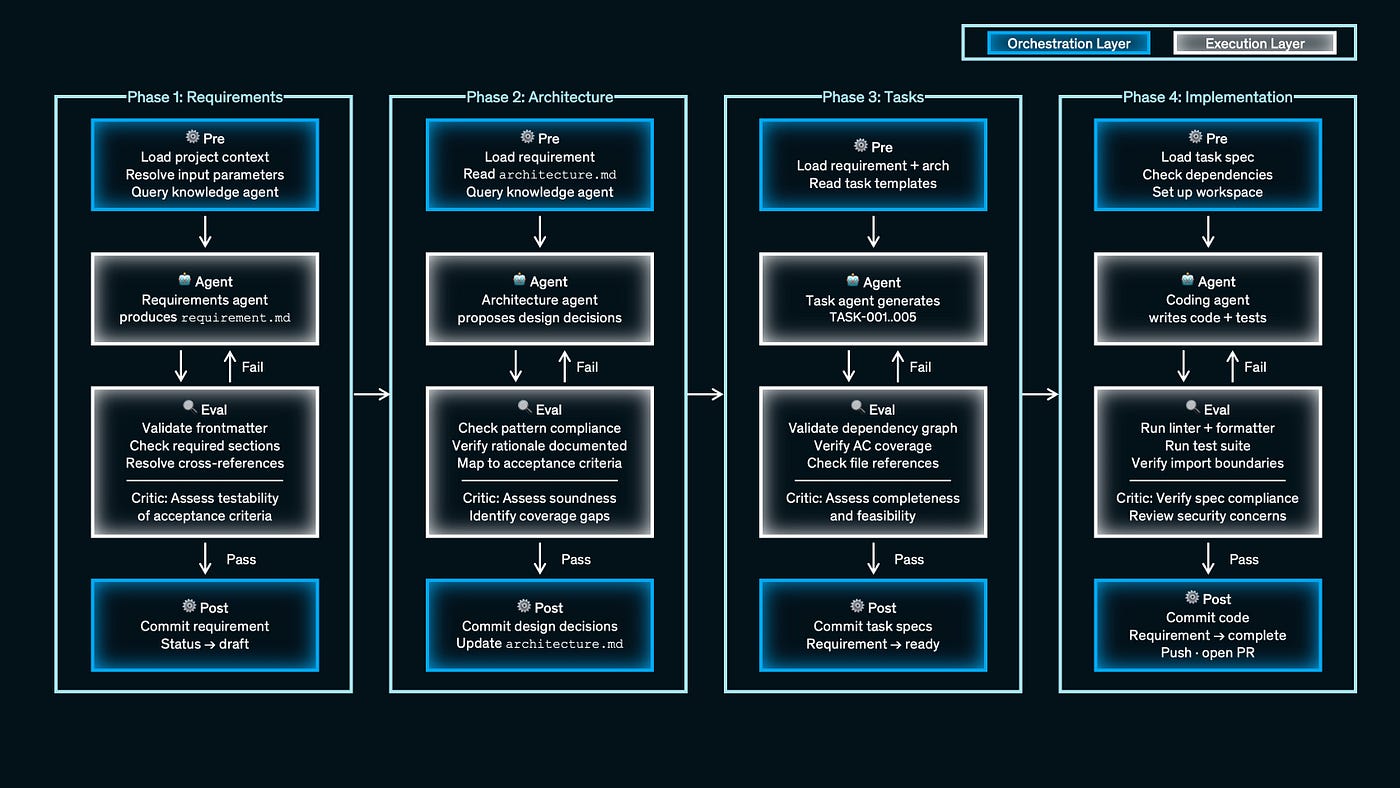
This vision of an augmented SDLC shows how individual agentic workflows can be composed into a more comprehensive system, where agents handle handoffs between stages (e.g., an architecture agent's output becomes the input for a task-generation agent).
Conclusion
In this lesson, we transitioned from the theory of agent design to the practical application of augmenting development workflows. You learned how to design processes that leverage AI's speed and analytical power while retaining essential human judgment.
Key Takeaways:
- Human-in-the-Loop is the Core Paradigm: The most effective agentic systems are designed as collaborations, where humans co-plan, co-execute, and provide final validation for agent actions.
- Design Workflows Iteratively: Don't try to build a perfect agentic system from scratch. Start with a real-world task, teach an agent how to do it through conversational trial and error, and only codify the process once you have a successful, human-guided run.
- Target Repetitive, Well-Defined Tasks: Prime candidates for augmentation are tasks like routine code checks and initial incident diagnosis, where a clear process can be defined and automated.
- The Goal is Augmentation, Not Full Automation: In areas like code review and incident response, the objective is to shift the human's role from manual execution to asynchronous review, saving time and reducing cognitive load.
Preview of the Next Lesson:
We've seen how to design workflows and have touched on the idea of multiple agents working together. In the next lesson, we will dive deep into the architectural patterns of multi-agent systems. We'll explore mechanisms for inter-agent communication, coordination, and task delegation, enabling you to design systems where teams of specialized agents collaborate to solve complex problems that a single agent cannot.