Welcome to your personalized course on building a predictive maintenance model for your thesis. This first lesson will establish the conceptual foundation for your entire project. We will connect the world of predictive maintenance directly to your expertise in actuarial science, framing the problem in a way that leverages your existing knowledge.
The main goal for today is to map the core concepts of your project—Failure Probability and Remaining Useful Life (RUL)—to their parallels in traditional actuarial and financial risk modeling. By the end of this lesson, you will be able to view the EVIoT dataset not just as engineering data, but as a portfolio of risks to be modeled, much like you would in an insurance or credit context.
The Core Analogy: From Credit Risk to Component Failure
Your project's primary goal is to predict the likelihood of a vehicle component failing. This is conceptually identical to a core problem in finance: predicting the likelihood of a borrower defaulting on a loan. In both cases, we use historical data to estimate the probability of a future adverse event.
To formalize this connection, let's start by revisiting the concept of Probability of Default (PD) in credit risk.
Credit Risk Modeling with Machine Learning | Towards Data Science
This article from Towards Data Science provides a clear, non-technical introduction to credit risk modeling. It will help us establish a common vocabulary for our project.
Please read the introduction, starting from the beginning of the article. Then, read the section defining default risk. As you read, focus on how a qualitative problem ("Will this person pay me back?") is transformed into a quantitative one (estimating a specific probability).
As the article explains, default risk is the probability that a borrower will fail to meet their obligations. This probability is not pulled from thin air; it is estimated by a model that uses data about the borrower.
To see how this is applied, let's watch a short video that breaks down the components of a PD model.
Credit Risk Modelling: The Probability of Default
This video from the Quant Next channel concisely defines Probability of Default and lists the typical inputs for such a model.
Watch the following segments: The definition of Probability of Default. The factors influencing PD. Notice the parallels between "credit history" or "financial health" and your dataset's features like State_of_Health or power_consumption_w. The methods used for assessment. Note the specific mention of logistic regression and random forests—the very models you will be comparing in your thesis.
The video confirms the analogy. Just as a credit model uses financial health indicators to predict PD, your predictive maintenance model will use vehicle health indicators from the EVIoT dataset to predict failure. Therefore, for your project, we can establish our first key mapping:
Failure Probability = Probability of Default (PD)
The "borrower" is the vehicle component, "default" is the component's failure, and the sensor readings are the "risk factors" that inform your prediction.
From Time-to-Default to Remaining Useful Life (RUL)
The second key target in your thesis is the Remaining Useful Life (RUL) of a component. This is a "time-to-event" prediction, a concept that is central to actuarial science, particularly in survival analysis and mortality modeling.
Let's get a clear definition of RUL in the context of engineering.
Estimating Remaining Useful Life (RUL) for Prognostics | Predictive Maintenance
This video from MATLAB provides a straightforward visual explanation of Remaining Useful Life.
Please watch the first segment that defines RUL as the time between the current moment and the point of failure.
As the video shows, RUL is the answer to the question: "How much longer will this component last?"
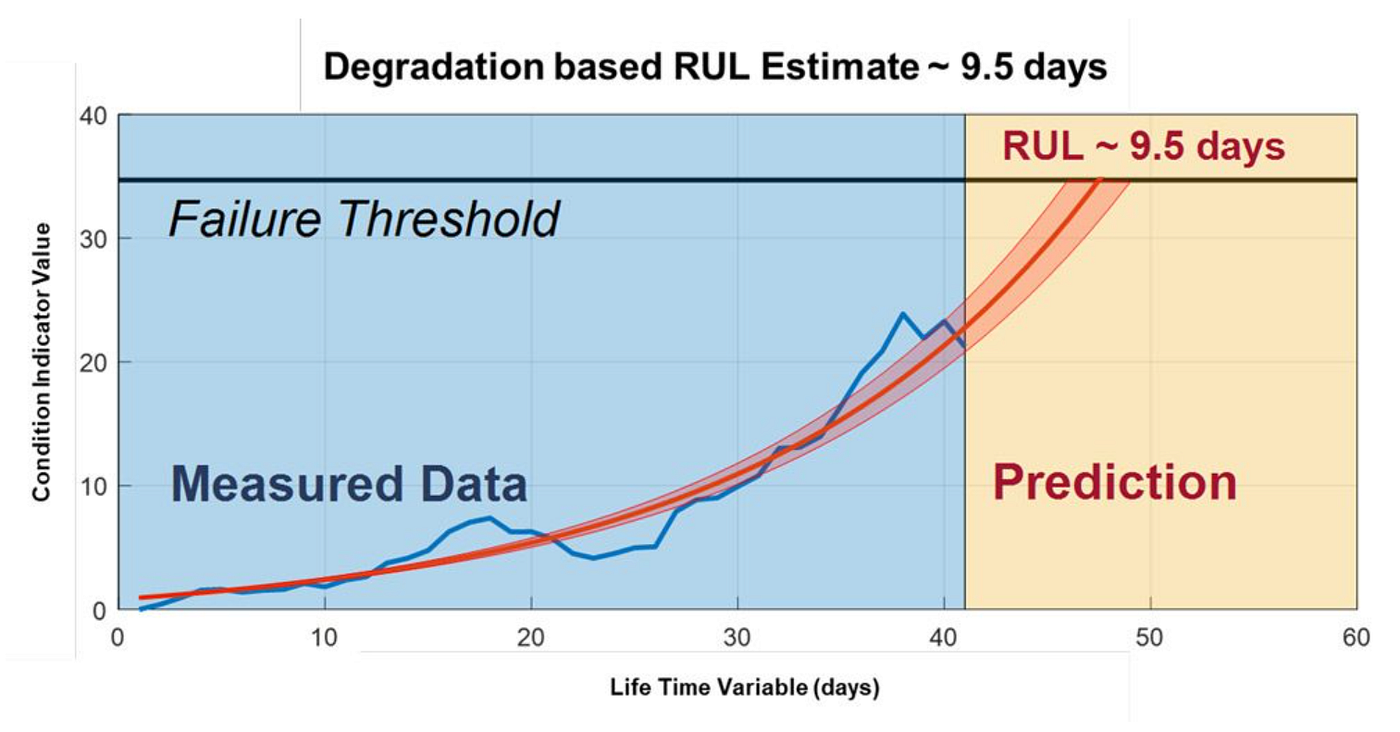
This type of forecasting—predicting the time until a specific event—is not unique to engineering. In fact, the methods were largely borrowed from health sciences and actuarial practice.
Part III, The Possibilities Of Probability: In Failure Curves And RUL | THE RAM REVIEW
This article from The RAM Review explicitly connects reliability engineering concepts like RUL back to their roots in actuarial science and healthcare.
Please read the section that begins "As we move further". Pay close attention to the mention of Kaplan-Meier plots and Cox Proportional Hazard models, which you've likely encountered in your actuarial studies. Next, read the following section starting from "The next level of RUL". This part highlights a critical point: RUL is inherently probabilistic, not deterministic.
The article makes the connection explicit. Predicting RUL is analogous to predicting a patient's survival time or modeling mortality rates in a population. It is a survival analysis problem. This gives us our second key mapping:
Remaining Useful Life (RUL) = Time-to-Event or Time-to-Default
When your model predicts an RUL, it is providing an expected value for the time until failure. The underlying reality is a probability distribution over time, often represented by a survival function.
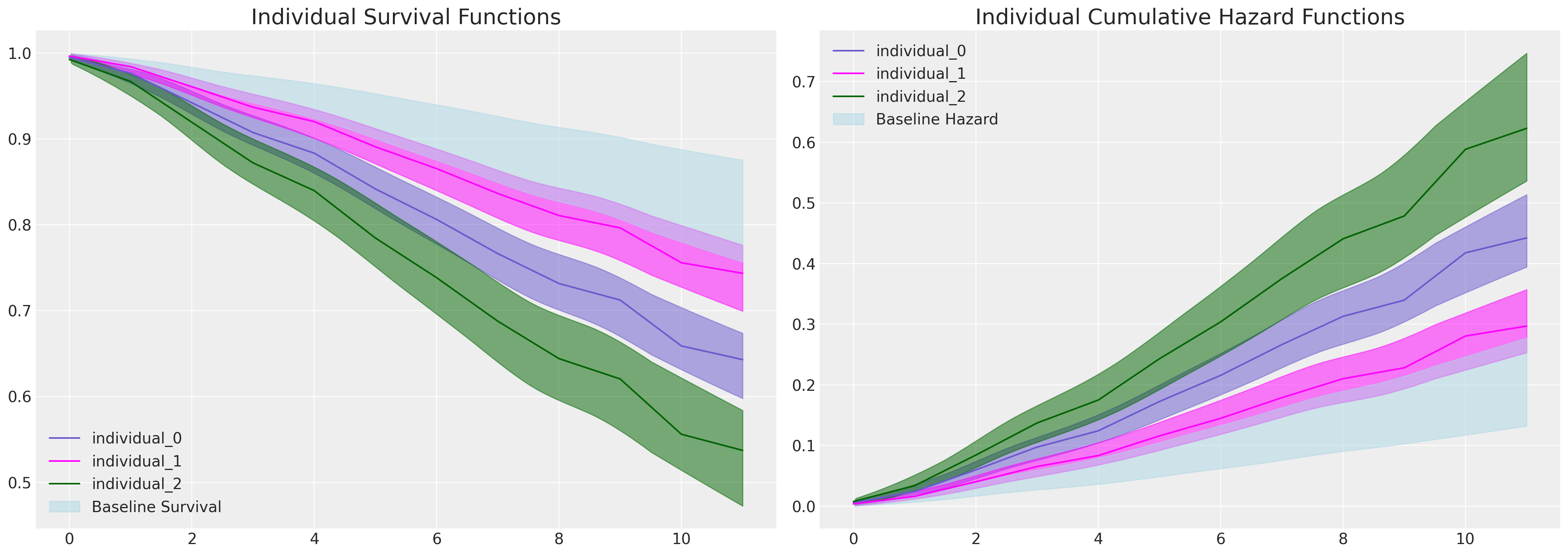
Tying It All Together
By framing your project through these two analogies, your path forward becomes clear:
- You will use features from the EVIoT dataset (e.g.,
battery_temperature_c,motor_vibration_db) as risk factors. - You will build two types of models (GLM and Random Forest) to predict two primary outcomes:
- Failure Probability: A classification problem to estimate the component's PD.
- RUL: A regression or survival problem to estimate the component's time-to-default.
- You will then compare these models based on their predictive accuracy and their interpretability, just as an actuary would compare different pricing or reserving models.
Conclusion
In this introductory lesson, we have built a crucial conceptual bridge between your actuarial background and your predictive maintenance project.
Key Takeaways:
- Predicting machine failure is a risk modeling exercise, directly analogous to credit risk modeling and actuarial survival analysis.
- Failure Probability is the predictive maintenance equivalent of Probability of Default (PD).
- Remaining Useful Life (RUL) is a time-to-event measure, equivalent to time-to-default.
- The sensor data in your dataset function as the risk factors used to predict these outcomes.
With this framework in place, we are ready to move from concept to practice. In the next lesson, we will take our first hands-on step by loading and profiling the EVIoT dataset. This will involve inspecting its structure, data types, and summary statistics to get a firsthand look at the "portfolio of risks" you will be modeling.