Welcome to the final and most exciting module of our course: the Capstone Project. Over the past eleven modules, you've honed your skills in sentence construction, word choice, sourcing, structure, and revision. Now, you get to synthesize all of that knowledge and craft a complete piece of entertainment journalism from scratch.
In our last lesson, you learned how to perform a "forensic analysis" on your own writing to identify strengths and recurring habits. That meta-skill of self-awareness will be invaluable as you build this new article.
Today, we begin at the beginning. This lesson addresses the first crucial step of any journalistic endeavor: Select a topic and format for a short entertainment piece and create a detailed outline. This is your blueprint—the architectural plan that will guide your writing and ensure your final piece is focused, structured, and compelling.
1. Finding a Story Worth Telling
In entertainment journalism, a great topic is more than just access to a celebrity or a new movie. Professional editors look for a specific, compelling angle—a unique perspective or a deeper story that hasn't been told. Your goal isn't just to report that something happened, but to explore why it matters.
To get a sense of what a real-world publication looks for, we'll start with the pitch guidelines for IndieWire, a major voice in film and TV journalism.
How to Pitch Stories and Articles to IndieWire
These guidelines from IndieWire provide a direct look into the mind of an editor. They reveal what makes a story idea stand out in a crowded inbox.
Please read two key sections: Start with the question “What kind of angles do you want?” and read through that paragraph. Notice the emphasis on "strong news hooks," "multiple sources," and specific ideas like "a unique production challenge" or "a dramatic change to the industry." Then, read the section under “How do I make sure I’m on the right track?” This reinforces the need to understand your target publication and find a fresh angle.
The key takeaway is that professional outlets value reported features over simple interviews or opinion pieces. They want stories with a clear point and supporting evidence. So, how do you find these stories? It often starts with simple curiosity and observation.
Let's hear from a New York Times reporter on how he finds subjects for his profiles.
Teach Your Students to Write Profiles Like a Times Reporter
In this video from The New York Times Learning Network, veteran reporter Corey Kilgannon shares his practical methods for finding compelling stories and subjects.
Watch the following clips: First, hear his methods for finding interesting people. He uses everything from direct observation on the street to professional directories. Next, listen to his thoughts on finding an angle. His goal is simple: "to write something that as many people as possible want to read." This starts with choosing someone or something inherently unique. Finally, pay close attention to his concluding advice at the most important decision. He argues that finding the right person is 90% of the battle, because a great subject makes the story "write itself."
As you begin to think about your own topic, let these ideas guide you. Look for the specific, the unusual, the untold story hiding in plain sight within your areas of interest—be it music, comics, or film.
2. Choosing Your Article's Format
Once you have a topic in mind, you need to decide on the best format to tell that story. Feature writing is more creative and descriptive than hard news, allowing for more personality and style.

Here are a few common formats in entertainment journalism you could choose for your capstone project:
- Personality Profile: A deep dive into a specific person (an artist, a director, an industry figure). It's built around interviews and observation to reveal their character and what drives them.
- Trend Piece: An article that identifies and analyzes a pattern in the entertainment world. (e.g., "Why are 90s rock reunion tours suddenly so popular?" or "How TikTok is changing movie marketing.")
- Reported Feature: An investigative piece that explores a specific issue, challenge, or backstory. (e.g., The story behind a difficult film production, or an analysis of a new union agreement for scriptwriters.)
- Critical Essay: A strong, evidence-based argument about a work or a cultural phenomenon. (This is distinct from a simple review; it has a broader thesis.)
The following video provides a great overview of what defines the "feature" style.
The Basics of Feature Writing (Journalism Lecture)
In "The Basics of Feature Writing," journalism lecturer Brett Atwood explains the different categories of feature stories.
Watch the segment on types of features. He lists several categories, including personality profiles, human interest stories, and trend stories, that you can use as models for your own piece.
3. Building Your Blueprint: The Outline
With a topic and format selected, you are ready to create your outline. A solid outline is the single best tool for preventing a story from becoming rambling or unfocused.
While hard news often uses the "inverted pyramid" structure (most important info first), feature writing typically follows a more narrative model.
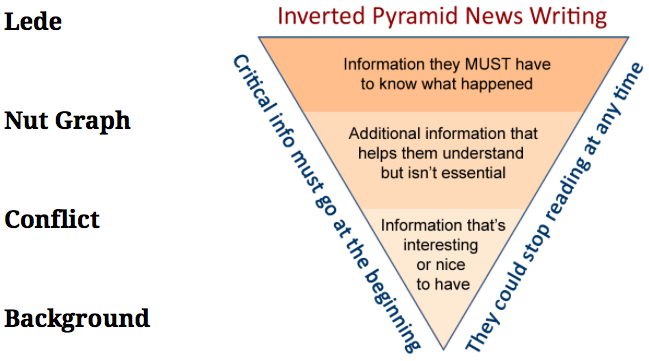
A widely used and highly effective structure for feature articles contains four key parts.
Nut-grafs & Cosmic Kickers: the perfect article or blog (2 of 3)
This blog post by journalist R. Leigh Turner breaks down a classic, powerful structure for writing feature articles.
Read the sections "Nut-grafs and cosmic kickers: the 4 key elements" and "Nut-grafs: start here." Focus on understanding the distinct purpose of each of the four parts: Lede: The opening anecdote or image that hooks the reader. Nut-graf: The paragraph that states your story's central message—the "so what?" Body: The main section where you provide evidence, quotes, and arguments. Kicker: The closing anecdote that provides a satisfying conclusion, often echoing the lede.
The crucial insight here is to start with the nut-graf. Before you write a single word of the article, you must be able to state your core point in a sentence or two. This central idea will anchor your entire piece.
This video lecture reinforces the same structural concepts, providing another perspective on how these parts fit together.
The Basics of Feature Writing (Journalism Lecture)
Returning to "The Basics of Feature Writing," this section details the structural components of a feature article.
Watch the portion of the video from the lead and nut graph through the discussion of the narrative thread and dialogue. The lecturer explains how the descriptive lead draws the reader in, the nut graph explains why the story matters, and the body uses devices like a narrative thread to tie everything together.
4. Your Task: Brainstorm and Outline
Now it's your turn to lay the foundation for your capstone article. For this exercise, aim for a short piece of about 800-1000 words.
Part A: Brainstorm (5-10 minutes)
Think of 2-3 potential story ideas that fit the criteria we've discussed. They should be specific, have a clear angle, and be feasible for you to report. Consider your interests:
- A local band with a unique sound and a new album coming out?
- A trend you've noticed in recent comic book scripts?
- A profile of an interesting person working behind the scenes in local theatre?
Part B: Select and Outline (15-20 minutes)
Choose one of your ideas and create a detailed outline using the Lede-Nut-Body-Kicker structure. Your outline should look like this:
- Working Title: (A temporary title to guide you)
- Format: (e.g., Profile, Trend Piece, Reported Feature)
- Lede: A one-sentence description of the opening scene or anecdote you plan to use.
- Nut-Graf: Write out the one or two sentences that state the core thesis of your article. This is the most important part of the outline.
- Body:
- Point 1: (e.g., The band's primary musical influence and how they subvert it). Potential evidence: Interview quote from the lead singer; analysis of a specific song.
- Point 2: (e.g., The financial challenges of being an independent musician today). Potential evidence: Data on streaming royalties; anecdote about the band's day jobs.
- Point 3: (e.g., How their upcoming album marks a major creative shift). Potential evidence: Quote from the producer; description of the new sound.
- (Add 1-2 more points as needed)
- Kicker: A one-sentence description of your planned ending. How can you circle back to the idea in the lede for a powerful conclusion?
Take your time with this. A strong outline now will make the writing process in the next lesson infinitely smoother.
Conclusion
In this lesson, you've taken the first concrete step in creating your capstone project. You've learned how to move from a general interest to a specific, professional-grade story idea and how to structure it for maximum impact.
Key Takeaways:
- Angle is Everything: Professional entertainment journalism requires a specific, reported angle, not just a topic.
- Find the Unique Story: The best subjects are often those with an unusual quality or story that makes a reader curious.
- Choose the Right Format: Select a format (like a profile or trend piece) that best serves the story you want to tell.
- Build on a Solid Blueprint: The Lede-Nut-Graf-Body-Kicker structure provides a robust and reliable framework for a compelling feature article.
You now have a complete blueprint for your article. In our next lesson, you will take this outline and begin writing the first full draft, bringing your story to life sentence by sentence and paragraph by paragraph.