Hello! In our last lesson, we focused on how the strategic use of verb tense helps control the narrative flow of a feature story, creating either a sense of immediacy or reflection. We saw how mastering tense is another key to crafting a "vivid continuous dream" for your reader.
Now, we arrive at the final paragraph. After you've guided your reader through scenes, quotes, and analysis, how do you end? This lesson tackles one of the most important elements of sophisticated feature writing. Our goal is to learn how to write a 'kicker' (a final, impactful closing paragraph) that leaves a lasting impression. A great kicker doesn't just stop the story; it makes the story resonate long after the reader has finished.
1. What is a Kicker?
Just as a compelling lead draws the reader in, a powerful kicker ensures they leave satisfied, thoughtful, or moved. It's your last word and, as such, carries immense weight. It's the final note that makes the entire piece cohere.
Let's begin with a brief overview of how to approach the end of a feature piece.
The Basics of Feature Writing (Journalism Lecture)
This short clip from Brett Atwood's lecture on feature writing provides a concise introduction to concluding a story.
Watch the segment on ending the story. Notice the key ideas mentioned: avoiding an abrupt end, using a profound quotation, or circling back to where the story began.
The video mentions two key strategies we'll explore in depth: using a powerful quote and circling back. However, it's crucial to understand that not all quotes make for good kickers. In fact, relying on a quote to do the work for you is a common trap for writers.
2. The Kicker Quote Trap
On deadline, it's tempting to find a decent quote, place it at the end, and call it a day. But this often deprives your story of a truly memorable ending. A quote ending can feel like outsourcing your conclusion to a source, when you, the writer, should have the final say.
Let's examine why this is a pitfall and how to think differently.
Put ends first – Chip on Your Shoulder
This article by writing coach Chip Scanlan makes a compelling case against the overuse of "kicker quotes" and provides powerful alternatives.
Read the first few sections, down to the quote from Rick Bragg. Note the argument that a quote ending is often a "reflex action" that prevents a more memorable conclusion. Pay close attention to the example from Rick Bragg's profile of a Mardi Gras Indian. Most writers would have ended on the quote, but Bragg's choice to use a narrative detail is far more powerful. Finally, read the author's personal anecdote at the end of the article, where he regrets using a quote ending and rewrites it to show the impact of a narrative conclusion.
The key insight is that an action or a detail often shows the story's theme more effectively than a quote that simply tells it. Anne Hull's ending—"Her back is always against a wall."—is a lasting image of trauma. Rick Bragg's—"He had 40 yards of velvet to cut and sew."—is a testament to devotion. These endings are crafted, not just transcribed.
3. The Anatomy of a Great Kicker
So, if not just any quote, what makes an ending work? According to former Associated Press writing coach Bruce DeSilva, a great kicker must do three things.
Put ends first – Chip on Your Shoulder
This section of the same article by Chip Scanlan lays out a clear, three-part framework for what a good ending must accomplish.
Find the section that begins, "A good ending absolutely, positively, must do three things at a minimum." Read Bruce DeSilva's three points carefully.
DeSilva's criteria give us a perfect checklist:
- Tell the reader the story is over: It provides a sense of finality.
- Nail the central point: It reinforces the "so what" of your article.
- Resonate: It stays with the reader, echoing in their mind.
With this framework, let's look at some specific, powerful strategies for crafting kickers that meet these criteria.
Good Endings: How to Write a Kicker Your Editor—and Your ...
This fantastic article from The Open Notebook breaks down several types of effective kickers, complete with the full context, the ending itself, and commentary from both the writer and editor.
Read the section "Circle Back to the Beginning." Notice how the ending of "The Spy Who Loved Frogs" creates a satisfying feeling of closure by returning to the story's opening theme. Next, read "Tie Everything Together." The kicker for "Engineering New Organs" masterfully weaves together a fairy-tale motif, a key scene (the rock on the beach), and the sound of applause into a single, resonant image. Finally, read "Make It Personal." The writer of the salmon story creates a powerful, visceral ending by placing himself—and thus the reader—directly into the scene.
These examples demonstrate that the best kickers are built from the core material of your story—a resonant image, a key theme, or a narrative echo.
4. Practice Exercise
Let's apply these strategies to an entertainment journalism scenario.
Scenario: You are writing a profile of a legendary, 80-year-old film score composer who is retiring after creating the music for over 100 films.
- Your Lead: The article opens with a scene from the composer's childhood: sitting at a dusty upright piano, trying to play the music he hears in his head, long before he ever had a formal lesson.
- Key Reporting Details:
- Detail 1: During your final interview at his home, you notice that same dusty upright piano in the corner of his studio.
- Detail 2: He has a collection of worn-out conductor's batons, one for each decade of his career. The one from the 2010s is snapped in half. "A bit too much passion conducting the Galaxy Raiders score," he says with a laugh.
- Quote: "People ask if I'll miss it," he tells you. "But the music doesn't stop. It's still in here," he says, tapping his temple. "It just won't be quite so loud for everyone else."
Your Task:
Write two different kickers (2-3 sentences each) for this profile.
- Kicker 1: The Circle-Back. Write an ending that circles back to the lead.
- Kicker 2: The Resonant Detail. Write an ending that uses one of the other details (the batons or the quote) but frames it as a narrative moment, not just a quote dropped at the end.
Take your time to craft each ending so it feels final, thematic, and resonant.
Conclusion
Today we've deconstructed the art of the kicker, moving beyond the easy-but-weak quote ending to explore more powerful narrative strategies.
Key Takeaways:
- A kicker is your last chance to make an impression; it should be as carefully crafted as your lead.
- Avoid the "kicker quote trap." An image, action, or narrative detail often resonates more strongly than a source's words.
- The best kickers provide finality, nail the story's central theme, and resonate with the reader.
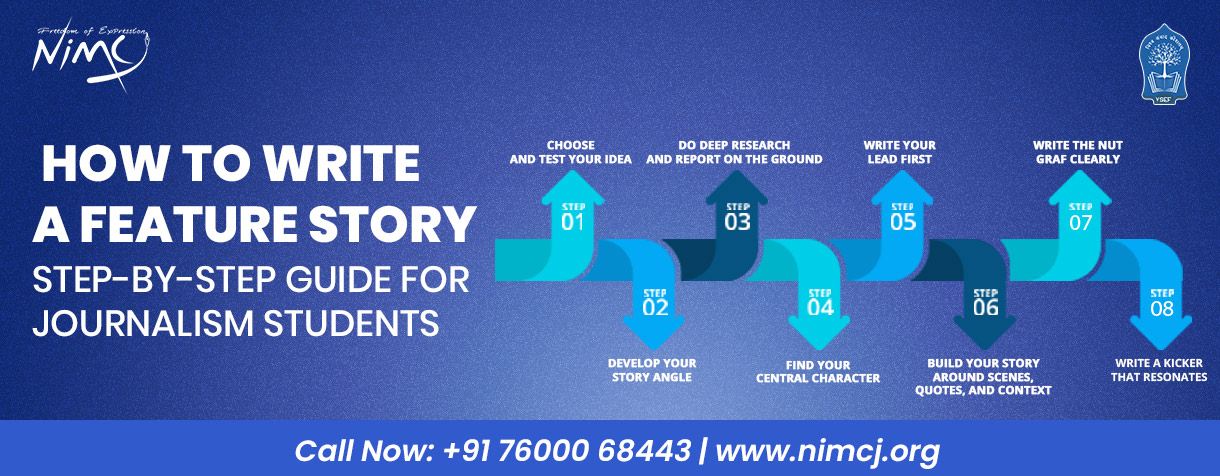
- Powerful techniques include circling back to the beginning, tying multiple story threads together, and focusing on a single, resonant detail.
Mastering the kicker means taking full authorial control of your story from the first word to the very last. It is the final element of craft that separates good feature writing from great feature writing.
This lesson concludes our module on Advanced Feature Writing Techniques. Having now examined the building blocks of a feature story—from leads and nut grafs to scene-setting and kickers—we are ready to zoom out. In our next module, The Professional Revision Process, we will learn how to take a complete draft and systematically revise it, focusing on everything from big-picture structure to sentence-level polish.