Welcome back. In our last lesson, we focused on crafting immersive openings by using scene-setting and descriptive detail. We established that the most powerful way to hook a reader in a feature story is to drop them directly into a moment—a technique we can call "showing."
Today, we'll build on that foundation. A feature article isn't just one long scene; it's a carefully constructed narrative that guides the reader through information, emotion, and time. To do this effectively, you must master how to alternate between scene-setting (showing) and exposition (telling) to manage your story's narrative flow and pacing.
Think of it like filmmaking. A director doesn't just show every second of a character's life in real-time. They use intense, detailed scenes for crucial moments (the climax, a key confrontation) and then use montages or quick cuts to move through less critical periods. In writing, "showing" is your close-up scene, and "telling" is your montage. Learning to balance them is key to controlling the rhythm of your story and keeping your reader engaged.
1. The Two Modes: Scene and Summary
First, let's clarify the distinction between "showing" and "telling." In narrative writing, these correspond to two primary modes: scene and summary (also known as exposition).
- Scene ("Showing"): This is where you dramatize a moment. You slow down time and let an event unfold for the reader in real-time. Scenes are built with concrete, sensory details, action, and dialogue. They create an immersive experience.
- Summary ("Telling"): This is where you condense information. You step back to explain background, connect events, or move the story forward across a period of time. Summary provides context and orientation for the reader.
This video offers a clear breakdown of this core distinction and the building blocks of each mode.
HOW TO WRITE A SCENE | elements of narrative + tips (with example doc)
The video "HOW TO WRITE A SCENE" by the channel ShaelinWrites provides an excellent introduction to the concepts of scene and summary. While it's geared towards fiction, the principles are identical for narrative journalism.
Watch from the beginning to understand the difference between scene and summary. Then, continue watching the next section on the building blocks of a scene. Notice how elements like dialogue, action, and description are used for "showing," while exposition and backstory are forms of "telling."
2. Finding the Right Balance
A common piece of writing advice is "Show, don't tell." While well-intentioned, it's an oversimplification. Professional writers know the real secret is "Show the important parts, and tell the rest." An imbalance in either direction can harm your article:
- Too much showing: The story can feel slow, unfocused, and exhausting for the reader. Not every moment deserves a full scene.
- Too much telling: The story becomes a dry report. It lacks emotional impact and feels distant, preventing the reader from becoming invested.
The following video brilliantly demonstrates this by workshopping a single passage, showing what happens when it's all action, all dialogue, or all narrative, before presenting a balanced, effective version.
The Secret to Writing Perfect Scenes
In "The Secret to Writing Perfect Scenes," Alyssa Matesic breaks down the three core elements—action, dialogue, and narrative (which includes exposition/telling)—and shows how to balance them.
First, watch the introduction to the three pillars. Next, see what happens in the examples that are too action-heavy (too much showing), too dialogue-heavy (also showing), and too narrative-heavy (too much telling). Finally, watch the revised, balanced scene and pay close attention to the color-coded breakdown that shows how the different modes work together.
As you saw, the most effective version weaves all three elements together. A line of action grounds the reader, a piece of dialogue reveals character, and a beat of narrative provides internal thought or necessary context. This interplay creates a rich, layered, and well-paced scene.
3. When to Show and When to Tell
So, how do you decide which moments to dramatize in a scene and which to summarize with exposition? The key is to think about your story's purpose and what moments are most critical to its central theme.
Show, Don't Tell: The Secret to Great Writing with Show and Tell ...
This article from The Write Practice provides an excellent, straightforward guide on when to use each technique.
Read the section titled "Show and Tell: When to Show and When to Tell." The two lists under the "Show if:" and "Tell if:" headings are your core strategic guide. The infographic included in this section provides a helpful visual summary.
To ground this in a journalistic context, "telling" often serves a very specific and necessary purpose: giving the reader the information they need to understand the scenes you are showing them.
Using Literary Techniques in Narrative Journalism - Writer's Digest
This article from Writer's Digest analyzes a Pulitzer-winning piece of narrative journalism, showing how these techniques work at the highest level.
Please read the section titled "The effective use of telling." Notice how the author, Jon Franklin, uses "orientation paragraphs" to step out of the action, tell the reader what's happening, and deliberately control the story's tension and pace.
In entertainment journalism, this balance is crucial.
- Show the emotional moment a director yells "cut" on their final day of shooting.
- Tell the reader about the film's complicated, ten-year production history.
- Show the tense interaction between a band's two estranged lead singers during a reunion tour rehearsal.
- Tell the reader how their previous multi-platinum album fell apart.
4. Structuring Your Narrative Flow
Visualizing your story's structure can help you manage its pacing. Imagine each scene ("show") is a vivid, full-color photograph, and each paragraph of exposition ("tell") is a caption or a connecting sentence. You need both to tell the full story.
Some writers use index cards to outline, using one color for scenes and another for exposition. This allows them to see the rhythm of their article at a glance.
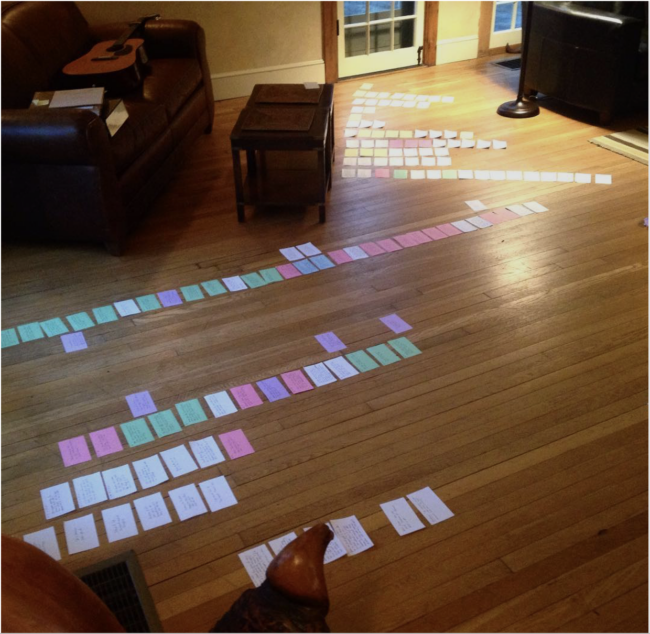
By alternating between these two modes, you control the reader's experience of time:
- Scenes slow down time. You force the reader to live inside a single moment.
- Summaries speed up time. You can cover hours, days, or even years in a single paragraph.
5. Practice Exercise
Let's put this into practice.
Scenario: You are writing a feature for a music magazine about a famously shy singer-songwriter performing the first show of her comeback tour after a five-year hiatus.
Your Task:
-
Write one "showing" paragraph (approx. 75 words): Describe the moment she steps onto the stage. The house lights are down, the crowd is roaring, and a single spotlight hits her. Focus on sensory details: the heat of the light, the sound of the crowd, what she does with her hands, the look on her face. Immerse the reader in her experience.
-
Write one "telling" paragraph (approx. 50 words): Summarize the reasons for her five-year absence. Briefly explain the burnout, writer's block, and personal struggles that led her to step away from the music industry after her last, hugely successful tour.
-
Analyze your choices: In a final sentence, explain why you chose to "show" the stage entrance and "tell" the backstory.
Key Takeaways
- Showing (Scene): Dramatizes key moments, slows down time, and immerses the reader using sensory detail, action, and dialogue. Use it for pivotal, emotional, and character-defining events.
- Telling (Exposition/Summary): Condenses information, speeds up time, and provides necessary context or background. Use it to connect scenes, cover less important periods, and explain complex information.
- Narrative Pacing: The skillful alternation between showing and telling is what controls the rhythm of your article, keeping the reader engaged by balancing immersive detail with efficient storytelling.
In our previous lesson, you learned how to build a scene. Now you understand how to place those scenes within a larger narrative structure. A key component of any scene is dialogue. In our next lesson, we will dive into the journalistic standards for handling what people say, as we learn to distinguish between direct quotes, indirect quotes, and paraphrasing, and select the best option for the context.