Welcome back! In our previous lesson, we began our module on journalistic style by covering the AP Style rules for capitalization, abbreviations, and acronyms. Mastering those conventions is the first step toward producing clean, professional copy.
Today, we'll continue building that essential toolkit. This lesson will focus on another critical set of AP Style rules that you'll use in nearly every article you write. Your learning outcome is to apply AP Style rules for numbers, dates, and titles of works and people. For an entertainment journalist, reporting on box office figures, release dates, and the creative works themselves, these rules are non-negotiable for achieving credibility and clarity.
Let's dive into the specifics.
1. Handling Numbers in AP Style
One of the quickest ways to spot an amateur article is by how it handles numbers. AP Style aims for readability and consistency, but the rules have many important exceptions.
The general rule is simple:
- Spell out numbers one through nine.
- Use figures for 10 and above.
However, this rule is often overridden by exceptions. For a clear explanation of the core rule and its most common exceptions (like for ages and money), let's start with a video.
This clip from Hofstra University's "Using AP Style" video provides a concise overview of the basic number rules and their most important exceptions.
Please watch from this section. Pay close attention to the examples where numerals are used for numbers under 10, specifically in the context of ages, money, and dates.
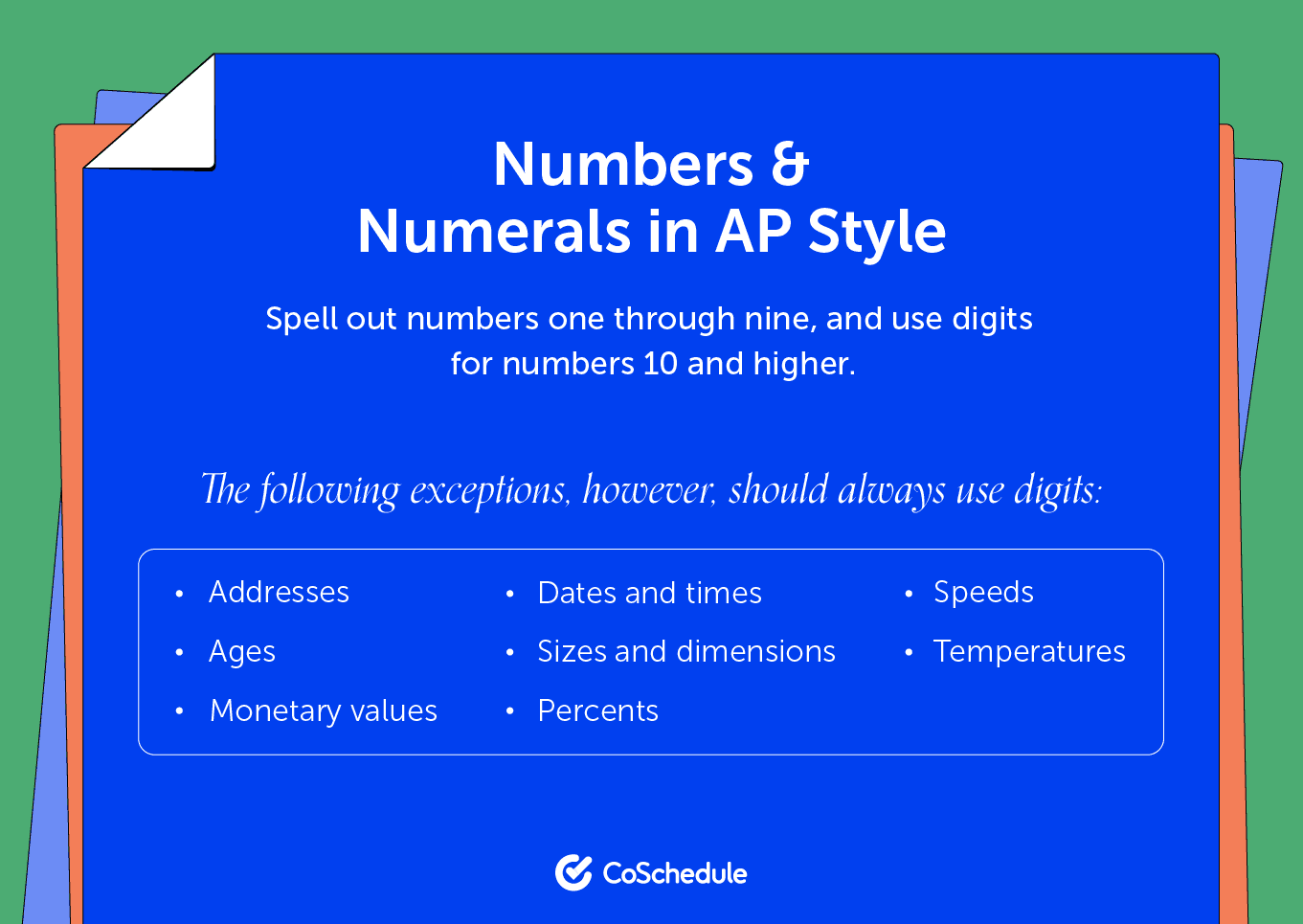
As the video highlighted, you should almost always use figures for:
- Ages:
The 5-year-old actor,The director is 42. - Money:
$3 million,8 cents - Dates and Times:
March 4,7 p.m. - Dimensions:
The 5-foot-10-inch actress - Percentages:
5%(Note: AP Style recently changed to favor the%symbol over spelling out "percent.")
The other crucial rule is to never begin a sentence with a numeral. If a number starts a sentence, you must spell it out.
- Incorrect:
1998 was the year the film was released. - Correct:
Nineteen ninety-eight was the year the film was released.(Though it's often better to rephrase:The film was released in 1998.)
This cheat sheet is a great visual summary of when to use figures.
2. Formatting Dates and Times
Dates are fundamental to news reporting, whether you're covering a film's release or an artist's tour schedule. AP Style has very specific formatting here.
Key rules for dates:
- Abbreviate long months: Abbreviate
Jan., Feb., Aug., Sept., Oct., Nov.,andDec.when used with a specific day. - Spell out short months: Never abbreviate
March, April, May, June,andJuly. - No ordinals: Use
May 22, notMay 22nd. - Commas with full dates: Use commas to set off the year in a full date. Ex:
The show premiered on Sept. 16, 2004, and ran for ten seasons.When using only a month and year, no comma is needed:The album was released in August 2021.
For a detailed look at these rules, particularly the month abbreviations, the following video is helpful.
This section from Mark Grabowski's "Associated Press Style" video details which months to abbreviate and which to spell out, and reinforces the rule against using ordinal numbers.
Watch from this segment on dates. Focus on the two distinct groups of months: those that get abbreviated and those that are always spelled out.
For times, the rules are straightforward:
- Use figures, with
a.m.andp.m.(lowercase, with periods). Ex:2:30 p.m. - Use
noonandmidnightinstead of12 p.m.and12 a.m.to avoid confusion.
Here is another excellent cheat sheet for a quick review of date and time formatting.

3. Titles of Works
As an entertainment journalist, you'll constantly be referencing the titles of movies, albums, books, and shows. Getting the formatting right is crucial. The main distinction is between quotation marks and italics.
-
Use quotation marks for:
- Books:
"The Great Gatsby" - Movies:
"Parasite" - TV shows:
"Succession" - Songs:
"Like a Rolling Stone" - Poems, articles, and individual episodes.
- Books:
-
Use italics for:
- Newspapers: The New York Times
- Magazines: Rolling Stone
- Journals: The New England Journal of Medicine
(Note: Some older versions of AP Style didn't use italics, but it is now the standard for major publications.)
The Hofstra video provides a quick and clear explanation of this distinction.
This brief clip clarifies the fundamental AP Style rule for formatting titles of creative works.
Watch from this section on works. The key takeaway is the difference in treatment between a composition like a movie and a publication like a magazine.
4. Titles of People
In the last lesson, we covered the basic rule: capitalize a formal title before a name (Director Greta Gerwig) but lowercase it after a name or when it stands alone (Greta Gerwig, the director,).
Let's add a few more important layers to this:
-
First and Subsequent References: Use a person's full name and title on first reference. On all subsequent references, use only their last name.
- First:
Actor Cillian Murphy won the award. - Second:
Murphy gave a moving acceptance speech.
- First:
-
Courtesy Titles: Do not use
Mr., Mrs., Miss,orMs.except in direct quotes. -
Academic Titles: Avoid using
Dr.for anyone who isn't a medical doctor. If their degree is relevant, explain it in the text.- Instead of:
Dr. Jane Smith, a film historian, wrote the book. - Prefer:
Jane Smith, who holds a doctorate in film history, wrote the book.
- Instead of:
This video explains these rules of reference clearly.
This segment explains how to handle a person's name and title on the first mention and in subsequent references.
Watch the video from this section on names and titles. Pay attention to the rules for first reference, subsequent reference, and when not to use courtesy titles like "Mr." or "Dr."
5. Practice Exercise
Now, let's put all these rules together. The following paragraph contains numerous AP Style errors related to numbers, dates, and titles. Please rewrite it to be compliant with AP Style.
On Oct. 10th, the new movie Starlight Drifter premieres in Los Angeles, California. The film's 9 year old star, Leo Gomez, is already getting Oscar buzz. Its director, Dr. Evelyn Reed, told the "New York Times" that the budget exceeded 20 million dollars. "We shot the movie over 3 months in 2022," Reed said. 250 crew members worked on the production.
View the corrected version and analysis
Here is the paragraph corrected according to AP Style:
On Oct. 10, the new movie "Starlight Drifter" premieres in Los Angeles. The film's 9-year-old star, Leo Gomez, is already getting Oscar buzz. Its director, Evelyn Reed, told The New York Times that the budget exceeded $20 million. "We shot the movie over three months in 2022," Reed said. Two hundred fifty crew members worked on the production.
Analysis of Changes:
Oct. 10thbecameOct. 10: Removed the ordinal "th."Starlight Drifterbecame"Starlight Drifter": Movie titles go in quotation marks.Los Angeles, CaliforniabecameLos Angeles: Major cities like Los Angeles stand alone without the state name in AP Style.9 year oldbecame9-year-old: When an age is used as an adjective before a noun, it's hyphenated.Dr. Evelyn ReedbecameEvelyn Reed:Dr.is reserved for medical doctors. Since her profession is director, the title is dropped."New York Times"became*The New York Times*: Newspaper titles are italicized. The article "The" is part of the official name.20 million dollarsbecame$20 million: Use the dollar sign and numeral figure.3 monthsbecamethree months: Spell out numbers under 10.250 crew members...becameTwo hundred fifty crew members...: Spell out a number at the beginning of a sentence.
Conclusion
You've now covered another essential layer of AP Style. These rules for numbers, dates, and titles are some of the most frequently used in all forms of journalism, and mastering them will significantly elevate the professionalism of your writing.
Key Takeaways:
- Numbers: Spell out one through nine; use figures for 10+. But use figures for most exceptions like ages, money, dates, and percentages. Never start a sentence with a numeral.
- Dates: Abbreviate long months with a specific day, but never short ones. Never use ordinals (
st, nd, th). - Titles of Works: Use quotation marks for compositions (movies, books, songs). Use italics for publications (newspapers, magazines).
- Titles of People: Use the full name on first reference and only the last name after. Avoid courtesy titles and be judicious with academic titles like
Dr.
In our next lesson, we will move from the micro-level of style rules to the macro-level of story structure. We'll explore the foundational structure of news writing: the inverted pyramid.