Welcome to the next lesson in our module on building cohesive paragraphs. In our last session, we looked at how varying paragraph length can control the pacing and rhythm of your writing, much like a musician uses rests and notes to create a compelling song. We shaped the blocks of our text; now it's time to add the cement that holds them together.
Today, we'll focus on using transitional words and phrases to signal the relationships between your ideas. For a journalist, this skill is essential. It's how you guide your reader smoothly from one point to the next, ensuring your arguments and narrative are clear, logical, and effortless to follow. Moving from choppy sentences to fluid prose is a hallmark of professional writing.
1. What Are Transitions and Why Do They Matter?
At their core, transitions are signposts. They are words and phrases that tell your reader how one sentence or paragraph relates to the one that came before it. Are you adding a similar point? Contradicting a previous one? Providing an example? Transitions make these connections explicit, so the reader doesn't have to stop and figure them out.
This short video provides a clear "before and after" example that demonstrates how much smoother writing becomes with a few well-placed transitions.
Make Your Writing Flow | Sentences: Transitions, Subordination, and Modification
The video "Make Your Writing Flow" by Writing with Andrew offers a great introduction to the power of transitions.
Please watch from the start of the introduction to transitions, through the paragraph example, and into the explanation of their function. Notice how adding words like "However" and "Furthermore" reduces the reader's workload.
As the video explains, the real goal is to make it easier for readers to process what you write. Instead of just dropping one fact after another, transitions help you lead your audience through your story, telling them what to do with each new piece of information.
2. A Toolbox of Transitions by Function
To use transitions effectively, you need to choose the right one for the job. The word you choose depends on the logical relationship you want to create. This next video breaks down the most common categories.
How to Transition Between Paragraphs and Sentences: Transition words with examples
The video "How to Transition Between Paragraphs and Sentences" from Tech meets Rhet provides a quick, categorized overview of different transition words.
Watch the following short segments that cover different types of relationships: Adding ideas Showing cause and effect Contrasting ideas Comparing ideas Giving examples Showing time or sequence
To help you build your vocabulary, here is a helpful chart that organizes transition words by their function. You might want to bookmark this for future reference.
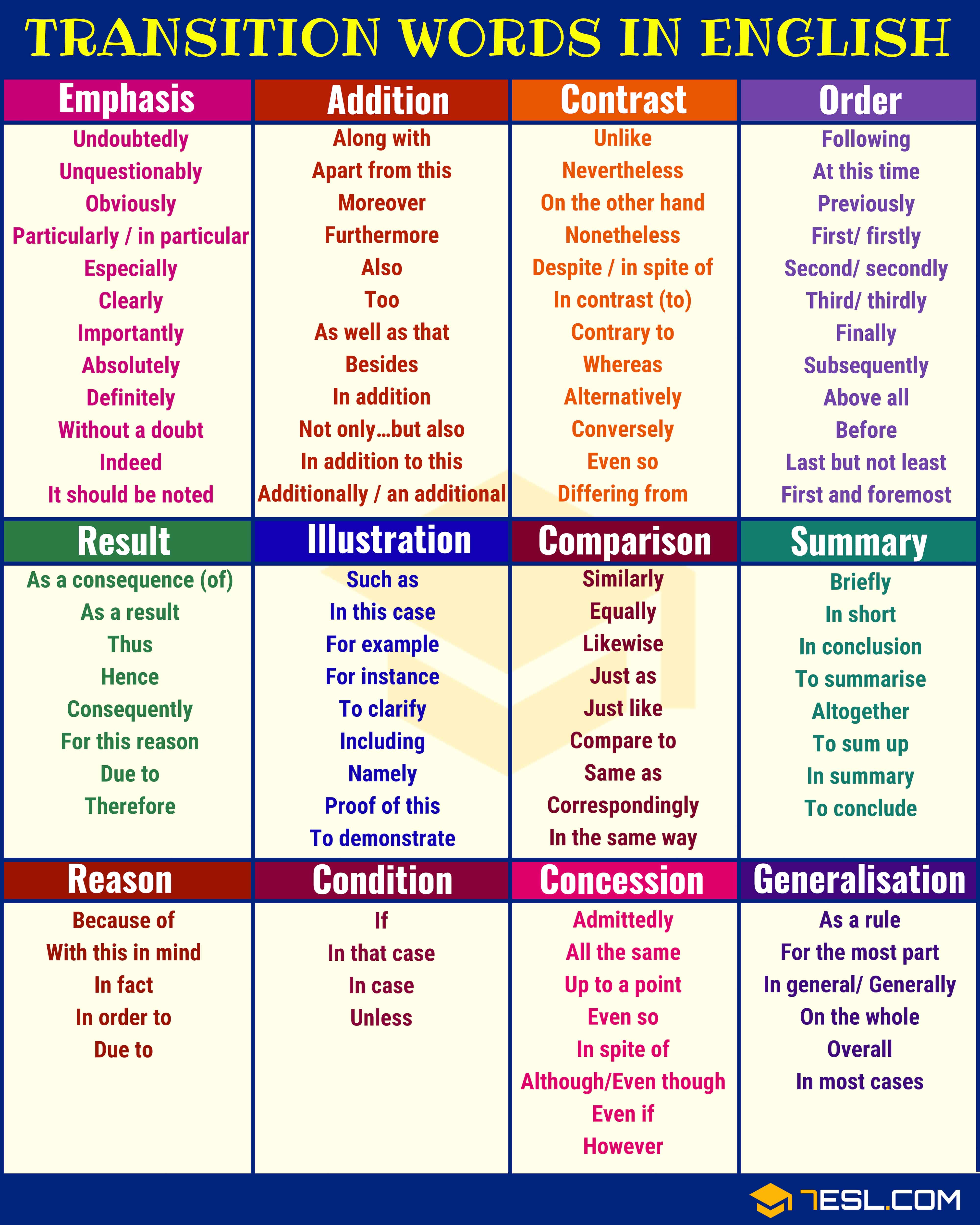
For an even more exhaustive list, you can explore the resource "Common Transition Words and Phrases" from Vanderbilt University's Writing Studio.
3. Transitions in Journalistic Writing
While knowing lists of words like "therefore" and "in addition" is useful, professional journalists often use more subtle and sophisticated techniques to ensure their stories flow. It’s not always about starting a sentence with a transition word followed by a comma.
The following article, written for journalists, explores some of these more advanced strategies.
Good Transitions: A Guide to Cementing Stories Together
This article from The Open Notebook digs into the craft of creating seamless transitions in nonfiction writing.
Please read two sections that introduce powerful journalistic techniques: Start at the heading "Head-to-Tail Transitions." Read how echoing a word or concept from the end of one paragraph at the start of the next creates a strong, clear link. Then, skip to the paragraph that begins "Sometimes a story requires a marked shift..." and read until the subheading "Pivoting at Section Breaks." This part explains the "contrast approach" and the "But wait" technique, which are perfect for introducing twists or new information in entertainment stories.
As you read, notice how these techniques are less about dropping in a single word and more about thoughtfully structuring the ends and beginnings of your paragraphs.
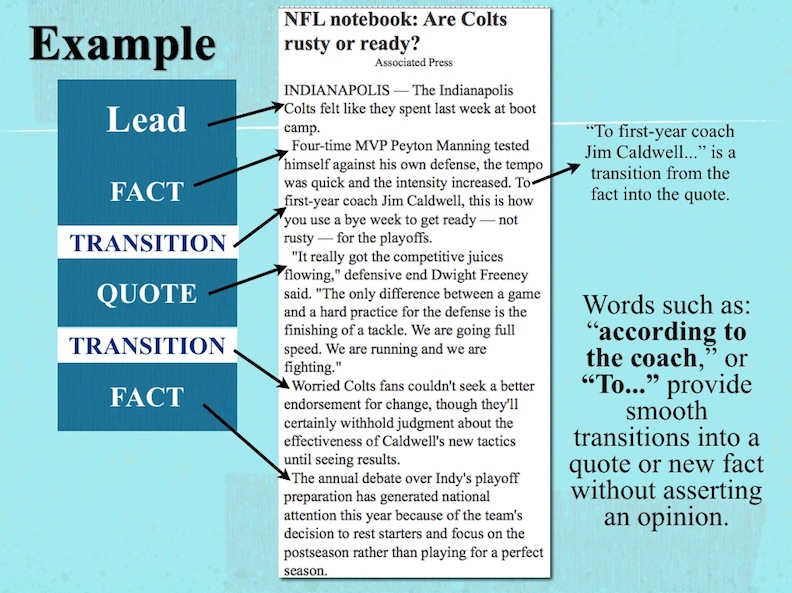
Here is a concrete example from a news article. Notice the highlighted phrase "To first-year coach Jim Caldwell..." which serves as a simple, effective transition to introduce a quote. It's smoother than just starting a new paragraph with the quote itself.
4. Your Turn: Connecting the Ideas
Let's apply these concepts. The following text is a short excerpt from an album review. It's choppy because the ideas are disconnected.
Your task is to rewrite it, adding transitional words and phrases to create a clear and logical flow. Feel free to use simple transitions ("however," "for example") or more integrated techniques like the "head-to-tail" method.
Original Text:
The band's third album, Neon Ghosts, largely abandons the acoustic folk of their earlier work. The opening track is built on a pulsating synthesizer and a heavy drum machine. The lead singer’s voice, once a gentle whisper, is now processed with a layer of digital distortion. The lyrics still explore familiar themes of love and loss. The album's final song, "Sunrise," returns to a single acoustic guitar, ending the record on a surprisingly quiet note.
Task: Copy the text and revise it to improve the flow between sentences.
Sample Solution
Here is one possible revision. Your version might be different, but it should demonstrate a conscious effort to link the ideas logically.
The band's third album, Neon Ghosts, largely abandons the acoustic folk of their earlier work. For instance, the opening track is built on a pulsating synthesizer and a heavy drum machine. Even the lead singer’s voice, once a gentle whisper, is now processed with a layer of digital distortion.
Despite this new electronic sound, the lyrics still explore familiar themes of love and loss. However, the album doesn't forget its roots entirely. The final song, "Sunrise," returns to a single acoustic guitar, ending the record on a surprisingly quiet note.
Analysis of this version:
- "For instance" clearly signals that the following sentence is an example of the new sound.
- "Even" adds emphasis, showing the extent of the sonic change.
- "Despite this new electronic sound" creates a sophisticated transition that contrasts the musical style with the lyrical content. This is a form of the "contrast approach."
- "However" provides a simple, effective pivot to introduce the final, contrasting point about the last song.
Conclusion
Today we've seen that transitions are the essential glue of good writing. By consciously selecting words and phrases that signal the logical connections in your work, you make your prose clearer, smoother, and more professional.
Key Takeaways:
- Transitions act as signposts that guide your reader, showing relationships of addition, contrast, cause-and-effect, and more.
- Building a vocabulary of transition words for different functions is the first step.
- Advanced journalistic transitions involve more than single words; they include techniques like the "head-to-tail" echo and the "but wait" pivot to create seamless flow.
In this lesson, we saw how echoing a key idea can create a strong "head-to-tail" transition. In our next session, we will expand on this principle. We'll explore how strategically repeating key terms and using clear pronoun references throughout an article work together to create cohesion, ensuring your entire piece feels like a single, unified whole.