Hello! In our last lesson, we focused on analyzing sentence rhythm and understanding how the "music" of prose affects tone and pacing. You learned to identify how professional writers use a mix of sentence lengths and structures to control the reader's experience.
Today, we'll shift from analysis to application. The goal is to take what you've learned and use it to actively improve your own writing. You will learn specific techniques for revising a paragraph to enhance its flow, paying close attention to how you can vary sentence length and structure to make your prose more dynamic and professional. This is a core skill for turning functional writing into compelling journalism.
1. From Choppy to Smooth: The Mechanics of Flow
In the last lesson, we saw how a series of short, simple sentences can sound choppy, while a string of long, complex ones can be exhausting. The key is variety, but how do we create it? Beyond just randomly making sentences longer or shorter, we can use specific grammatical tools to combine ideas and guide the reader smoothly.
This video from Writing with Andrew offers an excellent overview of three key techniques: using transitions, subordination, and modification.
Make Your Writing Flow | Sentences: Transitions, Subordination, and Modification
Watch this video, "Make Your Writing Flow," to understand the practical tools for connecting your sentences. The presenter uses clear analogies that make these concepts very intuitive.
Please watch the following three segments: Transitions: Notice how simple transition words signal the logical relationship between sentences. Subordination: Pay close attention to the analogy of "steps" (independent clauses) versus "ramps" (dependent clauses). This is a powerful way to think about creating smoother connections. Modification: This section shows how to turn entire sentences into descriptive phrases (-ing, -ed participles, etc.) to pack in more information without halting the reader's momentum.
As you saw, these techniques are about creating logical and structural bridges between your ideas. Instead of presenting a series of standalone thoughts, you guide your reader from one to the next.
A crucial point from the video is the danger of overdoing it. A paragraph where every sentence is a long, complex construction can become just as monotonous as a series of short, choppy ones. The goal is not to eliminate short sentences but to achieve a pleasing and effective variety.
2. The Music of Variety
Let's revisit the powerful example from Gary Provost that we saw in the last lesson. It perfectly demonstrates the "music" that variety creates.
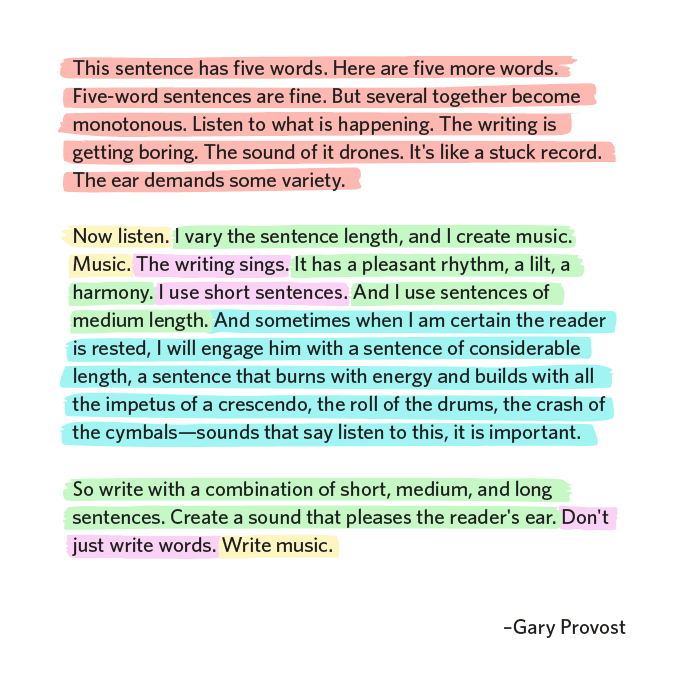
This isn't just an abstract artistic principle; it's a practical tool for controlling reader engagement.
- Short sentences create emphasis, tension, or clarity. They land like a punch. They make a point. They are direct.
- Long sentences create flow, detail, and complexity. They allow you to weave together multiple ideas, build a scene, or develop a nuanced argument.
A well-crafted paragraph uses this variation strategically. An article by Kate Abrosymova uses a passage from author Jhumpa Lahiri to illustrate this beautifully in her article "What Is Cohesion in Writing and How to improve Your Writing Flow?":
“I moved to Italy to read Italian better and to speak it better. I moved to write in Italian. I moved because I wanted to lose everything, to start over, to be reborn. In Rome, my desires seem absurd, self-destructive. One could say I threw myself away, that I abandoned the ship that had carried me. And yet I wait for the words to come.”
Notice the rhythm: a medium sentence, then a short one, followed by a long, cascading sentence that conveys a complex desire. This is followed by another medium, another long, and a final, short, poignant statement. This is conscious, controlled writing.
3. Practice: Revising for Flow
Now it's time to put these concepts into practice. The best way to check your writing's rhythm is to read it out loud. Your ear will catch awkward phrasing, monotony, or choppiness that your eyes might miss.
Guided Revision
Let's work through an example together. Here is a paragraph with poor flow, typical of a rough first draft about a film.
Original Paragraph:
The movie was long. It was over three hours. The director used many slow-motion shots. He also included long scenes with little dialogue. The cinematography was beautiful. The story felt bloated. It could have been shorter.
Reading this aloud, you can hear the choppy, monotonous rhythm. It's a list of facts, not a flowing piece of analysis. Let's revise it.
Revision Process:
- The first two sentences are related. Let's combine them using subordination.
- Running over three hours, the movie was long. (This is better, but a bit clunky).
- The movie was long, running over three hours. (Better flow).
- The next two sentences describe how the director made it long. We can combine them into one sentence that explains this.
- The director filled the runtime with slow-motion shots and long, quiet scenes with little dialogue.
- The final three sentences express a conflict: beautiful visuals but a bloated story. This is a perfect opportunity for contrast.
- The cinematography was beautiful, but the story felt bloated.
- Let's use a short sentence for that final punchy thought: It should have been shorter.
Revised Paragraph:
The movie was long, running over three hours. The director filled the runtime with slow-motion shots and long, quiet scenes with little dialogue. And while the cinematography was beautiful, the story ultimately felt bloated. It should have been shorter.
Notice the variety now: a medium sentence, a longer one, a complex one with a subordinate clause ("while..."), and a final, short, emphatic sentence. The rhythm is more sophisticated and the analysis is clearer.
Your Turn
Now, you revise a paragraph. The following text describes a documentary. It's functional but lacks rhythm. Your task is to rewrite it, applying the principles of varying sentence length and structure to make it flow.
The handout from San José State University's Writing Center has an excellent practice activity. We'll use an adapted version of the second paragraph.
Find "Activity 2: Adjusting Complexity." Your task is to rewrite the second paragraph provided below. There are many ways to do this correctly, so focus on creating a rhythm that feels engaging to you. Paragraph to Revise: The documentary is about minimalism. It promotes a lifestyle with fewer possessions. This may extend beyond physical items. It can also apply to digital life. Minimalists may commit to deleting old files from every device. Some viewers may be concerned. Minimalists might miss out on important memories. This is a common concern with the philosophy.
After you've written your version, you can compare it to the sample revision below.
Click for a sample revision
Sample Revision:
The documentary explores minimalism, a lifestyle promoting fewer possessions that can extend beyond physical items and into digital life. For example, some minimalists commit to deleting old files from every device. This raises a common concern with the philosophy: might they miss out on important memories? While some viewers may worry about this, the film argues the trade-off is worth it.
Analysis of the Revision:
- The first sentence is now a complex sentence that combines four of the original ideas into one flowing thought.
- The second sentence is a medium-length sentence that provides a concrete example.
- The third sentence uses a colon to introduce the central question, creating variety and emphasis. It is short and direct.
- The final sentence uses a "while" clause to acknowledge the concern and present the film's counterpoint, adding analytical depth.
- The mix of lengths (20, 11, 9, and 16 words) and structures creates a much more engaging rhythm.
Conclusion
You've done excellent work today, moving from the theory of sentence rhythm to the practical skill of revision. By consciously shaping your sentences, you gain tremendous control over the tone, pace, and clarity of your writing.
Key Takeaways:
- Improve paragraph flow by using transitions, subordination, and modification to connect ideas smoothly.
- Varying sentence length is essential for creating rhythm and avoiding monotony. Use short sentences for impact and long sentences for detail and complexity.
- The goal is purposeful variety, not just random changes. Your sentence structure should serve the meaning you want to convey.
- Reading your work aloud is one of the most effective ways to diagnose problems with flow and rhythm.
In our next lesson, we will continue exploring tone by analyzing how professional writers use humor, wit, and irony. You'll see how the very sentence structures you practiced today can be used to deliver a punchline or create a subtle, witty effect.