In our last lesson, we learned to distinguish between the core tones used in entertainment writing: formal, conversational, and irreverent. We established that your authorial voice is your consistent personality, while tone is the specific attitude you adopt for a given article.
Today, we move from identifying tones to actively controlling them. This lesson focuses on a crucial professional skill: adjusting your authorial tone to match the specific subject matter and publication style. For any writer, especially one working freelance in the fast-paced world of entertainment journalism, this adaptability is not just a stylistic flourish—it's a requirement of the job.
1. Tone, Voice, and a Writer's Professional Obligation
First, let's solidify the distinction between tone and voice, and connect it to the professional context of writing for a publication. A publication, whether it's The New York Times or a niche comic book blog, has a "brand." Its voice is a carefully curated identity, and your job as a writer is to contribute to it seamlessly.
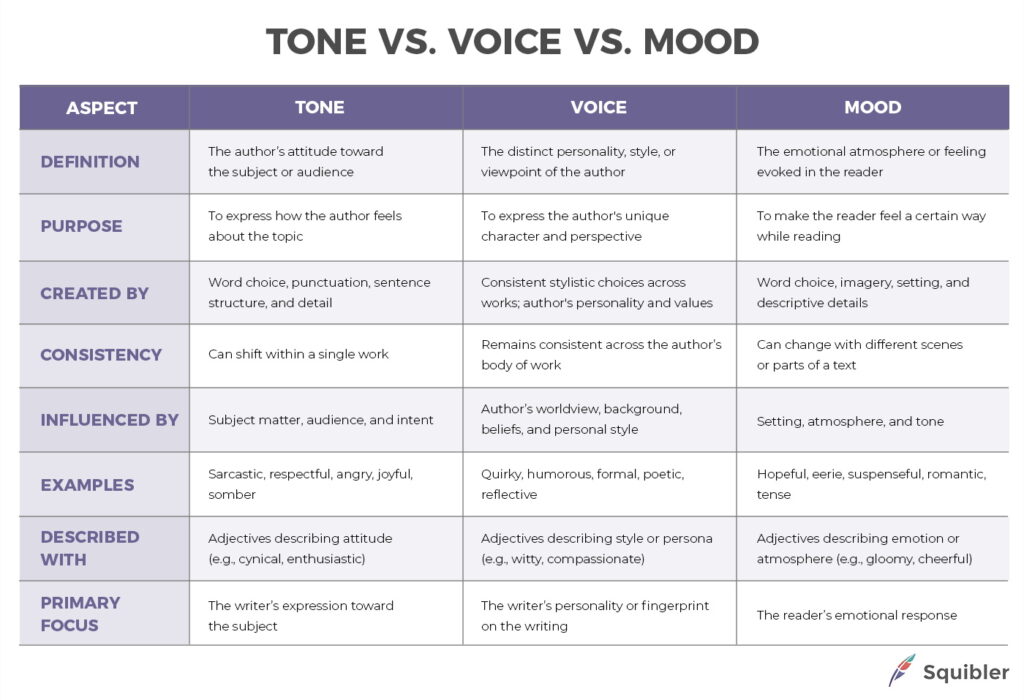
The following reading explains why adapting your tone is a fundamental part of being a professional writer.
How to Be a Writer: adopting style and tone of a publication
This article from the blog Quietly frames tonal adjustment as a core professional skill.
Read the introduction (the first few paragraphs) and the section titled "Tone." Pay close attention to how it defines tone as the author's attitude and connects it to the "W" questions: why am I writing this, who am I writing for, and what do I want readers to take away?
As the article states, your personal voice should still shine through, but the tone must be tailored to the specific context.
2. A Practical Framework for Adjusting Tone
To consciously adjust your tone, you need a mental model for what you're adjusting. In the last lesson, we introduced four "sliders." Now, let's explore a similar, very practical framework used by user experience (UX) writers and content strategists. It breaks tone down into four key dimensions.
The Four Dimensions of Tone of Voice
This article from the Nielsen Norman Group provides a clear, actionable framework for analyzing and adjusting tone.
Read the sections "The Importance of Tone," "The Four Dimensions of Tone of Voice," and "One Message, Many Possible Tones." As you read, focus on these four dimensions: Funny vs. Serious Formal vs. Casual Respectful vs. Irreverent Enthusiastic vs. Matter-of-fact Notice how the article demonstrates changing the tone of a simple error message by making small adjustments to word choice along these dimensions.
Think of these four dimensions as dials you can turn up or down. A review of a prestigious, somber historical drama might require a tone that is serious, formal, respectful, and relatively matter-of-fact. A recap of a wild reality TV show might be funny, casual, irreverent, and enthusiastic.
3. Matching Tone to Subject and Publication
Your tonal choices are guided by two main factors: the subject you're writing about and the publication you're writing for.
Tone and Subject Matter
The subject itself often suggests a natural tone. Writing about a beloved celebrity's lifetime achievement award calls for a different attitude than writing about a studio's controversial business decision. This might seem obvious, but it's where your judgment as a writer comes in. Sometimes, the most effective choice is a counterintuitive one—for example, using a deadpan, serious tone to describe an utterly absurd movie, letting the contrast create humor.
Tone and Publication Style
This is where professional versatility is essential. A publication's style is its identity. Your tone must align with it.
- The New Yorker expects a thoughtful, analytical, and often formal tone.
- Vulture (New York Magazine's culture site) thrives on a witty, highly conversational, and sometimes irreverent tone.
- Billboard, as a music industry trade publication, often balances a formal, news-oriented tone with more descriptive, feature-style writing.
In this video, journalist Brett Atwood gives a fascinating real-world example of this balancing act, describing an editorial debate about what tone to use for a news story he wrote for Billboard.
The Basics of Feature Writing (Journalism Lecture)
Listen to this anecdote about covering a serious news story for Billboard magazine.
Watch the segment from the editorial discussion. Pay attention to how he and his editors debated integrating personal "observations" and a more descriptive, feature-like tone into what was otherwise a straightforward, formal news report. The excerpt he reads about the police raid shows this "hybrid" tone in action.
This example shows that adjusting tone isn't just about picking one and sticking to it; it's about knowing how and when to blend different tonal elements to serve the story and the publication's identity.
4. Your Turn: Practice Adjusting Your Tone
Now it's time to put this into practice. The best way to develop tonal flexibility is to actively try on different styles, just as a musician practices in different keys.
The Scenario: A highly anticipated blockbuster sci-fi film, Cosmic Rift, was just released. It's visually spectacular but has a convoluted plot that critics are divided on.
Your Task: Write two short, distinct takes (around 100-150 words each) on the film's release.
- Version 1: The Prestige Critic. Write for a publication like The Atlantic or The New Yorker. Adopt a formal, analytical, and respectful tone. Your goal is to provide a nuanced, thoughtful critique.
- Version 2: The Pop Culture Blogger. Write for a publication like Vulture or a popular entertainment blog. Adopt a conversational, enthusiastic, and potentially witty or irreverent tone. Your goal is to be engaging and entertaining.
(Take about 10-15 minutes to write your two versions before checking the examples below.)
Click to see example answers
Here are two possible approaches to the exercise. Your versions will be different, but compare your word choice, sentence structure, and overall attitude to these examples.
Version 1: The Prestige Critic (Formal, Analytical, Respectful)
Cosmic Rift arrives in theaters not merely as a film, but as a cultural event, bearing the immense weight of audience expectation. Director Anya Sharma’s visual ambition is undeniable; the screen is a canvas for breathtaking cosmic vistas and meticulously crafted alien worlds. Yet, for all its aesthetic splendor, the narrative struggles to cohere. The plot, a labyrinth of temporal paradoxes and competing philosophies, feels more intellectually overwrought than emotionally resonant. While the film’s attempt to grapple with grand existential questions is admirable, one is left wondering if its visual reach ultimately exceeded its narrative grasp.
- Tonal Analysis: Uses complex sentences and elevated vocabulary ("aesthetic splendor," "intellectually overwrought"). The attitude is detached and analytical. It respects the filmmaker's ambition while delivering a measured critique.
Version 2: The Pop Culture Blogger (Conversational, Witty, Enthusiastic)
Well, Cosmic Rift has finally landed, and wow, what a trip. If you came for the eye candy, you're in for a treat—this movie looks like a billion dollars and then some. Seriously, every frame is a visual masterpiece. But the plot? Buckle up. It feels like the writers threw a physics textbook, three philosophy podcasts, and a time machine into a blender and hit 'puree.' You might need a flowchart to keep track of who's in what timeline, but honestly, when it looks this good, who's complaining? It's a glorious, beautiful mess, and you kind of have to love it for that.
- Tonal Analysis: Uses casual language ("eye candy," "buckle up"), addresses the reader directly, and employs humor ("threw...into a blender"). The tone is enthusiastic and slightly irreverent about the plot's complexity, prioritizing entertainment value.
Conclusion
Excellent work. Today you've moved beyond simply identifying tone and have started practicing the professional skill of modulating it. This ability to write in different registers is what separates an amateur from a working journalist.
Key Takeaways:
- Adjusting your tone is a professional requirement for aligning with a publication's "brand voice."
- You can analyze and control tone by thinking in terms of dimensions: Formal/Casual, Serious/Funny, Respectful/Irreverent, and Enthusiastic/Matter-of-fact.
- Your tonal choices should be informed by both the subject matter and the specific publication style.
- Practicing writing the same story in different tones is an effective way to build stylistic flexibility.
In our next lesson, we will zoom in further on the mechanics of style. We'll analyze sentence rhythm and how varying the length and structure of your sentences can have a powerful effect on the overall tone and feel of your writing.