Hello! In our last lesson, we focused on using concrete, sensory language to make your writing more immersive. Today, we'll continue sharpening your word choice by moving from the sensory to the subtle. You'll learn that words with similar meanings can have vastly different effects, and choosing the right one is a hallmark of a skilled writer.
Your learning outcome for this lesson is to select appropriate synonyms by considering connotation, register, and context. For an entertainment journalist, mastering this skill allows you to control the tone of your article with precision—whether you're writing a formal critique for a major publication or a conversational piece for a blog. It's the difference between saying a performance was "strange" and knowing when to call it "unorthodox," "bizarre," or "eccentric."
This lesson should take you about 60 minutes.
1. Beyond the Dictionary: Connotation
As a writer with a background in applied linguistics, you're likely familiar with the concepts of denotation and connotation. Denotation is a word's literal, dictionary definition, while connotation is the web of feelings, ideas, and cultural associations that surround it. Our focus today will be on how to harness connotation in your journalistic writing.
Let's start with a clear visual and a short video to refresh the concept.
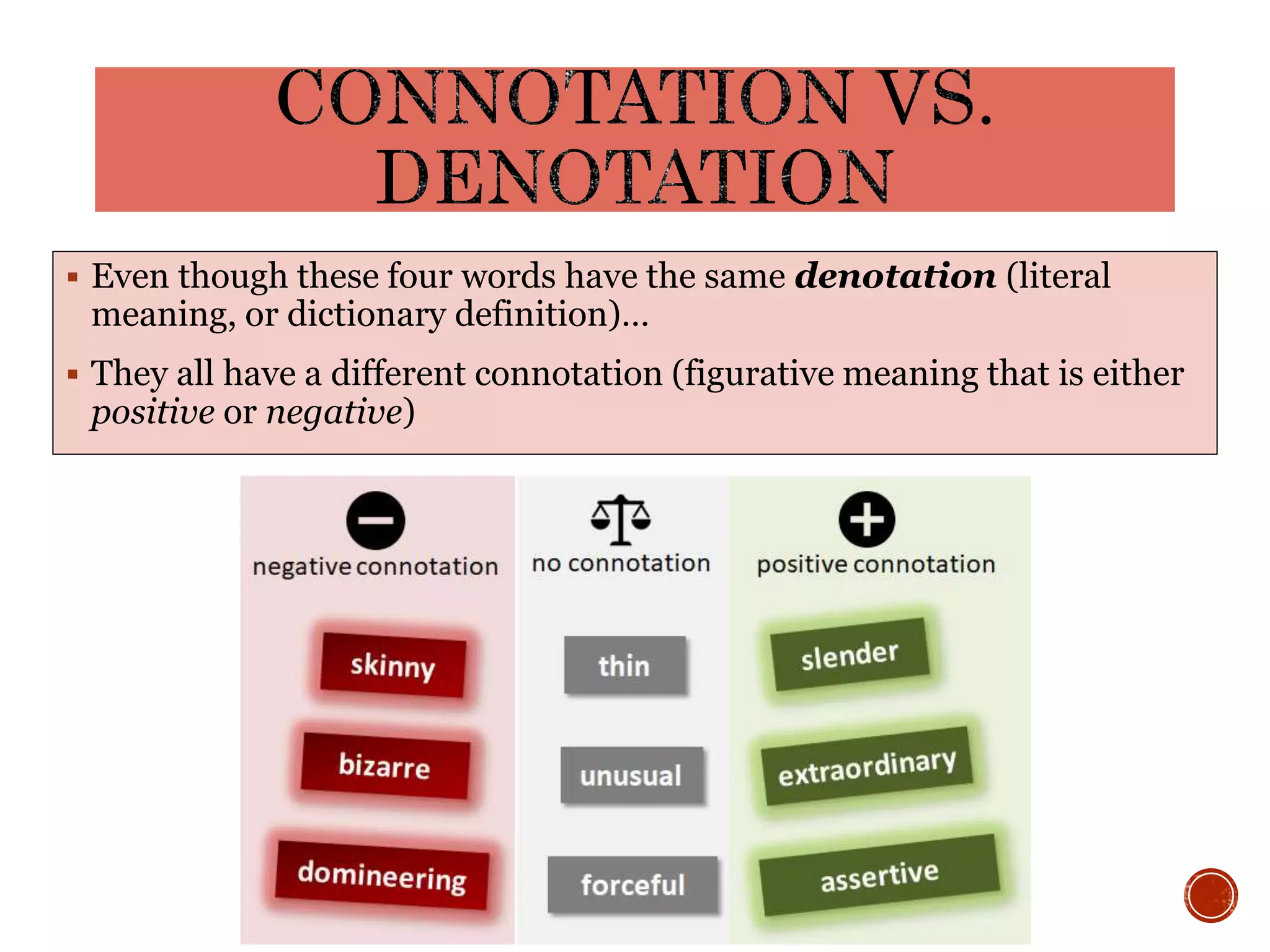
Now, watch this brief video for a dynamic explanation.
This video from The English Club provides a concise overview of connotation with clear examples.
Watch the following segments: Start with the definition of connotation as the "connection" or feeling a word gives you. Then, watch the two examples demonstrating the different connotations for synonyms of 'old' and 'young'.
To see this principle applied with more nuance, let's turn to a short article.
Unpacking the Ideal Synonym: Precision, Context, and the Nuance ...
This article from St. Augustine University delves into the illusion of perfect synonyms and highlights the crucial difference between denotation and connotation for a writer.
Read the section titled "The Illusion of Perfect Equivalence in Vocabulary" and the subsection "Connotation vs. Denotation." Pay close attention to the example contrasting "thin," "slender," "skinny," and "emaciated." Notice how each word paints a dramatically different picture, even though their denotation is similar.
In entertainment journalism, this is critical. Describing a director's style as "childlike" is a neutral observation. Calling it "childish" is an insult. The choice depends entirely on the meaning you intend to convey.
2. Matching the Room: Understanding Register
The second crucial element in word choice is register, which refers to the level of formality in your language. The register you use depends on your audience, your publication, and your subject. An article for Variety will have a more formal register than a post on a pop culture blog.
This video provides a great introduction to the concept.
The video "Editing for register and tone" from Academic Writing gives a clear definition of register and explains how it's determined by the writing situation.
Watch the first two minutes of the video, focusing on: The definitions of register (formality) and tone (attitude), and the helpful analogies to clothing and conversation. The three questions that determine register: Why are you writing? Who are you writing for? What is the genre?
English modulates register in fascinating ways. Your linguistics background gives you a great foundation for appreciating the mechanics of how this works. For instance, words derived from Germanic roots often feel more informal and direct, while words with Latin or French origins tend to raise the register.
Register: Language Formality in Creative Writing ... - Words like trees
This article from the blog Words like trees offers a deeper look at the linguistic tools that shape register in English.
Read the sections titled "What does register look like in English?" and the subsection "Vocabulary." The table comparing Germanic, French, and Latin synonyms (e.g., kingly, royal, regal) is particularly insightful. It demonstrates that you have a spectrum of words to choose from to precisely calibrate your level of formality.
Take a look at the image below for more examples of how words can be categorized by formality.

Thinking about word origins and formality levels allows you to make deliberate choices. In a film review, you might ask the reader to consider a theme. In a more academic analysis, you might inquire about it. In a casual blog post, you might just put it out there.
3. Putting It All Together: Context is King
Ultimately, connotation and register work together within a specific context. The "ideal synonym" is the one that best fits the surrounding words, your communicative goal, and the established conventions of the genre.
For example, in financial journalism, "liquidity" and "cash on hand" are not interchangeable, even if they seem similar to a layperson. The same is true in entertainment. A "cinematographer" is not just a "camera guy," and a "showrunner" is more than a "producer." Using the right term demonstrates credibility.
Unpacking the Ideal Synonym: Precision, Context, and the Nuance ...
Let's return to this article to see how context governs word choice.
Read the sections "Contextual Mapping: Where Synonyms Truly Matter," focusing on the subsections "Register and Formality" and "Semantic Range and Specificity." The example of "scrutinized" vs. "observed" vs. "glanced" is a perfect illustration of how word choice can signal different levels of intensity and intent.
4. Practice: Choosing the Right Word
Now, let's apply these concepts. For each sentence below, choose the most appropriate synonym from the options provided, considering the specified context. Think about the connotation and register of each choice.
Exercise:
-
Context: A formal, laudatory profile of a veteran actress in Vanity Fair.
Sentence: After fifty years in the industry, she remains a [powerful] figure in Hollywood.- (a) pushy
- (b) commanding
- (c) bossy
-
Context: A conversational, slightly snarky blog post about a reality TV show reunion.
Sentence: The host's questions were clearly designed to [annoy] the cast members and start a fight.- (a) provoke
- (b) vex
- (c) needle
-
Context: A neutral news report for the Associated Press about a movie studio's financial trouble.
Sentence: The studio plans to [sell] several of its less profitable divisions.- (a) offload
- (b) divest
- (c) dump
-
Context: A critical review in The New York Times that praises a screenplay's cleverness.
Sentence: The script is filled with [smart] dialogue that reveals character without resorting to clumsy exposition.- (a) witty
- (b) brainy
- (c) smart-alecky
View suggested answers and analysis
-
(b) commanding. "Pushy" and "bossy" have negative connotations, which would be inappropriate for a laudatory profile. "Commanding" has a positive connotation of authority and respect, fitting the formal register of Vanity Fair.
-
(c) needle. "Provoke" is a bit too formal for a snarky blog post. "Vex" is almost archaic. "Needle" perfectly captures the informal, slightly malicious intent in a conversational tone.
-
(b) divest. This is the most appropriate choice for a formal, financial news context. "Sell" is neutral but less precise. "Offload" and "dump" are informal and carry a negative connotation, suggesting the divisions are worthless, which injects an opinion inappropriate for an AP report.
-
(a) witty. "Brainy" sounds a bit awkward and juvenile. "Smart-alecky" has a negative connotation, implying the dialogue is arrogant. "Witty" is the perfect word, carrying a positive connotation of intelligence and clever humor that fits the register of a New York Times review.
Conclusion
In this lesson, you've moved beyond simply choosing words that are "correct" to choosing words that are effective. By carefully considering connotation, register, and context, you can add layers of meaning, precision, and professionalism to your writing.
Key Takeaways:
- Connotation vs. Denotation: Don't just consider what a word means, but what it implies.
- Register is about Formality: Match your language to the expectations of your audience and publication, from highly formal to casually conversational.
- Context Determines a Word's Fitness: The "best" word is always relative to the specific sentence, subject, and genre you are writing in.
In our next lesson, we will build on this by focusing on words and phrases to avoid. You will learn to identify and avoid clichés and jargon commonly found in entertainment journalism, helping you develop a fresher and more original voice.