Welcome back! In our last two lessons, we focused on the fundamental building blocks of using sources: first, integrating direct quotes, and then, paraphrasing accurately while maintaining your voice. Now, we'll learn how to connect these pieces to your own writing, creating a seamless and professional article.
Today, we're focusing on how to write effective transitions between your narration and sourced material. Think of this as building the bridges that guide your reader smoothly from your analysis to a source's words and back again. Mastering this skill is key to moving beyond simply presenting information and toward crafting a cohesive, compelling narrative.
1. The Purpose of Transitions
An abrupt, un-introduced quote can feel jarring to a reader, like a speed bump in an otherwise smooth road. These are often called "dropped quotes." Transitions are the "cement" that holds the different bricks of your story—your narration, facts, direct quotes, and paraphrases—together into a strong, coherent structure.
The following short video provides a great overview of why transitions are essential for creating logical flow and preventing reader confusion.
Journalism 101: How to organize news stories
This clip from "Journalism 101: How to organize news stories" by Mark Grabowski explains the fundamental role of transitions in journalistic writing.
Please watch these two segments: What are transitions? This part defines transitions and explains how they prevent a story from sounding "choppy." Using transitions. Pay attention to the example of how a transitional phrase like "In addition to..." signals a logical turn in the story, preventing reader confusion.
As the video explains, without a transition, a quote about a new topic can seem to come out of nowhere. Your job as the writer is to use your own words to prepare the reader for what they're about to hear from your source.
2. The LQTQ Format: A Structural Blueprint
One of the most practical ways to think about transitions is through a common newswriting structure: the L-Q-T-Q Format. This stands for Lead-Quote-Transition-Quote. It provides a reliable rhythm for weaving your narration and sourced material together.
The American Journalism Handbook offers an excellent breakdown of this format.
Quotes and Attribution - The American Journalism Handbook
This section from "Quotes and Attribution" explains a structural approach that places transitions at the heart of the story's flow.
Please read the section titled "The LQTQ Format." As you read, focus on the role of the "Transition" paragraph. Notice that it's not just a filler; it's a place to introduce new facts, provide context, or use a paraphrase to connect the previous quote to the next one.
Let's break down the flow described in the reading:
- Lead & Nut Graf: You set the scene and state the story's core point. The end of your nut graf often serves as the first transition, setting up the first major quote.
- Quote: A direct quote from a source that illustrates, proves, or adds emotion to the point you just made.
- Transition: This is your paragraph of narration. You might use it to:
- Introduce the next key piece of information.
- Provide context for the quote that's about to come.
- Paraphrase another source to show a different perspective.
- Bridge from one sub-topic to the next.
- Quote: A new quote that elaborates on the point you just made in your transition.
This pattern can then repeat: Transition-Quote, Transition-Quote...
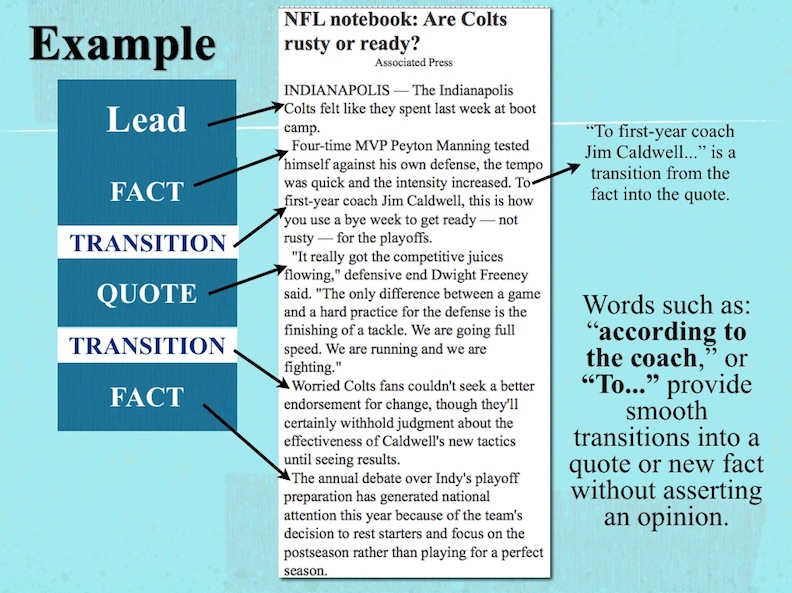
The image below, "Newswriting Lead Fact Quote," provides a simple visual of how a transition sentence connects a factual statement to a direct quote, ensuring a smooth handoff.
3. Techniques for Crafting Smooth Transitions
The LQTQ model gives you the "where," but how do you write the transition itself? Moving beyond simple phrases like "In addition..." is key to developing sophisticated prose.
The "Head-to-Tail" Transition
This powerful technique involves echoing a word or concept from the end of your paragraph at the beginning of the next one, creating a strong logical link.
Good Transitions: A Guide to Cementing Stories Together
This article from The Open Notebook explores the craft of writing transitions. This section introduces a specific, highly effective technique.
Please read the section "Creating a Logical Flow." Focus on the concept of "head-to-tail transitions" and analyze the examples provided. Notice how a word or idea at the end of one paragraph is picked up in the first sentence of the next.
Let's apply this to entertainment journalism. Imagine you've just written this paragraph:
The show's finale left fans divided, with many taking to social media to vent their frustration over the main character's abrupt and tragic fate.
Your transition sentence to introduce a quote from the showrunner could use the "head-to-tail" technique:
That very fate, however, was planned from the very beginning, according to the showrunner. "We knew from day one that her story had to end this way," she said in a recent interview.
By picking up the word "fate," you create an anchor for the reader, making the move to the quote feel natural and inevitable.
The "Contrast" and "But Wait" Approach
This is another common and effective transitional device, perfect for introducing a twist, a new discovery, or a counter-argument. You state the conventional wisdom and then pivot.
- "The band's first album was a critical and commercial failure. But their second effort would change their fortunes entirely."
- "On screen, the actor is known for his intimidating presence. Behind the scenes, however, he is famously gentle and soft-spoken."
This "But wait..." or "On the other hand..." structure creates narrative tension and signals to the reader that you are about to introduce new, surprising information, often via a quote.
Practice Exercise
Time to build a bridge. You are writing an article about a popular comedian who has taken on her first dramatic role.
Your Narration:
For over a decade, audiences have known Miller for her razor-sharp wit and slapstick physical comedy. Her sold-out stand-up tours and blockbuster comedies have made her one of the most beloved figures in entertainment.
The Source's Quote:
"I just wasn't getting scripts that challenged me anymore. It felt like I was being asked to play the same character over and over, and as an artist, that's a kind of death. I needed to feel scared again."
Your Task: Write a single, effective transition sentence that smoothly connects your narration to the comedian's quote. Try using either the "head-to-tail" or "contrast" technique.
View a potential revision and analysis
Here are a couple of strong options:
Option 1 (Contrast Approach):
But behind the laughter and public adoration, Miller felt a growing sense of artistic stagnation. "I just wasn't getting scripts that challenged me anymore..."
- Analysis: This uses the classic "contrast" pivot. The phrase "But behind the laughter..." directly contrasts her public image (your narration) with her private feelings (the quote), creating an intriguing turn in the story.
Option 2 (Head-to-Tail Approach):
Yet, that very position as one of the most beloved figures in entertainment began to feel like a trap. "I just wasn't getting scripts that challenged me anymore..."
- Analysis: This is a more subtle "head-to-tail" transition. It picks up the idea of her being a "beloved figure" and reframes it as a potential negative ("a trap"), which perfectly sets up her quote about wanting a new challenge.
Both options successfully prepare the reader for the quote by framing it, ensuring it lands with maximum impact.
Conclusion
Today, we've explored how to build the crucial connections between your words and your sources' words. Effective transitions are a hallmark of professional writing, guiding your reader effortlessly through your story.
Key Takeaways:
- Transitions are the "connective tissue" that prevents choppy writing and integrates quotes smoothly.
- The LQTQ (Lead-Quote-Transition-Quote) model provides a practical structure for organizing your articles.
- Your narration or a paraphrase can serve as a powerful transition to set up a direct quote.
- Techniques like "head-to-tail" and "contrast" transitions are craft-level tools for creating seamless flow.
In our next lesson, we'll zoom out to look at the bigger picture: how to balance quoted material with original analysis to maintain authorial control over the narrative. This will ensure that while you use sources effectively, your own voice and argument remain the driving force of your article.