Welcome back! In our last lesson, we focused on choosing the right attribution verbs and placing them strategically. Now we'll take the next step to elevate your prose: learning to integrate direct quotations smoothly into your narrative, creating a seamless flow.
This skill is at the heart of professional writing. It's the difference between an article that feels like a disjointed series of blocks—your writing, then a quote, then your writing again—and one that reads as a single, cohesive narrative. By the end of this 30-minute lesson, you'll have a set of powerful techniques to weave your sources' words into your own.
1. The Problem: "Dropped Quotes"
First, let's identify the common mistake we want to avoid: the "dropped" or "floating" quote. This is a quotation that is simply plopped into the text as its own sentence without any introduction or framing. It feels abrupt and makes your writing sound clunky.
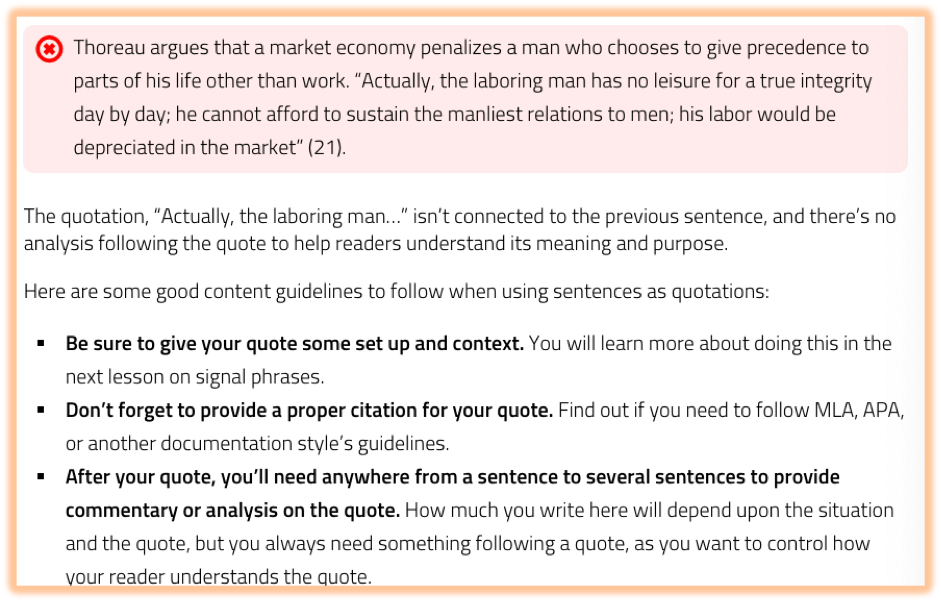
The following video explains why this is a problem and introduces the core idea of blending your words with your source's words.
How to Integrate Quotes in Research Papers (and Synthesis Essays)!
The video "How to Integrate Quotes in Research Papers" from the Garden of English channel clearly demonstrates the awkwardness of dropped quotes.
Watch from the beginning to the end of the example. Pay attention to the contrast between the "clunky" dropped-quote version and the revised version where the quotes are woven into the writer's sentences. The advice to keep quotes short is also a key principle for maintaining flow.
2. The "Quote Sandwich": A Mental Model
A simple and effective way to think about integrating quotes is the "Quote Sandwich" method. It ensures you never leave a quote to stand on its own.
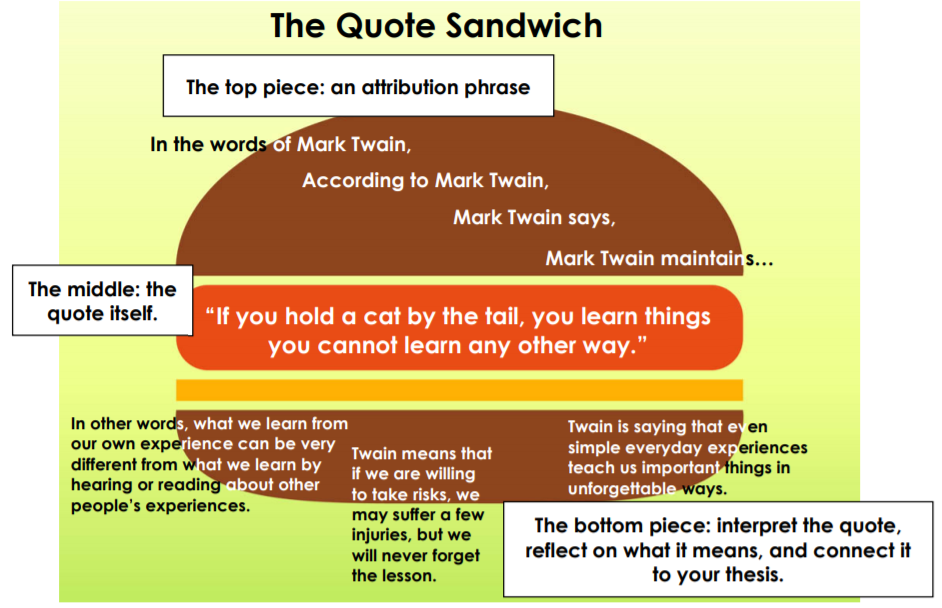
This model gives you a three-step process:
- Top Slice (Lead-in): Introduce the quote. Provide context, identify the speaker, and set up the quote so it makes sense. This is where you use the attribution skills from our last lesson.
- The "Meat" (The Quote): The direct quotation itself. As the video suggested, it's often best to use only the most impactful part of the quote.
- Bottom Slice (Follow-up): Explain the quote's significance. Connect it back to the main point of your paragraph or article. Don't assume the reader understands its importance.
3. Core Integration Techniques
Now, let's look at the specific grammatical techniques you can use to build your "quote sandwich" and create that seamless flow.
This next video, while focused on literary essays, provides an excellent and concise overview of the main techniques that are directly applicable to journalism.
How to Integrate Quotes SEAMLESSLY in Your Essays
In "How to Integrate Quotes SEAMLESSLY in Your Essays," Ms. Peer Editor demonstrates two of the most common and effective integration methods.
Watch the section on weaving quotes into your sentence. This is the most versatile technique. Notice how the writer's sentence provides the context and leads grammatically into the quoted material. Next, watch the section on using a colon. This method is perfect when your own complete sentence serves as a formal introduction to the quote that follows.
Let's break down those techniques with journalistic examples:
Technique 1: Weaving with Partial Quotes
This is the most fluid method. You integrate a short phrase or part of a sentence from your source directly into your own sentence's grammatical structure.
Notice how this works in an entertainment journalism context:
- Original Quote: "I think the most important thing about the character is that, underneath all the bravado and the wit, she is driven by a profound sense of loyalty to her friends. That's her core."
- Integrated Version: The actress argued that the character's core isn't her wit, but rather a "profound sense of loyalty to her friends."
By using only the most essential phrase, you maintain narrative control and create a smooth sentence. The article "Quote Me on That" calls this using a partial quote.
Quote Me on That: The Proper Use of Quotations in Journalism
This section from The Writers for Hire blog provides clear examples of how partial quotes can enhance your writing.
Read the subsection titled "Partial quote" under the "Four Types of Quotes" heading. Note how the examples weave a specific, powerful phrase into the journalist's own sentence.
Technique 2: Introducing with a Colon
This is a more formal but very clear way to set up a quote. You use a complete, independent sentence of your own to introduce the quote, followed by a colon.
- Example: The director summed up his vision for the film's aesthetic with a single guiding principle: "Every shot should look like a Renaissance painting."
Your introductory sentence creates anticipation and provides a frame for the quote that follows.
Technique 3: Breaking Up a Quote with Attribution
We touched on this in the last lesson, but it's a key technique for flow. Inserting the attribution in the middle of a long quote prevents the reader from getting lost and adds rhythmic variety.
- Example: "The audition process was grueling," the actor recalled, "but it taught me more about the character than weeks of rehearsal ever could."
This technique keeps your source's voice present without letting a long block of text interrupt your narrative momentum.
4. A Journalistic Pro-Tip: Patching
In interviews, people rarely speak in perfectly formed, consecutive sentences. "Patching" is a common journalistic practice where you link sentences from different parts of an interview to form a single, coherent quote. This must be done ethically, without changing the source's intended meaning.
Quotes and Attribution - The American Journalism Handbook
This section of The American Journalism Handbook explains the professional technique of "patching" quotes for clarity and flow.
Read the section "Direct Quotes." Focus on the definition of patching and the example provided about the Arsenal football club. This shows how to ethically combine non-consecutive thoughts into a logical quote.
Practice Exercise
Let's put this into practice. Below are two "dropped quotes" in an entertainment news context. Rewrite each one, integrating it smoothly using one of the techniques we've discussed.
Scenario 1:
The writer is discussing the surprising box office failure of a big-budget sci-fi film.
- Dropped Quote: "Audiences today are tired of spectacle. They want character and story." (Quote from a veteran film critic, Anna Singh).
Scenario 2:
The writer is profiling a musician who just released a deeply personal album.
- Dropped Quote: "I felt like I had to be completely honest on this record. After years of hiding behind a persona, I needed to write something that was 100% me, for better or for worse." (Quote from the musician, Javier Luna).
View potential revisions and analysis
Scenario 1 Revision (Weaving with a Partial Quote):
Veteran film critic Anna Singh suggests the film failed because audiences "are tired of spectacle" and are now looking for "character and story."
- Analysis: This version weaves the most important parts of the quote directly into the writer's sentence, creating a concise and flowing analysis.
Scenario 2 Revision (Breaking Up the Quote):
"I felt like I had to be completely honest on this record," Luna said about his new album. "After years of hiding behind a persona, I needed to write something that was 100% me, for better or for worse."
- Analysis: Breaking up this longer, more personal quote with attribution makes it more digestible. The first part sets the stage, and the second part elaborates, with the attribution acting as a natural pause.
Alternative Scenario 2 Revision (Introducing with a Colon):
Javier Luna explained his motivation for the new album with raw vulnerability: "I felt like I had to be completely honest on this record. After years of hiding behind a persona, I needed to write something that was 100% me, for better or for worse."
- Analysis: This approach uses the writer's lead-in sentence to frame the quote's emotional tone, making the colon an effective and dramatic entry point.
Conclusion
You now have a toolkit for moving beyond simply dropping quotes into your articles. By mastering these integration techniques, you can weave your sources' voices into your own, creating a more polished, professional, and readable story.
Key Takeaways:
- Always frame your quotes. Use the "Quote Sandwich" model: introduce, quote, and analyze.
- Weave short, partial quotes into your sentences for maximum flow.
- Use a colon after a complete introductory sentence to set up a longer or more formal quote.
- Break up longer quotes with attribution to maintain rhythm and clarity.
- "Patch" quotes ethically to create a coherent statement from a rambling interview.
In our next lesson, we'll cover the other side of using sources: paraphrasing. You'll learn how to accurately report a subject's point in your own words, which is often a better choice than a direct quote for conveying factual information.