Hello! In our previous lesson, we explored the strategic decisions behind choosing a direct quote, a paraphrase, or a partial quote. You learned that what you choose to quote is crucial for conveying personality and emotion. Today, we'll focus on the equally important technical side: how to punctuate those quotes correctly.
Your learning outcome for this lesson is to apply AP Style rules for punctuation within and around quotation marks. While these rules might seem like minor details, they are a key marker of professionalism in journalistic writing. Getting them right signals to editors and readers that you are a careful, credible writer who has mastered the craft's conventions.
This lesson will take approximately 30 minutes to complete.
1. The Foundation: Punctuating with Commas
The most common punctuation you'll use with quotes is the comma. It's used to introduce, interrupt, or conclude a piece of quoted speech with its attribution (the "speaker tag," like she said or the director explained). American English usage, which AP Style follows, has very specific rules for comma placement.
The following video provides an excellent breakdown of the three main scenarios you'll encounter.
How to Use Commas with Speech Marks in Dialogue (Quotation Marks) | English Punctuation Rules
This video, "How to Use Commas with Speech Marks in Dialogue" from Sparkle English, clearly explains the core rules for using commas with speaker tags.
Watch these three sections carefully. They cover the fundamental patterns you will use every day. Comma before a quote: When the attribution comes first. Comma after a quote: When the attribution comes after the quote. Pay close attention to how a period becomes a comma, but a question mark or exclamation point does not. Commas for interrupted quotes: How to punctuate when the attribution splits a quote in the middle.
The most important rule demonstrated here, which we will now formalize, concerns placement.
2. The AP Style Hierarchy of Punctuation
AP Style has a clear set of rules for which punctuation marks go inside the closing quotation mark and which go outside. Mastering this hierarchy is a quick way to clean up your prose.
Let's start with a comprehensive guide from the UAMS Creative Services' AP Style summary.
AP Style Guidelines | UAMS Creative Services
This guide clearly outlines the rules for various punctuation marks.
Read the section titled quotation marks ( “ ” ). It provides a complete summary of the placement rules for periods, commas, dashes, semicolons, question marks, exclamation points, and colons.
The rules you just read can be summarized into a simple hierarchy. This infographic provides a great visual summary of the core principles.
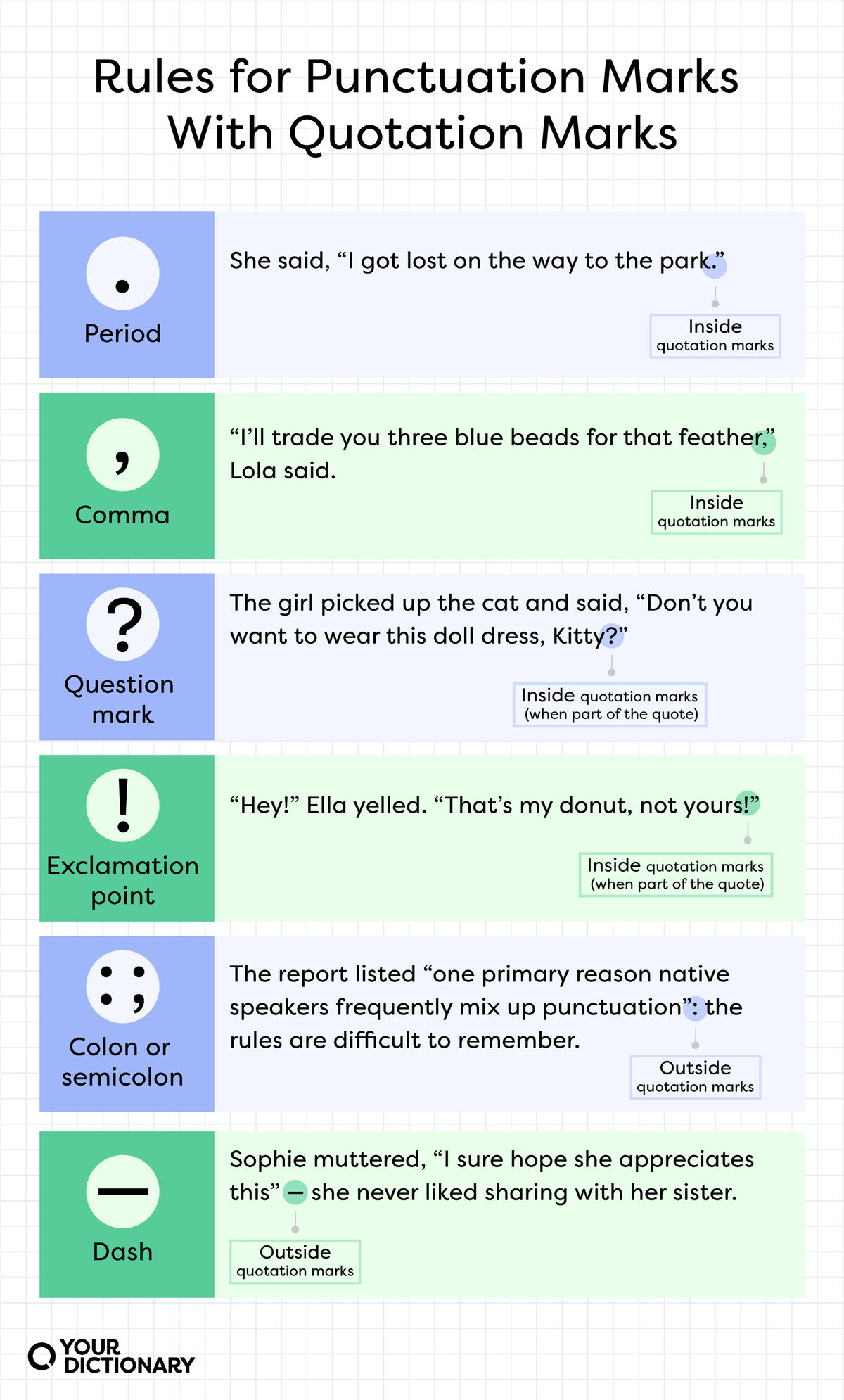
Here is a breakdown of that hierarchy:
-
Always Inside: Commas and periods.
- “I loved the script,” the actor said.
- The actor said, “I loved the script.”
-
Always Outside: Colons and semicolons.
- The review praised the film’s "visual splendor"; however, it criticized the plot.
- He gave his definitive list of "perfect films": The Godfather, Casablanca, and Pulp Fiction.
-
Depends on Context: Question marks, exclamation points, and dashes. These go inside if they belong to the quoted material, and outside if they belong to the larger sentence you are writing.
- Inside: The director asked, “Where is my coffee?” (The quote itself is a question).
- Outside: Who directed “The Godfather”? (The main sentence is a question; the quote is not).
- Inside: The producer shouted, “We’re over budget!”
- Outside: I can’t believe he hates the movie “Dune”!
3. Special Cases: Quotes within Quotes and Long Quotes
Two other common scenarios in journalistic writing involve nested quotations and formal introductions to long quotes.
First, let's cover how to handle a quote within another quote.
This clip from a Hofstra University video on AP Style explains the use of single and double quotation marks.
Watch the segment from quotes and quotes-within-quotes. The key takeaway is to use double quotation marks for the main quote and single quotation marks for the nested one.
Example in an entertainment context:
The critic wrote, "The director’s claim that 'this is my final film' should be taken with a grain of salt."
Notice that all punctuation (the period in this case) is still nested inside all the closing quotation marks.
Second, for introducing longer or more formal quotations, a colon is often more appropriate than a comma.
[PDF] AP Style, Spring 2024 - San Jose State University
This guide from San Jose State University's Writing Center offers a quick note on this topic.
Find the heading Punctuation for Quotations. Focus on the rule about using a colon "to introduce long quotations."
In practice, you would use a colon after a full, independent sentence that formally introduces the block of text.
The actor delivered a heartfelt speech about the film's impact: "This project was more than just a job for us. It was a chance to tell a story that mattered, to connect with people on a fundamental level, and to create something that will hopefully endure."
4. Practice Exercises
Now, let's put these rules into practice.
Activity 1: Video Quiz
First, return to the Sparkle English video and test your understanding with their interactive quiz.
How to Use Commas with Speech Marks in Dialogue (Quotation Marks) | English Punctuation Rules
This is the quiz section from the earlier video on comma usage.
Watch the quiz starting at the quiz. Pause the video for each question, decide on the correct punctuation, and then listen to the explanation.
Activity 2: AP Style Correction
The following sentences contain punctuation errors related to quotation marks. Rewrite each one to conform to AP Style. They are all typical of what you might write in an entertainment news piece.
- The star announced "I'm launching a new production company".
- Did the showrunner really say "This is the final season?"
- "This is my favorite role ever", the actor gushed, "it's been a dream come true".
- The director called the script "a masterpiece;" I, however, found it derivative.
- When asked about the sequel, the producer said "We're exploring our options".
View corrected sentences and analysis
-
Corrected: The star announced, “I’m launching a new production company.”
- Analysis: A comma is needed to introduce the quote. The period goes inside the closing quotation mark.
-
Corrected: Did the showrunner really say, “This is the final season”?
- Analysis: A comma introduces the quote. The question mark goes outside the quotation mark because the main sentence is the question, not the quote itself.
-
Corrected: “This is my favorite role ever,” the actor gushed, “it’s been a dream come true.”
- Analysis: A comma (inside the quotes) is needed to close the first part of the interrupted quote. The second part of the quote should start with a lowercase letter because it is continuing the same sentence.
-
Corrected: The director called the script “a masterpiece”; I, however, found it derivative.
- Analysis: Semicolons always go outside the closing quotation mark.
-
Corrected: When asked about the sequel, the producer said, “We’re exploring our options.”
- Analysis: A comma is needed to introduce the quote after the attribution. The period goes inside the closing quotation mark.
Conclusion
You've now covered the essential AP Style rules for punctuating quotations. While they may seem small, these conventions are a powerful signal of your professionalism and attention to detail.
Key Takeaways:
- Commas and periods always go inside the closing quotation mark.
- Colons and semicolons always go outside.
- Question marks and exclamation points go inside only if they are part of the quoted material.
- Use single quotation marks for a quote nested inside another quote.
- Use a comma to introduce most quotes and a colon after a complete sentence that introduces a long or formal quote.
In our next lesson, we will move from punctuation to attribution itself. You'll learn how to write correct attribution using varied verbs and appropriate placement, ensuring your quotes are not only punctuated correctly but also presented clearly and elegantly.