Hello! Welcome to the final lesson in our module on polyandry and female-centered relationships.
In our last session, we explored the varied psychological motivations for the male partners in these dynamics, distinguishing between roles like the "stag" and the "cuckold" and understanding drivers such as compersion and power exchange. We established that the journey into these structures often involves a profound emotional process.
Today, we will address the practical realities and potential difficulties of these relationships. Our learning outcome is to: Identify common challenges specific to polyandrous configurations and describe management strategies to address them. Recognizing these challenges isn't about creating fear or doubt; it's about building the resilience, awareness, and skills needed to navigate them successfully.
1. Identifying the Core Challenges
Any relationship structure has its unique set of challenges, and polyandry is no exception. These can arise from external societal pressures, internal group dynamics, and the logistical complexity of managing multiple relationships.
To start, let's get a clear overview of the most common issues.
A New World: Women and Polyandry - MOODRX LLC
The article 'A New World: Women and Polyandry' by MOODRX LLC provides a concise summary of the key difficulties people in polyandrous relationships may face.
Please read the section titled 'Challenges of Polyandry'. Focus on the three main categories presented: social stigma, jealousy, and decision-making.
The reading highlights three key areas of challenge:
- Social Stigma and Isolation: Because polyandry deviates significantly from the monogamous norm, individuals may face judgment or a lack of understanding from family, friends, and their wider community. This can lead to feelings of isolation and the stress of managing a private identity.
- Jealousy and Intra-relationship Competition: While jealousy can occur in any relationship, the structure of polyandry can present specific triggers. Competition for the central woman's time, attention, and affection is a common concern.
- Complex Decision-Making Dynamics: Coordinating schedules, finances, household duties, and parenting decisions between three or more adults is inherently more complex than in a dyad. Without clear systems, this can lead to conflict and emotional distress.
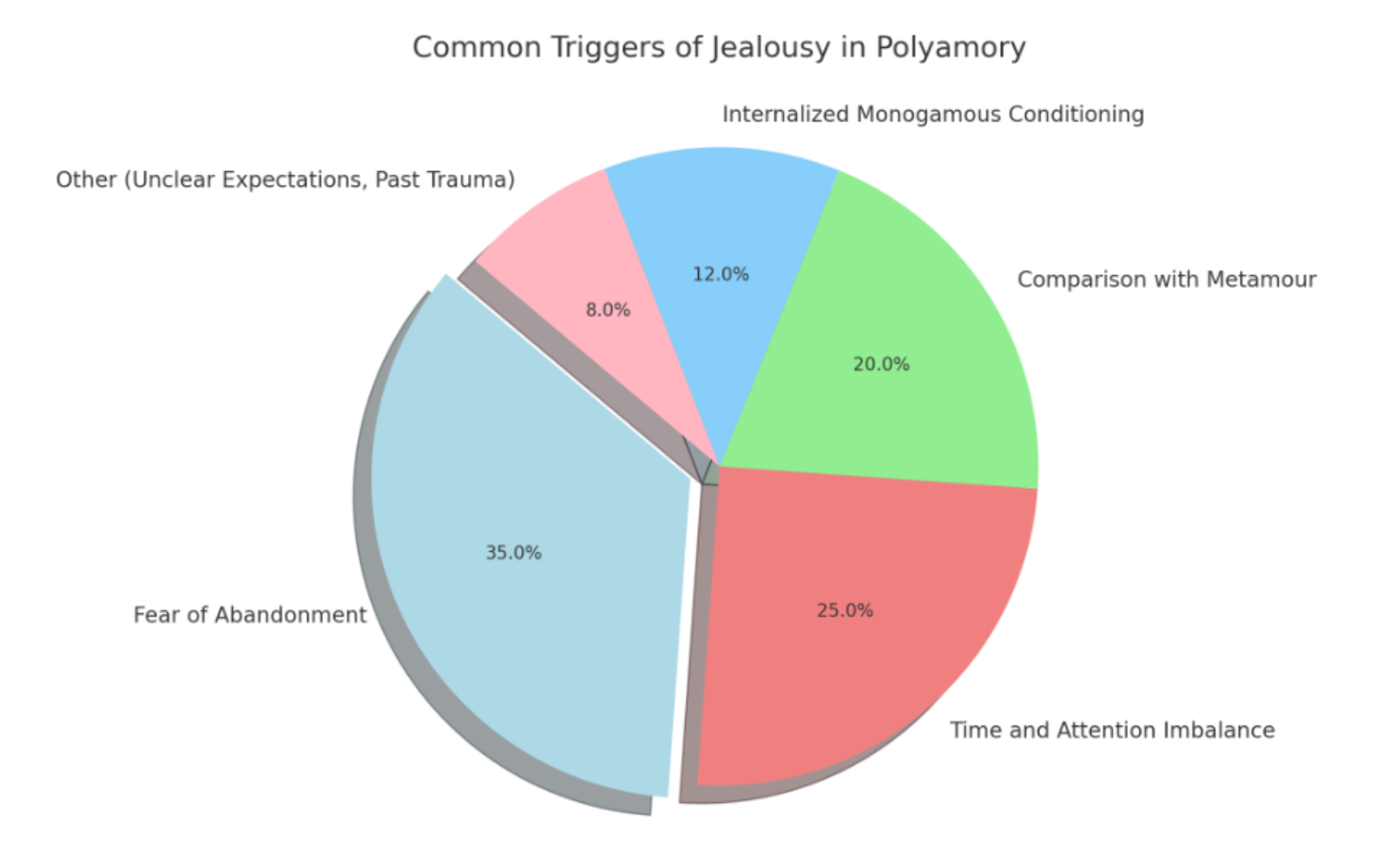
The issue of jealousy is particularly significant. The triggers are often related to perceived imbalances and insecurities.
2. The Unique Burden of the "Hinge"
In many polyandrous configurations, the woman is the partner connecting two or more men who are not romantically involved with each other. This "V" shape puts her in a specific relational role known as the hinge. This position comes with a unique set of pressures.
Spotlight On Hinges: A Polyam Relationship Role
The article 'Spotlight On Hinges' from the Institute for Relational Intimacy explains the challenges of this role and why it requires such a sophisticated emotional skillset.
Please read the first two paragraphs, which define the 'hinge' and describe the primary challenges associated with the role.
As the article points out, the central challenge for the hinge is balancing the needs and desires of two different partners while maintaining their own sense of self. It can be easy to fall into a pattern of simply "running back and forth, trying to please everyone," which leads to exhaustion and instability for the entire system.
This brings us to the concept of emotional labor. This is the often invisible work of managing feelings and emotional dynamics within a relationship to keep things running smoothly. The hinge partner in a polyamorous relationship frequently carries a disproportionate amount of this labor.

3. Management Strategies for a Resilient Dynamic
Acknowledging challenges is the first step; developing strategies to manage them is the second. A healthy and sustainable polyandrous relationship relies on proactive effort from all participants.
Let's explore the key strategies for navigating these complexities.
A New World: Women and Polyandry - MOODRX LLC
Returning to the 'A New World: Women and Polyandry' article, the second half outlines a practical toolkit for managing the mental and emotional health of the relationship.
Please read the sections titled 'Navigating Mental Health in Polyandrous Relationships' and 'A Real-World Example'. Focus on the four key strategies and how they were applied in the case study.
Based on the reading and the concepts we've discussed, we can synthesize the most effective management strategies:
A. Foundational Communication and Boundaries
This is the bedrock of any successful non-monogamous relationship.
- Structured Check-ins: Don't wait for problems to arise. Schedule regular, dedicated time for all partners to discuss feelings, needs, and concerns in a non-confrontational setting. This is the "radical honesty" and "planned reassurance" we saw in the "Love the Bull" video (LINK) from our previous lesson.
- Establishing Clear Boundaries: Proactively discuss expectations around time management, personal space, financial contributions, and intimate activities. These are the "scaffolding of safety" that allow for exploration within a secure container.
B. The Hinge Skill: Differentiation of Self
For the hinge partner, the most critical psychological skill is differentiation of self. This is the ability to maintain a clear sense of your own identity, beliefs, and choices while remaining emotionally connected to others. It is the antidote to people-pleasing and burnout.
Let's look at what this means in practice.
Spotlight On Hinges: A Polyam Relationship Role
The 'Spotlight On Hinges' article elaborates on differentiation and provides clear examples of what it looks like in communication.
Please read the section beginning 'Rather than trying fruitlessly to please everyone...' down to the end of the bulleted list. Contrast the two communication examples and note the signs of insufficient differentiation.
As the article illustrates, a well-differentiated hinge takes ownership of their decisions rather than blaming the needs of one partner to the other.
- Poor differentiation: "I have to cancel our date because Mark needs me." (This creates resentment and positions Mark as the problem).
- Good differentiation: "After talking with Mark, I've realized I need to focus on that relationship this week, so I am choosing to spend Friday with him. I will miss you, but this feels like the right decision for me." (This is honest, responsible, and non-blaming).
C. Building Robust Support Systems
You cannot and should not have to navigate this alone.
- Professional Support: Seek out therapists who are knowledgeable and affirming of consensual non-monogamy. They can provide tools for jealousy management, conflict resolution, and communication.
- Community Support: Connecting with other people in polyamorous relationships can dramatically reduce feelings of isolation. Online forums, local meetups, and support groups provide a space to feel understood and share experiences.
Conclusion
This lesson concludes our module on polyandry and female-centered relationships. We have moved from understanding the motivations of all participants to identifying the key challenges and, most importantly, the strategies to manage them effectively.
Key Takeaways:
- Common challenges in polyandry include external social stigma, internal dynamics of jealousy (often triggered by time/attention imbalances), and the logistical and emotional complexity of managing the group.
- The woman at the center of a V-shaped polyandrous relationship is in the "hinge" position, which carries a high risk of burnout and requires managing significant emotional labor.
- Effective management strategies include:
- Proactive Communication: Using structured check-ins.
- Clear Boundaries: Defining expectations around time, space, and intimacy.
- Differentiation of Self: The hinge's ability to own their choices and maintain their identity.
- External Support: Leveraging poly-aware therapists and community networks.
Preview of the Next Module
Throughout this module, we've used terms like "hotwifing" and "cuckolding" when discussing different dynamics. While related to polyandry, they carry very specific meanings and psychological drivers. In our next lesson, we will begin a new module, "Specific Dynamic: Cuckolding, Hotwifing, and Shared Fantasies," by precisely distinguishing between these practices to better understand their unique power dynamics and motivations.