Welcome to the second lesson in our module on systems of linear equations. In our previous discussion, we saw how to transform a system of equations into the elegant matrix equation . This was our first step in moving from a collection of individual equations to a single, unified mathematical object.
Today, we will take this simplification one step further. Our goal is to represent the entire system—both the coefficients and the constants—within a single matrix. This structure is called an augmented matrix. Mastering this representation is essential, as it serves as the primary data structure for the powerful solution techniques, like Gaussian elimination, that we will explore next.
What is an Augmented Matrix?
In the last lesson, we separated a system of equations into a coefficient matrix, , and a constant vector, . An augmented matrix is simply a way to combine these two parts into one. We take the columns of matrix and "augment" them by adding the column vector to the right. A vertical line is typically drawn between them to distinguish the coefficients from the constants.
For the system:
The matrix equation is .
The corresponding augmented matrix is:
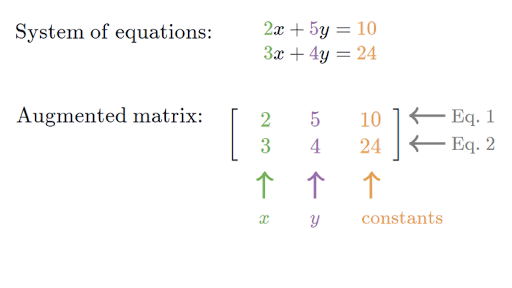
The augmented matrix is a compact and efficient way to store all the numerical information of a linear system, stripping away the variables and equal signs to leave only the essential numbers.

To get a more formal introduction to this concept, the following video provides a clear definition.
What is an Augmented Matrix? | Linear Algebra, Matrix Theory, Augmented Matrices
The video "What is an Augmented Matrix?" from the Wrath of Math channel starts by defining an augmented matrix in a general sense and then applies it directly to systems of linear equations.
Please watch from the beginning until the end. The first minute explains the general idea of augmenting one matrix with another. The remainder of the video shows precisely how this is used to represent a system of equations, creating the coefficient matrix and the constant vector before combining them.
Constructing an Augmented Matrix
While the idea is straightforward, there are a few important "housekeeping" rules to follow to ensure the augmented matrix correctly represents the system. Before you can write the matrix, you must ensure your system of equations is properly organized.
- Standard Form: All equations must be in standard form, with all variable terms on the left side of the equals sign and all constant terms on the right.
- Variable Alignment: The variables must be in the same order in every equation. This ensures that each column in the augmented matrix consistently represents the same variable (e.g., the first column is always for , the second for , etc.).
- Zero Coefficients: If a variable is missing from an equation, it means its coefficient is 0. You must include this 0 as a placeholder in the corresponding position in the matrix.
The following video provides an excellent walk-through of these practical considerations.
Understanding Matrices and Matrix Notation
In "Understanding Matrices and Matrix Notation," Professor Dave Explains covers the essential steps for preparing a system of equations before converting it into an augmented matrix.
Watch the video from the beginning to the final matrix. Pay close attention to the examples where he rearranges equations and inserts zeros for missing variables. This is a crucial skill for avoiding common errors.
Let's work through an example that requires these steps.
Problem: Represent the following system as an augmented matrix.
Step 1: Rewrite in Standard Form
We need to move all variable terms to the left and constants to the right.
- Equation 1:
- Equation 2: (already in good form)
- Equation 3: (already in good form)
Step 2: Align Variables and Insert Zeros
Now we write the system with all variables () aligned, using zero coefficients for any missing terms.
Step 3: Write the Augmented Matrix
With the system properly organized, we can now simply extract the coefficients and constants.
From Augmented Matrix to System of Equations
To ensure you fully grasp the connection, it's also important to be able to work backwards: converting an augmented matrix back into a system of linear equations. This skill reinforces what each part of the matrix represents and will be useful later when interpreting the results of our solution methods.
2.2 Solving Systems Using Matrices – Finite Mathematics
This reading from a Finite Mathematics text provides a clear, concise explanation of how to translate an augmented matrix back into a system of equations.
Please read the section titled "Writing a System of Equations from an Augmented Matrix" and review the accompanying Example 3. This will solidify your understanding of how each row and column of the matrix corresponds to an equation and a variable.
As a quick check, if you are given the augmented matrix:
Assuming the variables are and , you would read it as:
Which simplifies to and .
Conclusion
In this lesson, we have learned how to distill a system of linear equations into its most compact form: the augmented matrix. This representation is not just a notational shortcut; it is the key that unlocks systematic, algorithmic methods for solving linear systems of any size.
Here are the key takeaways:
- An augmented matrix combines the coefficient matrix and the constant vector into a single matrix, .
- Each row of the matrix represents an equation, and each column represents the coefficients of a specific variable.
- To create an augmented matrix, the system must first be in standard form, with variables aligned and zero coefficients used for any missing terms.
- You can easily convert back and forth between a system of equations and its augmented matrix representation.
We have now set the stage for the main event. In our next lesson, we will learn how to manipulate these augmented matrices using elementary row operations. These operations, which don't change the underlying solution of the system, are the fundamental tools we will use to perform Gaussian elimination and find the values of our unknown variables.