Hello! Welcome to your final lesson in the "Java Web & MVC Foundations" module.
In our last lesson, we explored the Front Controller design pattern. We learned how it centralizes request handling through a single servlet, which then delegates tasks to specialized command handlers. This approach solves the problem of code duplication and disorganized request mapping that can occur when using many separate servlets.
Today, we will connect that abstract pattern to its concrete, industry-standard implementation. This lesson directly addresses the learning outcome: Explain how Spring's DispatcherServlet implements the Front Controller pattern.
We will break down the request lifecycle within the Spring MVC framework, revealing the "magic" that happens under the hood. This lesson serves as the perfect bridge from foundational web concepts to the powerful capabilities of the Spring framework, which we will begin exploring in the next module.
From Theory to Practice: The DispatcherServlet
In the world of Spring MVC, the Front Controller pattern is embodied by a single, powerful servlet: the DispatcherServlet. It is the heart of any Spring web application, acting as the central hub that receives all incoming HTTP requests and orchestrates the entire process of generating a response.
The official Spring documentation confirms this design principle.
DispatcherServlet :: Spring Framework
Let's start with the official definition. The Spring Framework reference documentation provides a concise explanation of the DispatcherServlet's role.
Please read the first two paragraphs of the 'DispatcherServlet' section. Focus on how it explicitly mentions its design around the 'front controller pattern' and its use of 'configurable delegate components'.
As the documentation states, the DispatcherServlet provides a "shared algorithm for request processing," but the actual work is done by "delegate components." This is the key to its power and flexibility. Unlike the manual Front Controller we studied, which used if/else logic or simple class loading to find a command, the DispatcherServlet uses a sophisticated set of configurable helper components.
The Request Processing Workflow
So, what happens when a request hits the DispatcherServlet? It initiates a well-defined sequence of steps, collaborating with its delegate components to process the request. The entire flow is beautifully illustrated in the following diagram.
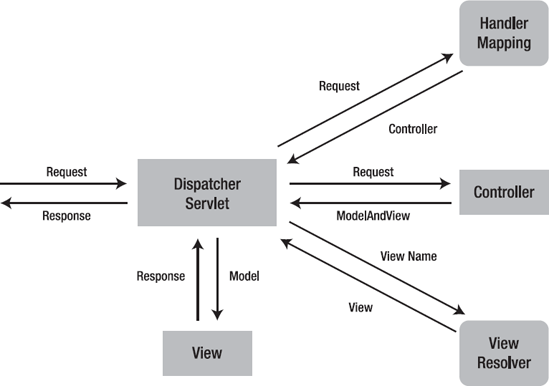
Let's break down this flow step-by-step, referring to the components in the diagram.
-
Request Interception: An HTTP request arrives. The servlet container (e.g., Tomcat) routes it to the
DispatcherServletbecause it is mapped to handle the application's URL patterns (e.g.,/). -
Handler Discovery: The
DispatcherServletdoesn't handle the request itself. Its first job is to find the right component to handle this specific request. To do this, it consults theHandlerMapping. TheHandlerMapping's responsibility is to inspect the request (e.g., its URL) and determine which controller method is configured to handle it. In modern Spring, this mapping is usually defined with annotations like@RequestMappingon your controller methods. -
Handler Invocation: Once the
HandlerMappingidentifies the correct handler method (e.g., thesaveUser()method in yourUserController), theDispatcherServletneeds a way to call it. This is done via aHandlerAdapter. TheHandlerAdapteris a crucial bridge that allows theDispatcherServletto invoke methods with a wide variety of signatures. It handles details like extracting request parameters, path variables, and request bodies, and passing them as arguments to your controller method. -
Business Logic Execution: The
Controllermethod is finally executed. This is where your application's business logic resides. The controller interacts with service layers and data access objects (DAOs) to perform actions, fetch data, or save data. It then prepares the data (the Model) that needs to be displayed to the user and determines the logical name of the view to render. It bundles this information into aModelAndViewobject and returns it to theDispatcherServlet. -
View Resolution: The
DispatcherServletreceives theModelAndViewobject. It now needs to translate the logical view name (e.g.,"user-details") into an actual view template file. To do this, it consults theViewResolver. TheViewResolveris configured to know where your view files are located and what they are named. For instance, it might resolve"user-details"to the physical file/WEB-INF/views/user-details.jsp. -
View Rendering: Finally, the
DispatcherServletpasses the model data to the resolvedView. The view template (e.g., a JSP file) uses the model data to render the final HTML content. -
Response to Client: The
DispatcherServletsends the generated HTML back to the client as the HTTP response.
To see this entire process in motion, watch the following video. It provides an excellent animated walkthrough of the architecture we've just described.
Spring MVC Architecture Workflow - Explained in Easy Way!
This video, 'Spring MVC Architecture Workflow - Explained in Easy Way!', visualizes the step-by-step flow of a request through the Spring MVC components.
Please watch the entire video (about 4 minutes). Pay close attention to how it names each component (DispatcherServlet, HandlerMapping, ViewResolver) and describes its specific role in the sequence.
The Benefits of Spring's Approach
By implementing the Front Controller pattern in this way, Spring MVC provides several significant advantages over a manual implementation.
- Decoupling: Components are highly decoupled. The
Controllerdoesn't know (or care) if the view is a JSP, a Thymeleaf template, or something else. That's theViewResolver's job. This makes the system incredibly flexible. - Centralized Logic: Common tasks like handling multipart file uploads, resolving locales for internationalization, and exception handling can be managed centrally by the
DispatcherServletand its delegates. - Declarative Programming: Instead of writing complex
if/elselogic to route requests, you simply declare the mapping on your controller methods with an annotation (@RequestMapping). This makes the code cleaner and easier to read. - Flexibility: The use of
HandlerAdaptermeans your controller methods can have very flexible signatures. Spring will figure out how to call them, whether they need a request parameter, a path variable, or a whole JSON body.
Let's watch a final short video that reinforces why this pattern is so beneficial by contrasting it with the older, multi-servlet approach.
0. Front Controller Design Pattern
The video 'Front Controller Design Pattern' by Miss Xing revisits the problems with having multiple servlets and highlights the key benefits gained by using a front controller like Spring's DispatcherServlet.
Please watch from 08:21 to 18:43. The first part (until 14:03) visually contrasts the old multi-servlet approach with the front controller. The second part (from 14:03) summarizes the key benefits, such as declarative routing and automatic data binding, which directly map to the features provided by Spring MVC.
Test your understanding!
Imagine your team decides to migrate your web application's frontend from JSP pages to a more modern template engine called Thymeleaf. In a well-designed Spring MVC application, which single component would you primarily need to reconfigure to support this change?
- All the
@Controllerclasses. - The
DispatcherServletitself. - The
ViewResolver. - The
HandlerMapping.
Show answer
- The
ViewResolver. The primary advantage of this architecture is decoupling. The controllers only return logical view names (like"user-list"). TheViewResolveris responsible for translating that logical name into a physical template file. By simply swapping out the JSPViewResolverfor a ThymeleafViewResolver, you can change the entire view technology without touching your controller logic.
Conclusion
Congratulations on completing the first module! You've built a solid foundation, progressing from the basic request/response cycle to the sophisticated architecture of a modern web framework.
Key Takeaways from this lesson:
- Spring's
DispatcherServletis the framework's implementation of the Front Controller design pattern. - It acts as a central coordinator, delegating tasks to specialized components like
HandlerMapping,HandlerAdapter, andViewResolver. - This architecture creates a highly decoupled, flexible, and maintainable system, allowing for centralized control and declarative request handling through annotations.
- You now understand the "why" and the "how" behind Spring's web request processing, which is essential knowledge for any backend developer using the framework.
What's Next?
With our understanding of the high-level web architecture in place, we are ready to dive into the core of the Spring Framework. In our next lesson, we will begin Module 2: Spring Core & Dependency Injection. We'll explore the fundamental principles of Inversion of Control (IoC) and Dependency Injection (DI), which are the concepts that make the entire Spring ecosystem possible.