Hello! Welcome to our final lesson in this module.
In our last session, we focused on the power of pace and pausing to make your speech sound clearer and more confident. That skill will be very important today.
The goal for this lesson is to learn how to use phrases to summarize key decisions and action items at the end of a discussion. When you lead or participate in a technical meeting, ending it with a clear summary is crucial. It ensures everyone leaves with the same understanding of what was decided and what needs to happen next. The confident, controlled pacing you practiced will help you deliver this summary with authority.
The 3 Steps to an Effective Meeting Conclusion
A good meeting conclusion isn't just about saying "goodbye." It's a structured process to make sure the meeting was productive. There are three main steps:
- Summarize Decisions: Briefly state the key conclusions you reached together.
- Assign Action Items: Clearly state who will do what task.
- Close the Meeting: Formally end the discussion and thank everyone.
This image shows this simple, effective process.
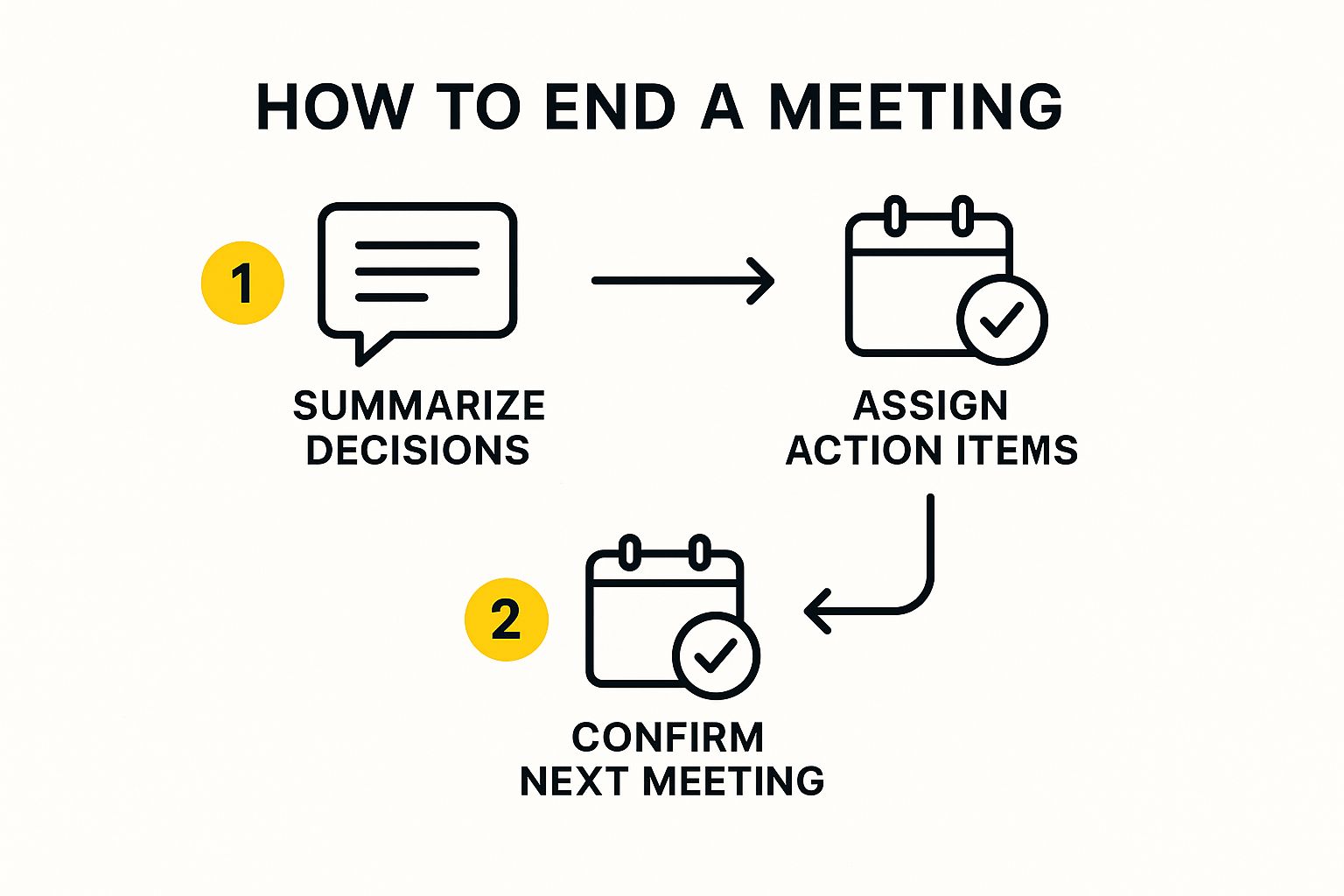
We will go through each of these steps and learn the phrases you need.
Step 1: Summarize Key Decisions
After a discussion, especially a technical one, it's important to make sure everyone agrees on the outcome. You start by signaling that you are about to summarize.
To hear how this sounds, let's watch a short video clip.
41 Phrases For Leading A Business Meeting - Business English (FREE E-Phrasebook)
The video '41 Phrases For Leading A Business Meeting' by Derek Callan demonstrates several professional phrases for starting a summary.
Please watch from 05:05 to 05:21. Listen to the different ways the speaker begins to summarize the meeting.
As you heard, you can use several clear phrases to begin your summary. Here is a list of common phrases you can use.
120+ Useful English Phrases for Business Meetings
The article '120+ Useful English Phrases for Business Meetings' provides a great list of phrases for this purpose. Let's review them.
Read the short section titled 'Phrases for summarizing'. These five phrases are excellent tools to have ready.
Some of the most useful phrases from that list are:
- "To sum up, we’ve talked about…"
- "Before we finish, let’s go over everything we talked about today."
- "Let’s quickly summarize the main points of today’s meeting."
After you use one of these opening phrases, you state the decision. For example:
"To sum up, we've decided to delay the software update until next week."
Step 2: Assign Action Items
An "action item" is a specific task that someone needs to complete after the meeting. When you assign an action item, you must be very clear. Everyone needs to know who is responsible for what.
This next short video clip gives a perfect example of how to state a decision and assign a related task.
40 Essential Phrases To Host A Meeting in English
In this clip from '40 Essential Phrases To Host A Meeting in English' by mmmEnglish, you will hear how to connect a summary to a specific action item.
Watch from 11:13 to 11:25. Notice how the speaker first summarizes and then assigns a task to a person.
The key structure you heard was: "We've all agreed that [Person's Name] will [do the task]."
Here are some other useful phrases for assigning tasks:
- "So, the action item is: [Name], could you please [do the task]?"
- "[Name], can you make sure to [do the task] by [deadline]?"
- "We've decided that [Name] will be responsible for [the task]."
For example, connecting it to our previous summary:
"To sum up, we've decided to delay the software update until next week. So, the action item is: Ali, could you please send an email to the project team to inform them?"
Test your understanding!
Imagine you just finished a meeting about a problem with a satellite connection.
- Decision: You will restart the main server tonight.
- Action Item: Your colleague, Fatima, will monitor the system for one hour after the restart.
How would you say the summary and assign the action item? Try to say it out loud.
Show answer
You could say something like this:
"Okay, to summarize, we've agreed to restart the main server tonight. Fatima, can you please monitor the system for one hour after the restart to ensure it's stable?"
Step 3: Close the Meeting
Once the summary is complete and action items are clear, you can formally close the meeting. This involves thanking everyone for their time and contribution.
This image provides some excellent phrases for summarizing and closing.

Here are some common phrases for closing, which you can also find in the resources:
- "I think that covers everything. Thank you all for attending."
- "That brings us to the end of the meeting. Thanks for your time."
- "If there’s nothing more to discuss, we can end here. Thank you, everyone."
Putting It All Together: Your Turn
Now, let's practice the full sequence. Read the following scenario, and then use your voice recorder to record yourself delivering the meeting conclusion. Remember to use the pausing techniques from our last lesson!
Scenario: You are a technical consultant. You just finished a meeting with your team about a customer's report of slow performance.
- Decision: The problem is old hardware. You will recommend an upgrade to the customer.
- Action Item: You will write the email to the customer with the recommendation.
Your task: Record yourself saying:
- A phrase to start the summary.
- The decision.
- The action item (assigning it to yourself).
- A phrase to close the meeting.
Listen to your recording. Do you sound clear and confident? Is it easy to understand the decision and the action item?
Conclusion
Great work today! You have learned the essential phrases and the structure for concluding a meeting professionally. This skill prevents confusion and ensures that your meetings lead to real action.
Key Takeaways:
- Follow the 3-Step Process: Summarize decisions, assign clear action items, and then formally close the meeting.
- Use Key Phrases: Start your summary with phrases like "To sum up..." or "Let's quickly summarize...".
- Be Clear on Action Items: Always state who is responsible for what. For example: "We've agreed that [Name] will [task]."
Preview of the Next Lesson:
This was our last preparatory lesson. In our final session, you will participate in a comprehensive simulated meeting. You will get to use all the skills you've learned in this course: giving an update, discussing a problem, expressing your opinion, and, of course, summarizing the outcome. You are ready for it